October 2008 Archives

Hotel of the Future- Your Way

October 30, 2008 8:51 AM | 0 Comments

What struck me most about the series of announcements (spanning Vancouver and Vegas to Dubai) on recent Nortel wins in the hospitality industry is how hotels are aligning their technology investments with their visions for enhanced guest experience.

For example, the Shangri-La Hotel in Vancouver wants to provide easy access to personalized services - from messaging and mobility to room service and reservations - without allowing technology to intrude. For example, hotel management explicitly did not want to use color touch-screen phones, as these are viewed to impose on the peaceful, laid-back, 'no-tech' atmosphere of guest rooms.

The Palazzo Las Vegas recognizes that going green is as much about cost and technology as it is about meeting social expectations of their guests. The Palazzo has been recognized as the largest 'green' building in the world with a Silver LEED (Leadership in Environmental and Energy Design) Certificate from the U.S. Green Building Council.

The Bonnington Jumeirah Lakes Towers- Dubai is investing in providing efficient wireless Internet access and voice services throughout the hotel, making staff readily available and reachable via a single number for rapid, responsive and personalized guest service.

These are leading the transformation of the hospitality industry with innovative technologies that can help enhance the guest experience, generate new revenues and improve operational efficiencies.

Nortel ACE's Avaya SIP App Server

October 28, 2008 6:49 AM | 0 Comments

Avaya made some noise at its recent analyst conference about its SIP App Server, an enterprise retrofit of its Ubiquity offer for carriers.

Should you be interested?

Not if you are interested in....
• Products today (Avaya is talking about 2009)
• Multi-vendor environments (Avaya is paying lip service to multi-vendor, but there's no reference to anything but Avaya)
• Integration with your SOA environment (nothing here for you since this was designed for carriers)
• Development toolkits ("will eventually open it up to ISVs and customers")

In contrast, the Nortel Agile Communication Environment (ACE) is ....
• A shipping product with announced customers like HSBC
• Multi-vendor out-of-the-box and interworking with Nortel Communications Servers, Microsoft OCS, IBM Sametime, Cisco CUCM and Tandberg video (interoperability with Avaya infrastructure is coming out soon)
• Integrated with Websphere Application Server and with Microsoft environments
• A foundation for pre-packaged applications (such as hot-desking), customized communications-enabled applications and a toolkit for enterprise, SIs and ISV application developers.

Finally, Avaya is just now folding communications-enabled apps into its UC organization, so integration of their SIP App Server with UC may take a while.

On the other hand, Nortel totally subscribes to the view promoted by UC Strategies, a consortium of industry analysts, that Unified Communications is "communications integrated to optimize business processes". That's why ACE is tightly integrated with Nortel's UC solutions (our own and those developed with Microsoft and IBM).

At his VoiceCon keynote in Amsterdam earlier in the month (Amsterdam), Royal Dutch Shell's Group IT Architect Johan Krebbers positioned UC (built on OCS) as a key element of Shell's global collaboration strategy (80% of teams in Shell are global!), tightly linked with their information sharing strategy and built around a single user experience.

He also stated that OCS was Shell's voice platform of the future, stressing that even today, the OCS feature set is adequate for many employees, many of whom are mobile and comfortable with soft phones.

Traditional PBX vendors should be worried by Microsoft's entry in the PBX market.

But Nortel is not among these. You see, we agree that the future of telephony is as a software UC application, and the future of Nortel is in software and services. To accelerate our transformation, we have developed unique alliances with Microsoft under the Innovative Communications Alliance, and with IBM with a particular focus on SOA.

But as William Gibson wrote: "The future is here. It's just not evenly distributed", and clearly Shell is at the tail of the curve.

In contrast, I am meeting next week with a successful insurance company that is 'very risk averse' in both financial and technology terms, and is just now starting to look at how to evolve their TDM telephony system, focusing predominantly on hard phones. They are just not ready for OCS-style telephony and UC.

So Nortel's unique value proposition is to help our customers meet their immediate telephony needs, while helping them evolve at their own business-driven pace, towards a suite of best-in-class UC applications, whether based on OCS, Sametime or Nortel's. Furthermore, we provide communications integration software (the Nortel Agile Communication Environment) and services that accelerate the business through communications-enabled business processes across multi-vendor networks.

Contrast this with the likes of Cisco and Avaya, which talk about software and openness, and then push the customer into a vertically integrated silo'd approach.

Hyperconnectivity A Sport?

October 22, 2008 4:02 PM | 0 Comments

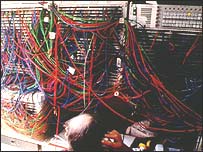
The first "speedcabling" competition took place earlier this year in Los Angeles. This new geek game is based on unravelling the rat's nest of wires found beneath most computer desks, as people connect an assortment of storage, scanner, printer, camera etc etc to their PCs.

Speedcabling.jpg

But this may be a short-lived "sport" as wireless USB, complemented by WiFi and to a lesser extent Bluetooth, emerge as solutions to everyone's below-the-desk Hyperconnectivity challenges.

Briefly Wireless USB (technically USB3.0) is a hub and spoke technology, creating a cluster of up to 127 devices. To achieve up to 480Mbps (equivalent to USB 2.0) at distances up to 3 meters, WUSB uses low power ultra-wideband (UWB) transmission over an extremely wide spectrum (technically from 3.1 to 10.5 GHz), and will coexist peacefully with other wireless technologies such as WiFi and Bluetooth.

How fast can you unravel the rat's nets of cables below your desk?

DynaTAC then.... iPhone Now

October 20, 2008 10:27 AM | 0 Comments

The first U.S. commercial cell call was placed 25 years ago to the grandson of Alexander Graham Bell in Germany - using Motorola's DynaTAC 8000X portable cellular phone. It weighed in at 28 ounces, and had 60 minute battery life on a 10 hour charge.

"DynaTAC" sounds more like a coffee drop than the start of a mass market technology revolution!

First cell phone.jpg

We, and this includes billions of people on the planet, have come a long way down the hyperconnectivity road.

The iPhone weighs less than 5 ounces, and has talk times of 5-10 hours on a single charge. WiFi phones have also reached maturity having traveled an accelerated path. For example, Nortel's latest WLAN Handset 6140 is 5 ounces and is also designed for heavy call usage.

So who made the first iPhone call made? Likely Steve Jobs, but I doubt that it was to Bill Gates;)

Nortel Embraces OCS 2007 Telephony

October 16, 2008 7:06 AM | 0 Comments

The recent OCS 2007 R2 announcement by Microsoft highlights the growing set of telephony feature provided by OCS.

This includes for example,
> Attendant console and delegation
> SIP CO trunking
> "Response group", providing a simple-to-use basic engine for call treatment, routing and queuing, and
> Single-number reachability to mobile devices such as Blackberry and Windows Mobile platforms.

So what is Nortel's response to user interest in OCS telephony, particularly for mobile and nomadic users?

Nortel is actively working with Microsoft, and our customers, to demonstrate the value of OCS, including its telephony features. This can be done through a variety of pilot programs that give customers the chance to test drive OCS, and ultimately to integrate it into their enterprise telephony environment. These are fully supported by Nortel Global Services, leveraging core competencies in voice and data, and in Microsoft technologies.

Whether you're an existing Nortel telephony customer or not, these trial opportunities offer a great chance to see Nortel and Microsoft solutions and services working together.

So Nortel is distancing itself from traditional PBX vendors (including Cisco) who pooh pooh OCS telephony, by embracing these UC telephony solutions under its unique alliance with Microsoft.

I admire truth in advertising.

And the Cisco human network effect is hugely .....NEGATIVE... when it comes to CO2 emissions.

smog.jpg

Across some 500 million Cisco enterprise ports globally, Cisco is adding an additional 11.5 MILLION metric tons of CO2, that wouldn't be added to the atmosphere if those ports were Nortel. That is equivalent to 656 BILLION miles (over a trillion kilometers) of travel in small cars or 23 MILLION cars at 30,000 miles per year!!!!

Are these numbers too big to relate to?

Say you have a 2,500 user network with GigE desktops and IP telephony, and are using Cisco and then switch to Nortel switches. The CO2 emissions savings would be 7106 metric tons. This is equivalent to 150 large cars or 249 small cars driven 100,000 miles each over 5 years. This is about 23 Kilograms per network port per year (7106 Metric tons/2500/5*1000).

Don't believe me. Check out the Nortel Energy Efficiency Calculator yourself.

The impact goes well beyond green considerations and is hitting the bottom lines of literally millions of businesses.

In fact, over a five-year period, businesses worldwide are spending $6.1-billion more in energy costs to power and cool Cisco networks than they would have had they used a comparable Nortel solution.

What you decide to do impacts all of us!

Contact Centers As Precursors of UC

October 10, 2008 8:05 AM | 0 Comments

I recently attended a Nortel Contact Center Customer Advisory Council, involving a number of leading edge customers.

This included companies from a diverse set of verticals: for example, a healthcare provider, a pharmaceutical, a retail bank, a global semiconductor tools vendor, an SI, a retailer, a food services firm. These folks get UC, because they have been doing it for years.

Why do I say this?

I would offer you three rationales for the notion that to a large extent the contact center environment is a precursor of what we are doing with UC.

1) Contact centers is a great example of aligning IT with the business. This is pre-requisite to any successful UC deployment.

2) Technically, a contact center consists of a set of specialized capabilities that we now generally associate with UC. Sure the language changes: for example, in contact centers we speak of skill-based routing.... in UC, we speak of presence and personal agents. But many of these concepts are being extended from agents to the general employee base (at by the way a considerably lower price point) and then back to the contact center in the form of UC-enabled capabilities (as we are doing in OCS-enabling our contact center offering).

3) The real value of Contact Centers comes when they are tightly integrated with customer service processes, just as the transformational values of UC come with UC is embedded in business processes, what we call communications-enabled applications.

What do you think?

Nortel's Business Communications Manager UC portfolio (including the just announced BCM 450) has been rated #1 by Dell'Oro.

Let me look under the UC covers as to how unified communications plays in the small medium business (SMB) market?

It certainly plays in companies that are communications intensive (e.g. real estate offices), have a high proportion of information or knowledge workers (professional offices), or are highly mobile (real estate agencies). In fact, Goldsmith-Agio-Helms, a global private investment banking firm, was the first company to implement UC across its entire employee base- with just over 100 employees, clearly an SMB.

But it doesn't stop there. For example, one of our customers is a family owned business out of the northeast US, Hancock Lumber.

Unlike enterprises, SMBs typically don't ask for UC per se, but rather are looking for integrated communications solutions that solve a business problem or significantly enhance business operation. They obviously see real value in unified office-in-a-box solutions, which deliver UM, message forwarding, meet me conferencing, CTI, intelligent contact center and more.

Simplicity and demonstrated business value are table stakes.

HSBC is a global financial institution, with a multi-vendor voice network with well over 100,000 phones, and a large Tandberg desktop video environment.

One immediate problem they were trying to solve is how to make their management team more productive when traveling across HSBC locations. Not being able to connect in the financial industry can be traced back to loss of revenue opportunity and poor customer service. If HSBC had a single telephony vendor and was only concerned with telephony, this would be an easily addressed problem.

But what HSBC needed went well beyond single vendor telephony hot desking.

HSBC turned to Nortel with its service-powered, single number, voice and video, hot desking application, driven by a presence-enabled corporate portal. Truly cool!

Central to HSBC's unified communications strategy is the Nortel Agile Communication Environment (ACE), a very hot product judging by customer interest.

ACE is a SOA-enabled communication integration application, which delivers a number of services (e.g. click to notify, aggregated presence, context, location). It includes adaptors to Nortel and non-Nortel call managers, as well as to video systems (e.g., From Tandberg), and can integrate with Microsoft OCS and IBM Sametime desktops.

While initially targeting 1000 users, HSBC plans to expand this ACE application across the globe, a strong testament to the value proposition delivered by Nortel ACE.

Personal Hotspots

October 3, 2008 3:36 PM | 0 Comments

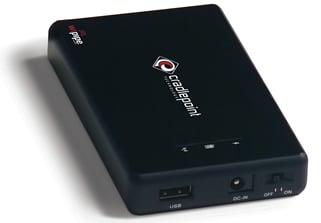
Hyperconnectivity is upon us, and now here's your WiFi-To-Go, a PDA-sized EVDO router that fits in your pocket.

Cradlepoint Personal Hotspot.jpg

As long as you're in your cell provider's EVDO coverage area, you just power on (via an AC adaptor or maybe a DC plug for your car) and you can connect any WiFi device to the Internet.

Pretty neat idea- this one from Cradlepoint, but a number of other vendors have solutions addressing variations on this theme.

Imagine how popular you would be with your friends if you created your personal hotspot with free access!

Create your own scenario.

Un-unified Communications From Cisco

October 1, 2008 11:14 PM | 1 Comment

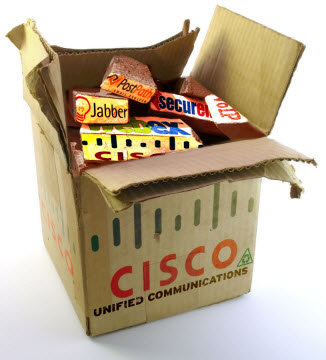
Cisco UC box2-small.jpg

....and, given a chance, they'll box you in too!

Nortel Brings IT on

October 1, 2008 7:31 AM | 0 Comments

The highlights of any CIO summits and customer advisory councils that I have participated in, has invariably been listening to and learning from CIOs exchanging views on everything from green IT to alignment with business priorities. The truth is that peer CIOs are by far the best source of knowledge and expertise, especially in the area of business transformation.

Now Nortel has taken a significant step to broadly share its real-world IT experience in operating a global enterprise, using Nortel technology and services.

In addition to business cases and implementation guides, the 'Nortel on Nortel' site includes free downloads of software utilities used in-house by Nortel IT to better manage their network.

A couple of examples. By having one-third fewer data center rooms and 1800 fewer servers, Nortel avoided an estimated 15M kWh of energy valued at approximate $530K annually. Nortel realized over $12 million in annual savings with a 10-month return on investment through its implementation of unified communications (I have been using it for over 6 years and couldn't live without it).

Nortel CIO Steven Bandrowczak knows that, if the business case for using Nortel technology doesn't make sense for us, it will not make sense for our enterprise customers.

Recent Comments

  • EyePOD: The Current product being marketed under that name, The EyePOD read more
  • Joshua Parker: Would an internal social network for small businesses fit into read more
  • Bo Gowan: Very cool Tony. I just saw a local story last read more
  • mike: Hey, I like your site. I was wondering if Nortel read more
  • Nortel Non-Advocate: Nortel has some good technology - the most detrimental problem read more
  • It Does really matter: Okay, and now Mr. Twain, are you dead yet? read more
  • Marc N: You can check out http://www.usedcisco.org for more used cisco products read more
  • hawkins44: You should read more because your comments are incorrect. Careful read more
  • Mike: Nortel has fallen to #3, behind Cisco and HP. Check read more
  • Tony Rybczynski: David Greenfield seems to echo my sentiment http://blogs.zdnet.com/Greenfield/?p=241 read more

Around TMCnet Blogs

  • Communications and Technology Blog - Tehrani.com:
    Interop New York 2009 Videos
  • On Rad's Radar?:
    Open Neutral Fair
  • VoIP & Gadgets Blog:
    iLive ISP209B Portable Speaker System Review - Alarm Clock
  • Communications and Technology Blog - Tehrani.com:
    Back From Interop NY 2009
  • First Coffee:
    Unified360, Riff Raters for IPhone, AltiGen, DocuSign at Dreamforce
  • On Rad's Radar?:
    Mainly Cellular News Tidbits
  • The Readerboard:
    Make Customers Smile? Give Them Low Priced Half-Decent Products
  • VoIP & Gadgets Blog:
    VoIP in Google ChromeOS
  • Latest Whitepapers

    TMCnet Videos