
Recently in Green IT Category

Extreme Energy Claims

December 1, 2008 2:31 PM | 0 Comments

Extreme Networks has copied Nortel's campaign of attacking the Cisco Energy Tax, but then hides energy consumption behind unreal 'best practices', and creates a closed calculator tool.

Virtually all Extreme's estimated "savings" are based on their assumption that all phones/ports are powered off - every night, weekends and holidays. Basically Extreme's "Green IT" best practices design recommendation is that customers power their network down the equivalent of 106 days out of the year to save electricity. For the vast majority of companies that I talk to this approach does not make either business or operational sense. Reject this best practice and the result is higher energy bills and TCO with Extreme solutions.

Extreme's Energy Savings Estimator is hard coded and hides any of the assumptions used to arrive at the results. Contrast this with Nortel's approach of making all assumptions clearly visible to users of our tool and verifying these through third party testing with open invitations for competitor participation. One analyst I spoke to actually uses the Nortel Energy Efficiency Calculator in a two-day course he runs.

So don't get blind-sighted by Extreme claims ... and demand all the facts.

I admire truth in advertising.

And the Cisco human network effect is hugely .....NEGATIVE... when it comes to CO2 emissions.

smog.jpg

Across some 500 million Cisco enterprise ports globally, Cisco is adding an additional 11.5 MILLION metric tons of CO2, that wouldn't be added to the atmosphere if those ports were Nortel. That is equivalent to 656 BILLION miles (over a trillion kilometers) of travel in small cars or 23 MILLION cars at 30,000 miles per year!!!!

Are these numbers too big to relate to?

Say you have a 2,500 user network with GigE desktops and IP telephony, and are using Cisco and then switch to Nortel switches. The CO2 emissions savings would be 7106 metric tons. This is equivalent to 150 large cars or 249 small cars driven 100,000 miles each over 5 years. This is about 23 Kilograms per network port per year (7106 Metric tons/2500/5*1000).

Don't believe me. Check out the Nortel Energy Efficiency Calculator yourself.

The impact goes well beyond green considerations and is hitting the bottom lines of literally millions of businesses.

In fact, over a five-year period, businesses worldwide are spending $6.1-billion more in energy costs to power and cool Cisco networks than they would have had they used a comparable Nortel solution.

What you decide to do impacts all of us!

The EnergySmart Hospitals Initiative was launched last July and aims to help improve efficiency in existing buildings by 20%! This is a laudable objective, since more than 50% of institutions reported double digit energy cost increases... and lights out operation is not an option.

Part of that saving can be achieved by switching to Nortel healthcare solutions, which use 40% less energy, while delivering 7x the resilience of those from Cisco.

This is a win-win for energy conscious hospitals who also demand clinical-grade networks.

I've written extensively about the Cisco energy tax.

We have run into tow type of situations.
1. Enterprises with Green initiatives and someone who is accountable, immediately embrace 40% lower energy efficiency with Nortel (over Cisco) and start asking all the right questions (e.g. "Are we really best served by putting all our networking investments in Cisco's coffers?")
2. Others understand the Cisco energy tax but come back that they don't see or own the monthly energy bill, and so they don't have the budgetary impetus to change what they are doing.

Last week, we neatly addressed the latter type of customer with a win-win offer. Specifically, if you are a first time Nortel data buyer in North America, you could get an energy saving credit towards equipment purchases, based on your first year energy savings.

How is this credit calculated? Based on the Nortel Energy Efficiency Calculator, of course. And you can see what your credit would be by running through the calculator yourself.

In this way, you can double the energy saving benefits of Nortel data solutions - first in the upfront credit which improves your IT budget line, and then through reduced energy consumption improving your enterprise's bottom-line.

London put sustainability at the heart of its bid for the 2012 Games, framed by the concept of 'Towards a One Planet Olympics'.

earth_satellite.jpg

This was derived from the World Wildlife Federation BioRegional concept of 'One Planet Living®' , which is based on the fact that globally mankind are consuming resources at a faster
rate than the planet can replenish them. If everyone lived as most Europeans do, we would
need three planets; if as most North Americans do, then five!

In announcing Nortel as its Official Network Infrastructure Partner for the 2012 Games, the London Organizing Committee of the Olympic and Paralympic Games also declared Nortel as its Official Sustainability Partner.

There are a number of ways that Nortel helps the environment.

REDUCE with up to 40% lower energy consumption: Nortel products are proven by third-party, independent experts to use significantly less power than the primary competitor while delivering robust performance and reliability.

RE-USE In The Form Of Evolvable Products: Nortel calls this our 'evergreen' philosophy; our customers call it investment protection; and the green community calls it re-use.

RE-CYCLE through Product life cycle management: Last year, our three Investment Recovery Centers (the first of which opened in 1939!) handled 6.2 million pounds of material and separated over 96% into 34 commodity recycling classes.

But it goes beyond this. The Nortel Supplier Code of Conduct incorporates criteria to help identify where risk lies in our supply chain with regard to workplace social, labour, environmental, health, and safety conditions.

Outside recognition and verification of Nortel commitment to and successes in sustainability include the Dow Jones North America Sustainability Index and the Jantzi Social Index.

Who's championing sustainability in your enterprise?

I have spoken extensively about the Cisco Energy Tax. It's all part of our commitment to give you the facts on what your Cisco network is really costing you (up to 64% more according to a new Tolly Group report) and how Nortel can lower your recurring monthly energy bill substantially.

Now the Nortel Energy Efficiency Calculator has gone public. You can calculate your savings for yourself, based on your specific environment. Just click here and start calculating.

The NEEC runs on Excel (backed by an extensive database), not on PowerPoint!

And customers like Prairie Cardiovascular Consultants, a nationally-recognized leader in cardiovascular care, have first hand experience with the tool. "We used the Nortel Energy Efficiency Calculator and found we could save thousands of dollars over competing approaches over five years using Nortel's energy efficient products in our data and communications centers... the solution reduces the networking power requirements as well as those associated with cooling and facilities".
With energy costs escalating and increased awareness of environmental concerns, it's no surprise that the sight of the Cisco Energy Tax collector has hit a raw nerve with many enterprises.

Cisco just announced a four-year plan to make its business more environmentally friendly, but nothing specific to make its products more energy efficient. The Cisco energy tax will continue.

But Cisco IT doesn't have the option of saving a bundle by using Nortel data solutions. With over 65K employees and HQ'd in California, this is no small change: $10M and 40M KWH over 5 years.

Fortunately, unlike Cisco IT, you have a choice.

As did the Spring Independent School District in Houston, Texas, which is buying Nortel networking solutions, after assessing the Nortel's energy efficiency offer.

Watt should you do? Start by getting the facts.

"Another factor (in our decision to go with Nortel data) included costs savings on electrical consumption alone. This, combined with ease of configuration, time tested resiliency capabilities, and absence of code security issues commonly found in other vendor products provided a compelling case for making a switch from the University's incumbent vendor." That comes from Michael Firsdon, Network Engineering team lead at the University of Toledo (Ohio).

In fact the savings are no small change: $1.5M over 5 years, a number referenced by Joel Hackney at his keynote at Nortel user conference.

Customers are getting the facts on Nortel vs Cisco solutions, a key tool being the Nortel Energy Efficiency Calculator.

While Cisco may tell you that the Cisco Energy Tax is temporary (governments say this all the time to get a vote), don’t expect it to go away anytime soon.

I wrote about the Cisco Energy Tax being architecturally rooted and requiring significant product redesign.

But get the total scoop from JT Turgeon of our Ethernet Switching group, and draw your own conclusions.

Ever since Interop, there’s been a lot of buzz in the industry about the Cisco Energy Tax.
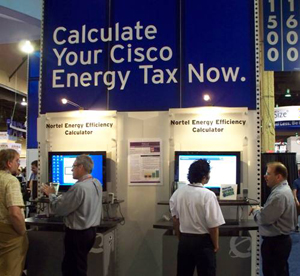
Interop%20Cisco%20energy-tax.jpg

Customers have asked me: “Why are Cisco routers and switches such energy hogs?”

The answer lies in how Cisco has architected their products, driven by their network-centric strategy built on IOS. IOS has evolved into a Swiss army knife of functionality, with literally hundreds of features that most enterprises have little use for (I discussed this ‘Feature Creep’ in an earlier posting). Anyone still running DECnet or IPX in their networks?

To deliver on this strategy, Cisco tends to develop their own custom silicon (processors) in many/most of their product designs, with apparently little consideration of energy efficiency. In contrast, Nortel chooses to leverage off the shelf merchant silicon, without sacrificing features or performance. Merchant silicon not only has a smaller energy footprint, but is also on an accelerated price/performance curve.

There is no quick fix to Cisco’s energy woes. Expect Cisco to rev up their marketing machine, with their CEO telepresenting how energy efficient Cisco is (or would like to be!) on every occasion. .

But there is a better way for customers.

Instead of waiting for Cisco to re-architect their products and deliver this to you as a rip-and-replace solution, you can pay 50% less on your energy bill for 2-3 years, AND get better performance and reliability.

Perhaps you've seen this ad?

SJM_print-small.jpg

Central to our efforts to give you the facts on the Cisco energy tax as compared to Nortel solutions, is the Nortel Energy Efficiency Calculator. This calculator is an engineering planning tool, that not only addressees networking in the data center (the hottest area in Green IT discussions), but also the converged LAN/WAN including IP phones and call servers.

I played with it and it’s a very neat tool..

For example, it includes average industrial energy costs from every US state and from various regions around the world, and automatically calculates heat generation in BTUs and CO2 emissions.

It allows you to assess the relative efficiencies of Nortel and Cisco in wiring closets with a mix of PoE and non-PoE environments. To illustrate the thought that went into the design of the tool, you can also specify the average utilization of phones, since the power consumption is different when you’re talking or not talking. In this regard, a contact center has very different power consumption than a general business office.

One customer case we modeled, for a building with 2500 IP phones, resulted in a 5-year saving of over $630,000 by going with a Nortel solution over one from Cisco.

So get the facts and invite Nortel to the table to assess how the Cisco energy tax is impacting you and what tax avoidance strategies you can use.

Previous 1 2

Recent Comments

  • Jeff Martin: Does Sipex have billing solution to provide multi-tenet application. TonyRyb: read more
  • debt reduction: hahaha funny pic read more
  • EyePOD: The Current product being marketed under that name, The EyePOD read more
  • Joshua Parker: Would an internal social network for small businesses fit into read more
  • Bo Gowan: Very cool Tony. I just saw a local story last read more
  • mike: Hey, I like your site. I was wondering if Nortel read more
  • Nortel Non-Advocate: Nortel has some good technology - the most detrimental problem read more
  • It Does really matter: Okay, and now Mr. Twain, are you dead yet? read more
  • Marc N: You can check out http://www.usedcisco.org for more used cisco products read more
  • hawkins44: You should read more because your comments are incorrect. Careful read more