<?xml version="1.0" encoding="UTF-8"?>
<feed xmlns="http://www.w3.org/2005/Atom" 
      xmlns:thr="http://purl.org/syndication/thread/1.0">
  <link rel="alternate" type="text/html" href="http://blog.tmcnet.com/blog/tom-keating/voip/covad-t1-speed-and-latency-test-plus-overview.asp" />
  <link rel="self" type="application/atom+xml" href="http://blog.tmcnet.com/blog/tom-keating/atom.xml" />
  <id>tag:blog.tmcnet.com,2014:/blog/tom-keating//4/tag:blog.tmcnet.com,2007:/blog/tom-keating//4.32901-</id>
  <updated>2014-03-28T20:21:07Z</updated>
  <title>Comments for Covad T1 Speed and Latency Test Plus Overview</title>
  <subtitle>VoIP &amp; Gadgets blog - Latest news in VoIP &amp; gadgets, wireless, mobile phones, reviews, &amp; opinions</subtitle>
  <generator uri="http://www.sixapart.com/movabletype/">Movable Type 4.38</generator>
  <entry>
    <id>tag:blog.tmcnet.com,2007:/blog/tom-keating//4.32901</id>
    <link rel="alternate" type="text/html" href="http://blog.tmcnet.com/blog/tom-keating/voip/covad-t1-speed-and-latency-test-plus-overview.asp" />
    <link rel="service.edit" type="application/atom+xml" href="http://blog.tmcnet.com/mt/mt-atom.cgi/weblog/blog_id=4/entry_id=32901" title="Covad T1 Speed and Latency Test Plus Overview" />
    <published>2007-06-20T15:02:38Z</published>
    <updated>2008-04-10T21:35:11Z</updated>
    <title>Covad T1 Speed and Latency Test Plus Overview</title>
    <summary>As part of the Covad Blogger&apos;s program, Andy setup several industry bloggers with a Covad T1. Greg, Phoneboy, and Ken Camp, have all covered their experiences with using a Covad Internet T1 connection. On a related note, Rich Tehrani had...</summary>
    <author>
      <name>Tom Keating</name>
      <uri>http://blog.tmcnet.com/blog/tom-keating/</uri>
    </author>
    
    <category term="VoIP" />
    
    <content type="html" xml:lang="en" xml:base="http://blog.tmcnet.com/blog/tom-keating/">
      <![CDATA[<img vspace="5" hspace="5" align="right" src="http://blog.tmcnet.com/blog/tom-keating/images/covad-logo.gif" alt="Covad" />As part of the Covad Blogger's program, <a href="http://andyabramson.blogs.com/voipwatch/">Andy</a> setup several industry bloggers with a Covad T1. <a href="http://blog.tmcnet.com/blog/greg-galitzine/voip/covads-t1-delivers-expected-bandwidth.html">Greg</a>, <a href="http://www.phoneboy.com/node/1541">Phoneboy</a>, and <a href="http://www.realtime-unifiedcommunications.com/practical_pointers/2007/06/video_testing_for_the_covad_bl.htm">Ken Camp</a>, have all covered their experiences with using a Covad Internet T1 connection. On a related note, Rich Tehrani had an interview with Covad's Jeff Ahlquist, Vice President of Corporate Development and Strategy that is definitely <a href="http://blog.tmcnet.com/blog/rich-tehrani/voip/covad.html">worth checking out</a>.<br />
<br />
Anyyway, last week, I had my T1 installed and configured. One of the first things I did was perform a bandwidth speed test. I went to <a href="http://www.speakeasy.net/speedtest/">http://www.speakeasy.net/speedtest/</a> and ran an online bandwidth test. First the download test ran and I got 1,450Kbps, which is pretty close to a standard-rated 1.544Mbps (1544Kbps) T1 connection. Then the upload (upstream) test ran and to my shock I was only getting 444Kbps. This isn't nearly as fast as it should be. I tried another speed test website and got similar results.<br />
<br />
I fired off an email to Andy explaining my benchmark results and asked him if I received a &quot;true&quot; T1. He responded that it was a true T1 and that there was no way my upstream should be that slow. He suggested I contact Covad technical support, but before I did that, I decide to play around with my Linksys WRT54G router.<br />
<br />
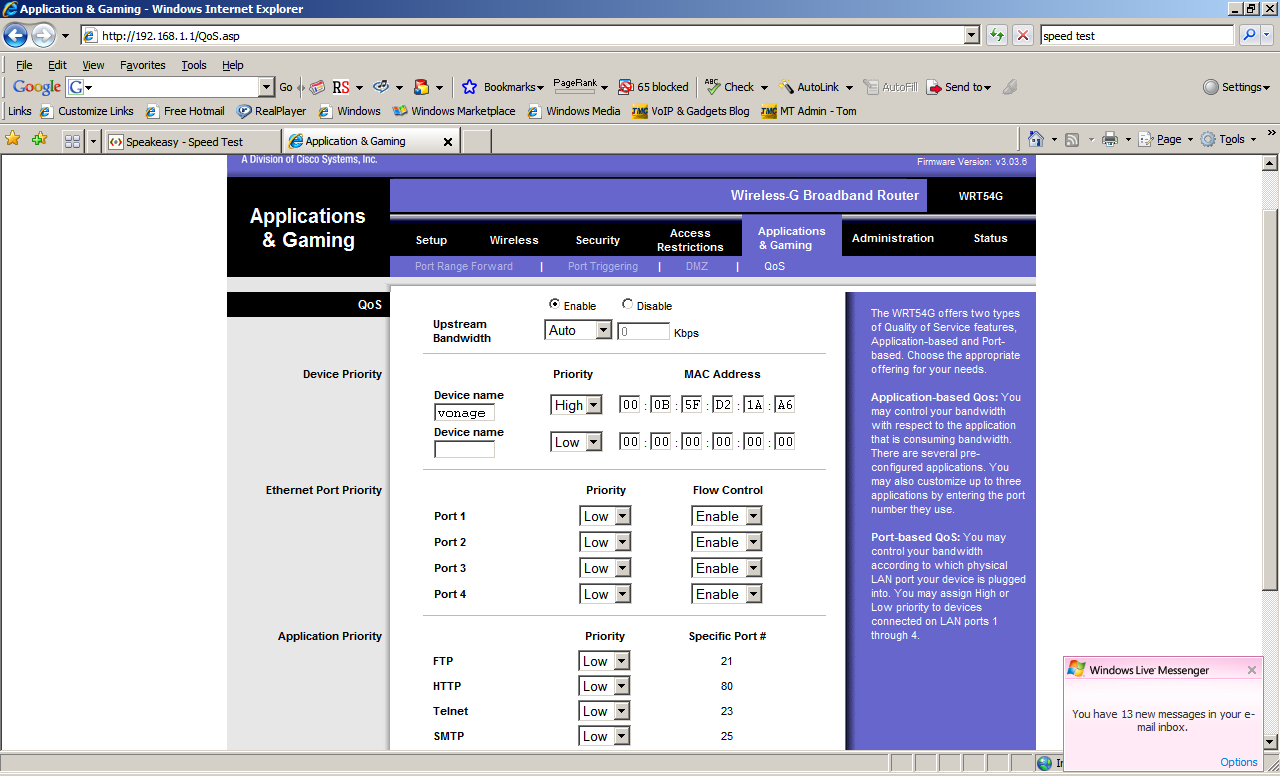
Just by chance I happened to click the <strong>Applications &amp; Gaming</strong> menu in the Linksys Web-based admin and noticed a QoS tab. I clicked on the QoS tab and noticed I had QoS turned on and configured to give my now defunct Cisco ATA-186 &quot;high priority&quot;. I set my ATA-186 to &quot;high priority&quot; over a year ago when I was having VoIP quality issues with Vonage. I forgot I had QoS turned on, but surely having QoS enabled wouldn't affect my upstream bandwidth, would it? The Linksys router should be smart enough to see that there is <strong>no </strong>Vonage device with the MAC address specified currently receiving/transmitting packets, and therefore the router should give <strong>all the bandwidth</strong> to any application that wants it. Seems logical, right?<br />
<br />
Wrong! I turned off QoS and then ran another bandwidth test and voila, I had symmetric speeds of about 1,450Kbps. Actually, the upstream was slightly faster than the downstream on my first test with 1,468Kbps vs. 1,450Kbps. I joked with Andy, &quot;Well, it is a cheap residential WRT54G router, so I guess I can&rsquo;t expect commercial-grade QoS with ToS bits, etc.&quot; Here's a screenshot of the Linksys QoS setup screen showing how I had the Vonage ATA device set to high priority. (click for Larger Image)<br />
&nbsp;<a href="http://blog.tmcnet.com/blog/tom-keating/images/linksys-qos-vonage.png"><img width="630" height="385" src="http://blog.tmcnet.com/blog/tom-keating/images/linksys-qos-vonage.png" alt="" /></a> <br />
<strong>Moral of the story</strong> - If you want maximum performance leave QoS turned <strong>off</strong> if using a Linksys router. Seems counter-intuitive doesn't it?<br />
<br />
However, if I still had Vonage and used a bandwidth hog such as P2P client (eMule, Bittorent, etc.) I would need to leave QoS turned on so the voice packets get priority. It would appear as a side effect I would lose roughly 1,000Kbps of upstream bandwidth, which really sucks. Maybe Linksys has new firmware for the WRT54G, which resolves this issue. I'm running v3.03.6 currently.
<p>In any case, I did one other test to check the latency of the Covad T1, which is actually more important than raw bandwidth if you're doing VoIP or videoconferencing. As a benchmark test, I pinged Yahoo.com and TMC's T3 router. Here are the results of an approximately 10min ping test:<br />
<br />
<strong>TMC T3 Router</strong><br />
Packets: Sent = 1075, Received = 1075, Lost = 0 (0% loss),<br />
Approximate round trip times in milli-seconds:<br />
Minimum = 10ms, Maximum = 921ms, Average = 100ms<br />
<br />
<strong>Yahoo!</strong><br />
Ping statistics for 216.109.112.135:<br />
Packets: Sent = 1017, Received = 1016, Lost = 0 (0% loss),<br />
Approximate round trip times in milli-seconds:<br />
Minimum = 13ms, Maximum = 37ms, Average = 18ms<br />
<br />
Pretty impressive latency numbers, especially when pinging Yahoo.com since it's maximum latency was 37ms and it's average was an amazing 18ms. It would appear that Covad sits very close to where Yahoo connects to the Internet. Obviously, since Covad is a carrier they sit near the main fat pipes. Yahoo gets massive traffic, so I'm sure they connect just a few short hops from the fat pipes. I'm sure both have multiple connections across the country and of course Covad has Tier-1 peering agreements, which guarantees that cross-country traffic is super fast.<br />
<br />
Overall,&nbsp; I'm very happy with my Covad T1 experience. The installer was friendly and courteous. The latency is excellent and the bandwidth, in particular the upstream is much better than my DSL. I asked the Covad installer about Covad offering fiber in the near future, since Verizon is quickly deploying their FiOS service and AT&amp;T is going gangbusters with their U-verse service. Both of these competitors can provide Triple Play packages (voice, video, data).</p>
<p>He mentioned he was aware of Verizon FiOS and that Covad currently doesn't offer a fiber solution, but hinted that FiOS was helping to <em>push </em>Covad to provide fiber in the very near future. I think AT&amp;T and Verizon are starting to drive some of the Tier-2 carriers to provide fiber to the home (FTTH) or provide a hybrid-fiber/copper approach like AT&amp;T's U-verse is taking. And that my friends is great news for residential customers which are clamoring for more bandwidth and more services at an inexpensive price point.</p>]]>
      
    </content>
  </entry>

  <entry>
    <id>tag:blog.tmcnet.com,2007:/blog/tom-keating//4.32901-comment:26682</id>
    <thr:in-reply-to ref="tag:blog.tmcnet.com,2007:/blog/tom-keating//4.32901" type="text/html" href="http://blog.tmcnet.com/blog/tom-keating/voip/covad-t1-speed-and-latency-test-plus-overview.asp"/>
    <link rel="alternate" type="text/html" href="http://blog.tmcnet.com/blog/tom-keating/voip/covad-t1-speed-and-latency-test-plus-overview.asp#c26682" />
    <title>Comment from PhoneBoy on 2007-06-20</title>
    <author>
        <name>PhoneBoy</name>
        <uri>http://www.phoneboy.com</uri>
    </author>
    <content type="html" xml:lang="en" xml:base="http://www.phoneboy.com">
        <![CDATA[<p>Latency and consistency are the two big reasons I am going to miss my Covad T1 when I move. :(</p>]]>
    </content>
    <published>2007-06-20T17:39:02Z</published>
  </entry>

  <entry>
    <id>tag:blog.tmcnet.com,2007:/blog/tom-keating//4.32901-comment:26685</id>
    <thr:in-reply-to ref="tag:blog.tmcnet.com,2007:/blog/tom-keating//4.32901" type="text/html" href="http://blog.tmcnet.com/blog/tom-keating/voip/covad-t1-speed-and-latency-test-plus-overview.asp"/>
    <link rel="alternate" type="text/html" href="http://blog.tmcnet.com/blog/tom-keating/voip/covad-t1-speed-and-latency-test-plus-overview.asp#c26685" />
    <title>Comment from Alberto on 2007-06-20</title>
    <author>
        <name>Alberto</name>
        <uri>http://www.alblog.it/</uri>
    </author>
    <content type="html" xml:lang="en" xml:base="http://www.alblog.it/">
        <![CDATA[<p>I think the router problem is the "auto" setting fot the upstream bandwith.<br />
I use that router but i'm using the DD-WRT firmware and the upstream bandwidth setting is manual.<br />
If you set it, for instance, to 450 it limits the bandwdith to 450!<br />
Probably the "auto" setting is not able to discover the real upstream bandwith: if yo have a manual setting try it!<br />
If you prefer you can also try the DD-WRT firmware: i like it very much ;)</p>]]>
    </content>
    <published>2007-06-20T20:33:05Z</published>
  </entry>

  <entry>
    <id>tag:blog.tmcnet.com,2007:/blog/tom-keating//4.32901-comment:26704</id>
    <thr:in-reply-to ref="tag:blog.tmcnet.com,2007:/blog/tom-keating//4.32901" type="text/html" href="http://blog.tmcnet.com/blog/tom-keating/voip/covad-t1-speed-and-latency-test-plus-overview.asp"/>
    <link rel="alternate" type="text/html" href="http://blog.tmcnet.com/blog/tom-keating/voip/covad-t1-speed-and-latency-test-plus-overview.asp#c26704" />
    <title>Comment from Jack Damn on 2007-06-21</title>
    <author>
        <name>Jack Damn</name>
        <uri></uri>
    </author>
    <content type="html" xml:lang="en" xml:base="">
        <![CDATA[<p>Of course you can get commercial-grade QoS with ToS bits, etc.<br />
Get your WRT54G on linux and enjoy netfilter<br />
<a href="http://www.dd-wrt.com">http://www.dd-wrt.com</a></p>]]>
    </content>
    <published>2007-06-21T13:08:36Z</published>
  </entry>

  <entry>
    <id>tag:blog.tmcnet.com,2007:/blog/tom-keating//4.32901-comment:26705</id>
    <thr:in-reply-to ref="tag:blog.tmcnet.com,2007:/blog/tom-keating//4.32901" type="text/html" href="http://blog.tmcnet.com/blog/tom-keating/voip/covad-t1-speed-and-latency-test-plus-overview.asp"/>
    <link rel="alternate" type="text/html" href="http://blog.tmcnet.com/blog/tom-keating/voip/covad-t1-speed-and-latency-test-plus-overview.asp#c26705" />
    <title>Comment from Tom Keating on 2007-06-21</title>
    <author>
        <name>Tom Keating</name>
        <uri></uri>
    </author>
    <content type="html" xml:lang="en" xml:base="">
        <![CDATA[<p>>>Of course you can get commercial-grade QoS with ToS bits, etc.</p>

<p>Good point. I'm familiar with OpenWRT. I'm not familiar with DD-WRT, but a quick glance at the website seems to indicate it's a variant of the OpenWRT GPL.</p>

<p>What are the advantages of this variant?</p>]]>
    </content>
    <published>2007-06-21T13:15:57Z</published>
  </entry>

  <entry>
    <id>tag:blog.tmcnet.com,2007:/blog/tom-keating//4.32901-comment:26786</id>
    <thr:in-reply-to ref="tag:blog.tmcnet.com,2007:/blog/tom-keating//4.32901" type="text/html" href="http://blog.tmcnet.com/blog/tom-keating/voip/covad-t1-speed-and-latency-test-plus-overview.asp"/>
    <link rel="alternate" type="text/html" href="http://blog.tmcnet.com/blog/tom-keating/voip/covad-t1-speed-and-latency-test-plus-overview.asp#c26786" />
    <title>Comment from Frank on 2007-06-24</title>
    <author>
        <name>Frank</name>
        <uri></uri>
    </author>
    <content type="html" xml:lang="en" xml:base="">
        <![CDATA[<p>Based on the version info, I'm guessing you're running a WRT54G v4.0 or earlier.  I would recommend you upgrade it to v4.21.1.</p>

<p>Version 4.0.7 mentions "Updated QoS features".<br />
Version 4.20.6 mentions "Resolve issues with port based QoS".</p>

<p>If you have time to retest with the QoS feature on, I would be interested in hearing your results.</p>

<p>Frank</p>]]>
    </content>
    <published>2007-06-24T16:46:18Z</published>
  </entry>

</feed>