<?xml version="1.0" encoding="UTF-8"?>
<feed xmlns="http://www.w3.org/2005/Atom" 
      xmlns:thr="http://purl.org/syndication/thread/1.0">
  <link rel="alternate" type="text/html" href="http://blog.tmcnet.com/blog/tom-keating/voip/the-2009-voip-surge-theory.asp" />
  <link rel="self" type="application/atom+xml" href="http://blog.tmcnet.com/blog/tom-keating/atom.xml" />
  <id>tag:blog.tmcnet.com,2016:/blog/tom-keating//4/tag:blog.tmcnet.com,2009:/blog/tom-keating//4.39136-</id>
  <updated>2016-03-16T16:42:08Z</updated>
  <title>Comments for The 2009 VoIP Surge Theory</title>
  <subtitle>VoIP &amp; Gadgets blog - Latest news in VoIP &amp; gadgets, wireless, mobile phones, reviews, &amp; opinions</subtitle>
  <generator uri="http://www.sixapart.com/movabletype/">Movable Type 4.38</generator>
  <entry>
    <id>tag:blog.tmcnet.com,2009:/blog/tom-keating//4.39136</id>
    <link rel="alternate" type="text/html" href="http://blog.tmcnet.com/blog/tom-keating/voip/the-2009-voip-surge-theory.asp" />
    <link rel="service.edit" type="application/atom+xml" href="http://blog.tmcnet.com/mt/mt-atom.cgi/weblog/blog_id=4/entry_id=39136" title="The 2009 VoIP Surge Theory" />
    <published>2009-01-16T15:53:22Z</published>
    <updated>2009-01-16T16:14:49Z</updated>
    <title>The 2009 VoIP Surge Theory</title>
    <summary>Don Witt, President of cyLogistics, theorizes that the stock market meltdown and slowing economy will actually spur faster VoIP growth in an article he penned for TMCnet. He writes, &quot;More and more executives will be under the gun to cut...</summary>
    <author>
      <name>Tom Keating</name>
      <uri>http://blog.tmcnet.com/blog/tom-keating/</uri>
    </author>
    
    <category term="TMCnet" />
    
    <category term="Unified Communications" />
    
    <category term="VoIP" />
    
    <content type="html" xml:lang="en" xml:base="http://blog.tmcnet.com/blog/tom-keating/">
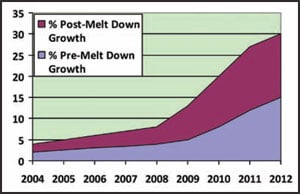
      <![CDATA[Don Witt, President of cyLogistics, theorizes that the stock market meltdown and slowing economy will actually <b>spur faster VoIP growth</b> in an article <a href="http://www.tmcnet.com/voip/1208/a-bad-economy-drives-a-2009-voip-surge.htm">he penned for TMCnet</a>.<br /> <br /> He writes, "More and more executives will be under the gun to cut costs. There are a number of ways to cut costs but one way to cut costs tends to jump out at you -- the PHONE BILL. This will force many companies to take the digital/VoIP plunge. As a result, VoIP sales will increase significantly over the next year or two."<br /> <br /> <img align="right" src="http://images.tmcnet.com/it-magazine/1208/bad-economy-2.jpg" alt="" />He adds, "The stock market crash has effectively pulled in the VoIP growth curve by 6-12 months or more! As identified in the Post-Melt Down chart, VoIP sales may increase by 200-300% over previous forecasts. Thus, next year's VoIP growth can be expected to jump from 4% to 8% or 12% or more next year."<br /> <br />  Of course theories, and pretty chart graphs can be made to make <i>anything </i>look good. Is the VoIP industry <i>truly </i>headed towards faster growth in this economic climate? I tend to agree with Don. There are indications that not only enterprises, but also municipalities and schools are deploying VoIP to save on costs.<br /><br />In fact, I recently came across one town right here in Connecticut (Enfield), which <a href="http://www.voipplanet.com/trends/article.php/3792716">recently deployed VoIP</a>, resulting in dramatic savings -- and not just in phone charges, but also in ongoing maintenance costs. According to the article, "Previously the schools and the town each had its own independent tech support team. Today a staff of three network support employees manages a network consisting of more than 29 remote locations and over 4,000 networked devices." Obviously, VoIP isn't just about saving on long-distance charges. A consolidated voice &amp; data network in Enfield, CT has resulted in reduced support costs and lower TCO as well. <br /><br />While one example doesn't make it the rule, I do think companies, municipalities, etc. are looking to cut costs and VoIP is one sure-fire way to do just that.]]>
      
    </content>
  </entry>

  <entry>
    <id>tag:blog.tmcnet.com,2009:/blog/tom-keating//4.39136-comment:45453</id>
    <thr:in-reply-to ref="tag:blog.tmcnet.com,2009:/blog/tom-keating//4.39136" type="text/html" href="http://blog.tmcnet.com/blog/tom-keating/voip/the-2009-voip-surge-theory.asp"/>
    <link rel="alternate" type="text/html" href="http://blog.tmcnet.com/blog/tom-keating/voip/the-2009-voip-surge-theory.asp#c45453" />
    <title>Comment from https://www.google.com/accounts/o8/id?id=AItOawlacBYIyCFI8mz5HS_pdsnSDV1wLz6Vgc8 on 2009-07-02</title>
    <author>
        <name>https://www.google.com/accounts/o8/id?id=AItOawlacBYIyCFI8mz5HS_pdsnSDV1wLz6Vgc8</name>
        <uri></uri>
    </author>
    <content type="html" xml:lang="en" xml:base="">
        <![CDATA[<p>We have implemented over 50 VoIP systems in the last 18 months and all but 6 clients realized immediate cost savings.  If you view All My Sons Moving and Storage testimonial at <a href="http://www.unified360.com/content/testimonials">http://www.unified360.com/content/testimonials</a> their CFO explains how VoIP helped them save over $100,000 annually but more importantly helped them increase revenues using VoIP integration with their database.</p>]]>
    </content>
    <published>2009-07-02T04:10:08Z</published>
  </entry>

</feed>