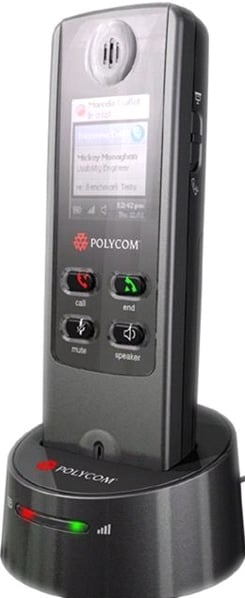
 Similar to the Microsoft Office Communicator client, the phone features colored presence indicators that let you know the status of your coworkers, friends, etc. I asked Microsoft who made this IP phone but they said it was still unannounced, but would be released sometime this year. There is another phone that integrates with Microsoft OCS from Polycom, as seen to the right. I'm not sure the model of this new Polycom phone, but it too should be out sometime this year. Looking at these two "presence-capable" IP phones, it got me thinking - why would anyone buy a phone that doesn't have presence? I know I am more productive when I can IM a coworker and I know I can receive an instant response, so why shouldn't this be extended to voice? Imagine you are a sales rep about to close a major deal but you need to get a manager's approval for a 15% discount. You put the customer on hold and try and conference in your manager, but he's not there. You then try another manager, and she isn't at her desk either. Assuming you haven't hung up on the customer with all these conference attempts, these communication attempts are not only time-consuming, but it gives a bad impression of your organization. If the sales rep in this scenario could see the presence of all the managers, he could have quickly conferenced in an available manager. Folks, this kind of "presence-capable" phone is the future. Cisco, Avaya, Nortel, and all the others will have to provide this functionality or lose business to those that do. Watch for tons of presence-capable IP phones in the next 18 months - that's my prediction.
 Microsoft's Secret Codec Weapon?
One fact that hasn't gotten any attention from the mainstream media (& tech media) coverage of OCS 2007 is the VoIP and video codec Microsoft is using. During my conversation with Microsoft they kept talking about how Office Communicator's VoIP works well not only in broadband environments, but also in limited bandwidth narrowband environments, i.e. dial-up -- and even on Windows Mobile 5 devices. They stressed how their codec works well even with high packet loss due to Forward Error Correction (FEC) and other algorithms. I inquired whose codec they were using and they said that they developed it themselves. This was a bit of a surprise since there are at least two well-known adaptive VoIP codecs available, including Spirit DSP, and Global IP Sound (GIPS), which is used by Skype, Google Talk, and a plethora of other softphones. When I asked if Microsoft considered using/licensing the GIPS codec, Microsoft stated that they were in talks with Global IP Sound, but chose to go their own way, to avoid the licensing costs, but more importantly Microsoft stated that their own performance benchmarks showed their codec performed better. Relatedly, Psytechnics said Microsoft's codec performed better than Cisco 7961 IP Phones. Wow, score one for software-based digital signal processing (Microsoft) over a hardware DSP (Cisco). I meant to ask Microsoft is they planned on offering their software codec for license, which would compete with Spirit DSP and GIPS, but forgot. However, just from various conversations, it didn't seem like that was their goal. But if Microsoft did license their technology or worse - give it away for free, then Spirit DSP and GIPS could be in trouble.
I asked what they were using for NAT traversal and they stated they were using ICE, which I actually covered in my 2005 blog post, Microsoft and Cisco think ICE is Cool.Stuff! It was interesting to see two arch-competitors, Cisco and Microsoft team up to announce their endorsement of Interactive Connectivity Establishment (ICE) – a draft standard. under consideration by the Internet Engineering Task Force (IETF) to enable media traversal of NAT /firewalls. With ICE built-into OCS 2007 and the Office Communicator client, you don't need to setup a VPN to connect to the office network. Of course, there are plenty of IT folks that aren't happy with their employees installing Skype, which is notoriously good at penetrating corporate firewalls, so it will be interesting to see which company develops the first firewall to block ICE or at least be able to set ICE policies. Also security-related is that all OCS 2007 communications are encrypted by default and the media stream uses SRTP (Secure Real-time Protocol) to prevent unauthorized packet capture and playback of conversations.
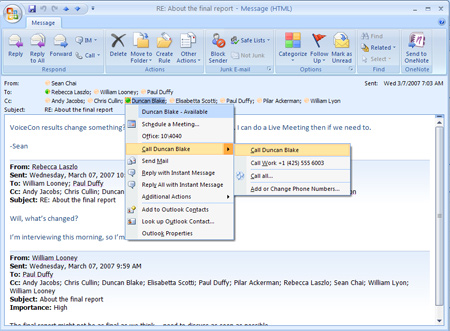
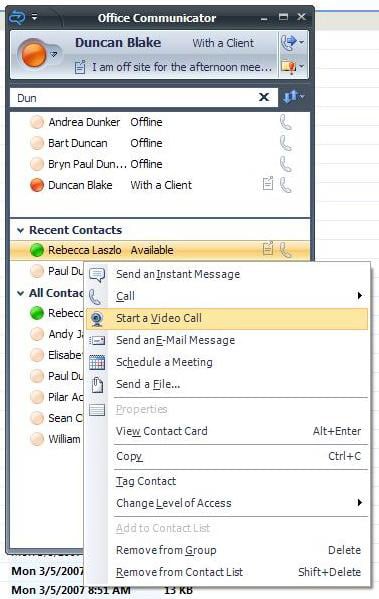
I will have much more on Microsoft OCS 2007 once I get a chance to install and test it. In the meantime, here are a couple of screenshots just to "wet your whistle" until I fully test it. The first screenshot is from Outlook 2007 - notice how their are colored presence indicators next to each name in the To: and Cc: lines so you can easily figure out if someone is available, and then initiate a call, IM, video session from within an email message. The 2nd screenshot is the Office Communicator client initiating a video call.