Rich met with ooma recently to see their latest wares and hear about their current business model. Recently, ooma ditched the 'P2P voice network' idea where users actually "share" their home landline with others and instead became a traditional VoIP broadband provider. Apparently, the privacy issues were too much to overcome, since users were concerns about fraudulent activity happening on their home landline by outside ooma users. I had my own reservations about the business model as well, since they claimed it would take 2,000 strategicly placed ooma boxes in all the various local exchanges to get good local call coverage for free P2P calls.
Besides becoming a traditional VoIP broadband provider, ooma is now going to start offering high-end media phones, that according to Rich Tehrani will in the future feature a picture frame, in-house sensors and cameras. As for what they offer today, in early January, ooma launched Telo, which offers unlimited, free VoIP-to-PSTN (U.S.) calls over the Internet along with a DECT 6.0 cordless phone that supports call screening, MP3 ringtones, 12-hour talk time, HD voice, speakerphone, two-line support, mobile transfer, and intercom. It supports up to eight phone numbers and six phones
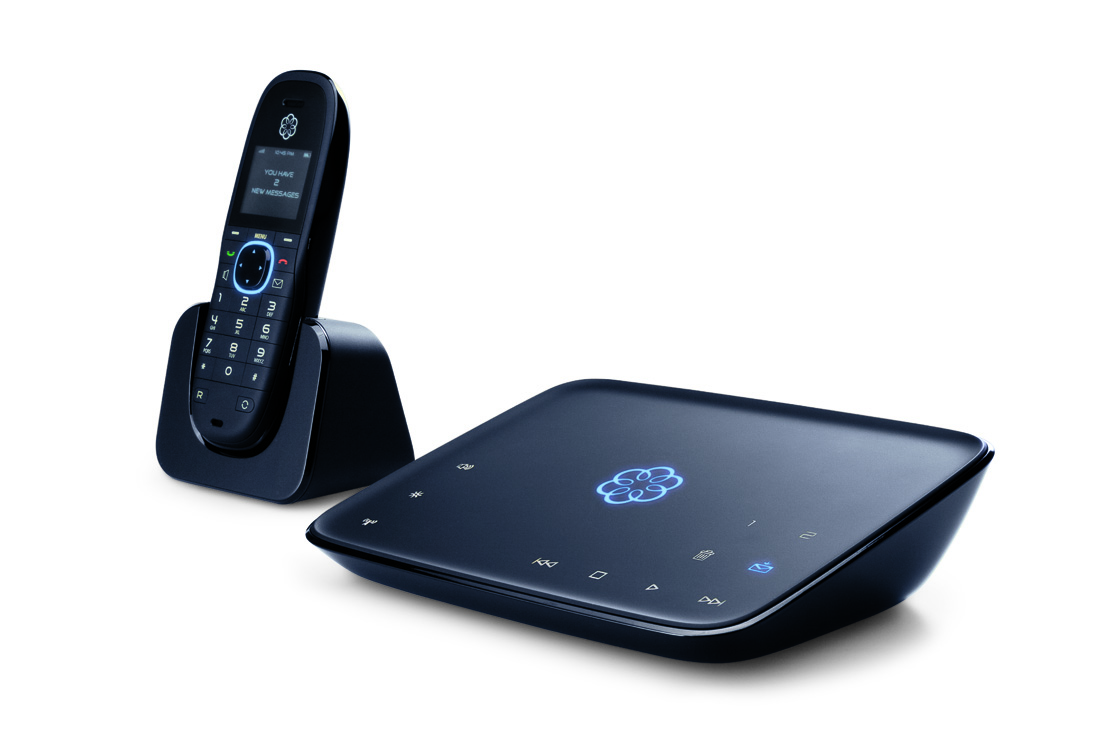
ooma's Telo phone system with DECT 6.0 handset.
The Telo phone system is expected to be available in the first half of 2009. The next question you're probably thinking is "If it's free unlimited U.S. VoIP-to-PSTN calls, how does ooma make any money?" The answer to that is ooma offers ooma Premier, with advanced features that they hope people will opt & pay for. (See: http://www.ooma.com/company/how_we_make_money.php)
Some of the Premiere features include:
Check out Rich's post for more on Telo and how the FCC is actually an investor in ooma.
Besides becoming a traditional VoIP broadband provider, ooma is now going to start offering high-end media phones, that according to Rich Tehrani will in the future feature a picture frame, in-house sensors and cameras. As for what they offer today, in early January, ooma launched Telo, which offers unlimited, free VoIP-to-PSTN (U.S.) calls over the Internet along with a DECT 6.0 cordless phone that supports call screening, MP3 ringtones, 12-hour talk time, HD voice, speakerphone, two-line support, mobile transfer, and intercom. It supports up to eight phone numbers and six phones
ooma's Telo phone system with DECT 6.0 handset.
The Telo phone system is expected to be available in the first half of 2009. The next question you're probably thinking is "If it's free unlimited U.S. VoIP-to-PSTN calls, how does ooma make any money?" The answer to that is ooma offers ooma Premier, with advanced features that they hope people will opt & pay for. (See: http://www.ooma.com/company/how_we_make_money.php)
Some of the Premiere features include:
- Instant Second Line allows you to make or take two simultaneous calls from a single phone number
- Blacklists helps you protect your privacy and block telemarketers
- Multiring lets you answer calls from your home phone or cell phone
- Message Screening allows you to listen in as the caller is leaving their message
- Send to Voicemail allows you to transfer a call to your voicemail
- Voicemail Forwarding lets you forward voicemail so that you can listen to it from your favorite email program
- Do Not Disturb allows you to roll your calls into voicemail without ringing your phone
- Personal Numbers allows you to select additional phone numbers in any calling area in the US
Check out Rich's post for more on Telo and how the FCC is actually an investor in ooma.


Technorati
Del.icio.us
Slashdot
Digg
twitter
Really it's no contest... I have had both. The Ooma rocks and the MagicJack is flakey at best.
The Ooma has a bunch of cool features that the MJ lacks...
Kinda like comparing a Dodge Charger to a Winnebago in a drag race... they are both similar in the fact that they are motorized vehicles, but the difference is so vast that they can't be categorized together.
MagicJack and Ooma both let you make VOIP call's, yes. But Ooma is a sleek sports car in a world of VOIP clunkers.
One of the best purchases I have ever made was my first gen Ooma. It's easily paid for itself and I will probably give the Telo as a gift as well as get one for myself.
They are really different products. Both has advantages and disadvantages. It's like asking if an RV is better than a sport car. The answer depends on what do you plan to do, isn't it ?
I like Ooma but its draw back is that you need to have YOUR internet connection, hooked up to it for it to become functional. Works great at home. The convenience of not needing the PC is one up on Magic Jack for sure.
But if you go out of town, you can't haul your Ooma with you. I went overseas with my magicjack and was able to call home via wifi connection in my hotel room. Now who has the edge ?
Both are great. Get them both, especially if you are on the move a lot, you will find Magic Jack will come in really handy.
RE the previous comment.
You can take Ooma with you and use it anywhere there is a wired broadband Internet connection, just remember your e911 info is not accurate unless you update it.
Nick, You can take the Ooma with you but i agree it wouldn't be practical to pack the Ooma for a vacation to Europe. it would be practical to pack the Ooma if you stay at a vacation home for a month or longer.
Although if I were taking a vacation and needing VoIP I wouldn't choose MagicJack. Why carry more than you need on a vacation. Just use Skype on your laptop instead of carrying a USB MagicJack device that also needs a phone plugged in to it. MJ is not as practical for travel as Skyping from your PC or cellphone Internet connection.
Ooma is the best land line VoIP replacement I have come across. MagicJack is a cheap device with poor call quality that can't compare to Ooma in the home or Skype on the road.
If you are using MagicJack as a landline replacement you will want to keep the thing running full time. It doesn't make sense to have to boot/sleep your computer every time you enter/leave the home just to be able to receive calls. Factor in the additional electricity to run your computer for MagicJack.
An additional 12 hours a day on top of regular computer usage adds up fast. Over a year you will pay $60-$100 per year in additional electricity to keep the average computer running. MagicJack ends up being a lot more expensive than Ooma. MagicJack for some can cost more than Vonage.