Yankee Group - Fighting Goliath: Can Alternative VoIP Providers Survive?

Yankee Group VoIP Marketshare

Yankee Group VoIP Marketshare

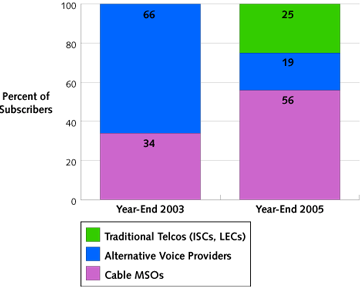
Yankee Group just announced a very interesting report essentially saying that single-play (vs. Triply Play) players such as Vonage, Packet8, Lingo, etc. are in trouble in 2005, as seen in the graph - Blue is Vonage, Packet8, etc. I made a similar prediction in my 2005 VoIP Predictions.

Here's a copy of the Executive Summary of the Yankee Group report. (contact Yankee Group for the full report):

Local VoIP providers can be broadly grouped into three categories: cable MSOs, major players (IXCs and RBOCs) and alternative VoIP providers. Alternative VoIP providers include the nontraditional players that are entering the telephony market with a bring-your-own-broadband strategy. These players are generally small upstarts. In the coming year, they will be facing the communications market leaders (AT&T, Verizon, Comcast and Time Warner). Can they survive? In this report, the Yankee Group will examine the competitive market to determine whether or not there is a viable long-term role for alternative VoIP providers as the local VoIP market matures.

Alternative VoIP providers such as Vonage and many of the Vonage-like providers have a first-to-market advantage. In 2003, a number of these companies, dominated by Vonage, introduced VoIP phone service to consumers. At the end of 2003, these small startups comprised nearly 66% of the local residential VoIP market. Vonage dominated the market with than 90% of all the subscribers in the alternative VoIP provider segment or 61% of the local residential VoIP market.

Alternative VoIP providers lose market share every day to the major players. MSOs, IXCs and ILECs are joining the VoIP game, and their available resources dwarf even the largest of the alternative VoIP providers. The local VoIP market is already crowded with more than a dozen players vying for local consumers. As major players accelerate their roll-out strategies, alternative VoIP providers will feel increasingly squeezed, and pricing pressure will intensify. The Yankee Group expects the alternative VoIP providers to lose 47% market share to the MSOs and IXCs/ILECs by the end of 2005.

Delivering primary-line voice service is a very resource-intensive effort. The MSOs are bringing VoIP to the mass market as a primary-line replacement. Incumbent local providers look to VoIP as a long-term network development strategy; regardless of interim activity, VoIP is part of their future. So, where will the little guys fit? Are these providers struggling to build a market that will soon leave them behind?

| 5 Comments | 0 TrackBacks

Listed below are links to sites that reference Yankee Group - Fighting Goliath: Can Alternative VoIP Providers Survive?:

0 TrackBacks

Yankee Group - Fighting Goliath: Can Alternative VoIP Providers Survive? TrackBack URL: http://blog.tmcnet.com/mt/mt-tb.cgi/1090

5 Comments

It will be interesting to see how well service providers like Skype, FWD, etc. will compete in the overall market. The ASP (Application Service Provider) model has some definite advantages. Ease of use, access, inexpensive, and software driven. Can a ISP running over a telco or cable line actually steal their customers?

Interesting concept if you really think about it. The telco or cable company provides the network access for termination fees, but potentially loses voice revenues to a Skype.

Am I missing something here?

Where do you think peering fits in all of this? By peering, I mean direct VoIP to VoIP that by-passes the PSTN completely. It seems to me that the real benefits of VoIP come when we have peering, because it allows video, wideband audio, presence, and other true innovations. But peering probably means a less robust service, as much of the media will travel over the public Internet. Perhaps some of the big companies can establish peering relationships at the IP level among themselves and thereby guarantee good quality. But then again, maybe not. If even the incumbent players must send media over the public Internet, does that really give them a significant advantage? Or will a move to peering (and video, presence, etc) happen too late for the newcomers to survive?

This is for all ppl interested in voip services have tringotel bcoz they have partnered with Sunrocket and there are additional features available in this company and the voice quality is awesome. I am using this service for several months and there are no issues till now although there are some delays in the shipment. But that's ok


U GUYS ROCK!

interoperability, portability and mobility is key.
While bundling is a great concept, price and service delivery will play a major role in the scheme of things here.
We'll see how this plays out.
JB.

www.uniatelecom.com

Vonage alternative Unia Telecom is perfecting the art of service delivery by capping annual subscriber base in ensuring quality service delivery. http://www.uniatelecom.com They've kept their operations 100% in the US which will help them greatly in the long run..in addition to being a socially responsible operation.
Looked'em up and have read some really good things.....

Jeremy in New Hampshire

Leave comment to Yankee Group - Fighting Goliath: Can Alternative VoIP Providers Survive? article

Subscribe to Blog

    View my Microsoft MVP Profile:

Blogroll

Recent Assets

  • trojanhorse.jpeg
  • object-world.jpg
  • z_overview_top_tn.jpg
  • legotrip.jpg
  • bs_CDGSx4_lg.jpg
  • asterisk-net-release-directory.jpg
  • personalist.jpg
  • visual-studio-toolbox-items.jpg
  • plumble-logo.jpg
  • i19.jpg