C2Call - New browser-based Java VoIP app

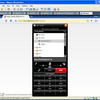
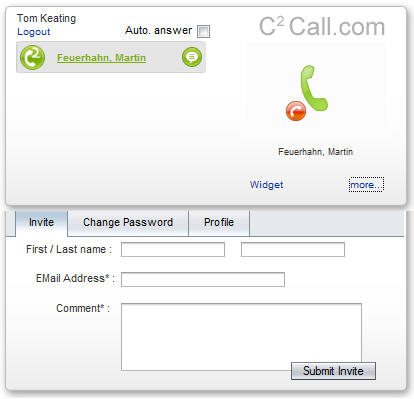
C2Call (C2Call) lets you make web-based P2P VoIP phone calls direct from your browser whether you're using Linux, Windows, or an Apple Mac. The software is a Java widget that is loaded temporary from the C2Call web page into your browser each time you use C2Call. Using the C2Call Java widget I spoke with Martin Feuerhahn, Director of Actai Networks Pte Ltd Taiwan Branch. The voice quality was excellent and the latency wasn't too bad either considering I'm in Connecticut and he's in Taiwan!
In Internet Explorer when you first load the widget you'll see that the application has a digital signature that has been validated by a trusted source:
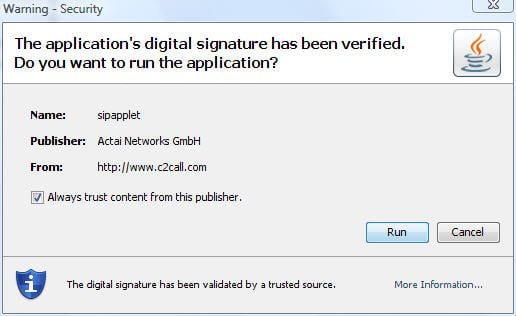
Actai Networks GmbH, the company mentioned in the above screenshot is the parent company of www.c2call.com. In Firefox the app just ran without showing the digital signature verification message. The client is just 1.1MB in size so it's fairly small.
The beauty of C2Call is that you can send a call invitation to anybody you want to talk to simply by sending an email invite directly from the www.c2call.com applet. The recipient can click on the link and can instantly talk to you. This is a really great viral feature that is especially good for non-technical people. For instance, you can invite your grandma to talk simply by emailing her. Unlike Skype which would require her to install the software, register a username, configure Skype, etc., grandma can just click a link and speak to you almost instantly. Here's a sample email invite being sent out to my boss and industry-leading VoIP pundit, Rich Tehrani.

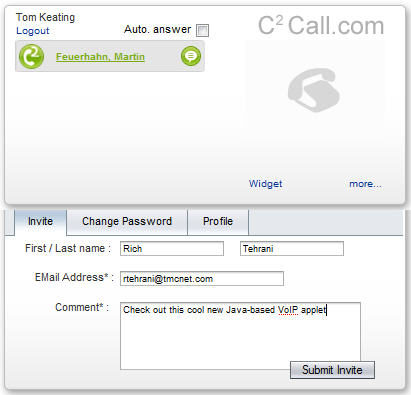
The widget is SIP-based and importantly it uses the Speex codec, which gives the software its very good voice quality. So you're probably wondering how a Java-based VoIP app fares versus a Flash-based VoIP app, such as the Flashphone app I've written about. Well, for one if you decide to use an Adobe Flash-based solution, you have to use the Nellymoser codec, which is not a free codec.
Another feature of note is that C2Call can traverse about 90% of firewalls using standard SIP technology. The official launch isn't for another couple weeks, but if anyone wants an invite give me a shout (Contact link above).
Post a comment
- Apple » C2Call - New browser-based Java VoIP app
- Linux » C2Call - New browser-based Java VoIP app
- VoIP » SIP » C2Call - New browser-based Java VoIP app
- VoIP » Skype » C2Call - New browser-based Java VoIP app
- VoIP » TMCnet » C2Call - New browser-based Java VoIP app
- VoIP » C2Call - New browser-based Java VoIP app
- Related Entries
- Zingaya Media Server enables Adobe Flash-based VoIP - Feb 19, 2008
- Flashphone adds SIP Call Me Button - Dec 18, 2007
- flashphone Beta Running on Adobe Flash launches - Nov 06, 2007
- TringMe opens platform API to developers - Apr 16, 2008
- PhoneFromHere.com & Digium Ink 5 Year Deal - Apr 09, 2008
- SightSpeed Light Flash Video Conferencing & Chat - Jan 07, 2008
- Ribbit Launches - Dec 17, 2007
- Firefox VoIP Extension open to any SIP provider - Dec 13, 2007
- Ribbit Flash VoIP App Launch - Dec 07, 2007
- PushCall.com Another Flash VoIP Player - Dec 04, 2007
Search Technorati: Actai Networks GmbH, Adobe, browser, C2Call, Flash, Java, Nellymoser, P2P, peer-to-peer, SIP, VoIP, web
Related Tags: based, widget, invite, codec, flash, software
Using each Web Services and AJAX, links below show you related pages by searching the web
Listed below are links to sites that reference C2Call - New browser-based Java VoIP app:
Trackback Pings
TrackBack URL:
http://blog.tmcnet.com/mt3/t.fcgi/35698
Comments to C2Call - New browser-based Java VoIP app
-
Aswath :
April 4, 2008 1:54 AMSince Nellymoser codec is n integral part of Flash, I would have thought that there is no concern about licensing that codec. Isn't that not true? I would think that the more serious issue would be the fact that Flash uses TCP instead of UDP for media transport. Probably now they do allow UDP transport?
Also, I wish VoIP companies start stating that they follow ICE for NAT traversal rather than claiming 90% success rate. After all by using a TURN server I can get 100% success rate. It is also important to select the most direct route possible.
-
Tom Keating
:
April 7, 2008 6:50 PM>>Since Nellymoser codec is n integral part of Flash, I would have thought that there is no concern about licensing that codec.
I actually thought the same thing as you when C2Call told me that.
I believe for playback there isn't any issues with licensing but for encoding their is. I'll have to look into that.
-
omfut :
April 8, 2008 12:33 AM@ashwath and Tom:
Nelly Moser codec is an integral part of flash server. I guess the issue however is the scalability of using flash media server. In addition, using flash media server for VoIP calls become more expensive. Since the flash plug-in for web browsers are free, adobe makes money by selling flash media server. ( No wonder adobe's pacifica has yet to see the light partly because they dont know how to make money out of the feature) If you use flash on the web browser to record live voice conversation, then the only way to decode those samples is using Nelly Moser or flash media server. Nevertheless, some startups are using the hacked version of Nelly Moser codec to decode the samples. Flash 9 supports sending packets to a server. So using the hacked up version of Nelly Moser, u can achieve VoIP calls without flash media server. Not sure if tringme and flashphone use flash media server for Web based Voice calling
I still don't think applet based Web Calling is gonna be big. There are so many clients like busta, gizmo, and jaduka support this model. I guess any plug-in download will have some resistance from users. In addition, unless the service is free, not sure how the viral aspect is going to work here.Cheers
Omfut
http://latestgeeknews.blogspot.com
-
Alexey :
April 8, 2008 5:38 AMAs you see you can't reach most of users without server anyway (STUN, TURN) if both are behind the NAT, but flash-based technology can be used as RTMPT allows HTTP tunneling. About TCP delay - it's not so significant in case of good internet connection.
-
Aswath :
April 10, 2008 8:12 PMTom: According to Wikipedia (http://en.wikipedia.org/wiki/Nellymoser_Asao_Codec_in_Flash), Flash client has encoding capability. So I am back to square 1.
Omfut: I agree that Flash server is a problem here. But I am missing your point about FMS is needed to decode voice. I thought the servers are needed only to stitch the two TCP connections. My understanding from their presentation at VON, Pacifica uses a service provider model and not technology platform provider. My take was that they are like Ribbit and so I am interested to see how the relationship between them develops.
Alexey: Yes, there is no penalty in using TCP on a sunny day. It is only during congestion times, you would like to recover with minimal loss; but TCP will exacerbate the situation during those times. At least that is the current collective thinking. By the way, STUN server is used only momentarily and empirical evidence suggests that TURN is required only rarely. And optimization suggested by ICE minimizes traversal through public Internet as much as possible. But Flash requires a central server in all cases thereby increasing the operational cost in the long run.
-
Tom Keating
:
April 11, 2008 9:33 AMAswath, you are always a diligent researcher!
Always love the technical analysis as well. Pretty busy this week and next or I'd look into this more myself.
-
johnathan :
April 28, 2008 2:48 PMI thought this may be an appropriate place to mention FilesWire.com. It is an Online Browser-based p2p file sharing platform. There is nothing to download and nothing to install so you can begin sharing instantly. I've used it a few times, it not so good for movies but is brilliant for mp3's.
Technorati
Del.icio.us
Slashdot
Digg
Previous blog:


RSS feed


Firefox :
April 3, 2008 12:32 PM
I wonder what this java widget will do if both users are behind the NAT. Some problems can't be solved without the server...