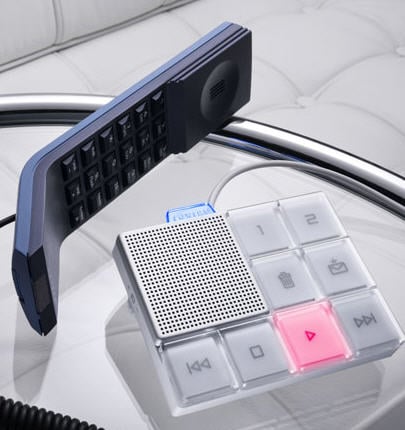
The buzz around Ooma is deafening and I certainly jumped in as well. I mean what's not to love about Ooma? It's using P2P, it gives you free domestic calling, and it even has some Hollywood glitz with Ashton Kutcher behind it. But now that I've had some time to think about it, I have some reservations I'd like to share.
First, I should point out that Ooma works by sharing your PSTN analog phone line with other Ooma users. So for example, if I am located in Connecticut with area code 203 and a New York Oooma user with area code 212 dials a Connecticut number, the call will be routed over the Internet to my Ooma Hub where it then dials out my PSTN analog line. Well this is fine and dandy, but what if the phone number dialed isn't a local call? This means I incur a charge for another Ooma user dialing through my Ooma hub. An area code's geographic footprint is HUGE however only a small set of exchange numbers is actually a local call. For instance, TMC is located in Norwalk, CT and it can make local calls to Norwalk, Wilton, Stamford, and some other towns. Some of the local call exchanges in Norwalk (free local call) include these: 203-854-XXXX, 203-852-XXXX, 203-853-XXXX, 203-457-XXXX. I'm sure there are more, but this is still a very small number of exchanges that the Ooma Hub can be used for free local calls.
In addition, every Ooma user is going to have a different dialing plan with their local phone company. Some may have unlimited local calling, others may have a set number of minutes before you have to pay per minute. Low phone usage houses actually pay per minute both for local and long-distance, so they wouldn't be good Ooma gateways.
Thus, I wonder if the Ooma box only lets you select your area code (first 3 digits), or if it lets you have more granular control by letting you add a complex dial-plan that includes all your various local exchanges. This would require at least matching the first 6 digits, i.e. 203-852-XXXX. Further, this would require the user to configure their Ooma box to have these local exchanges unless Ooma has a centralized database of everyone's local exchanges and is able to automatically update the Ooma boxes. In order for this P2P voice network to work, Ooma would have to have a geographic footprint across the entire country. They are using a viral marketing strategy that is giving away Ooma boxes for free as part of a closed invitation-only beta. In fact, they are giving away 2,000 Ooma boxes to users, who will then be able to invite three friends to also get a free Ooma box in exchange for deploying the box.
But is 2,000 Ooma boxes enough? I don't think so. There are more than 2,000 local exchanges in the country so you'd have to have at least 1 Ooma in each local exchange. Not going to happen. But even if it did, you'd only be able to have 1 person call through that Ooma hub located in that exchange at any given time. Anyone else trying to simultaneously call that exchange won't be able to since the PSTN line will be in use. I assume when you dial long-distance, Ooma queries it's P2P network to see if a remote Ooma is available and if no remote Ooma in the local exchange you are trying to reach is available, then the call is simply sent over your normal/regular PSTN connection. Obviously, in this case when the long-distance call is routed over your regular PSTN line you will incur any long-distance charges. That can be frustrating if you paid $399 for a box that only periodically saves you money. Question is, how many Ooma boxes would have to be deployed for this P2P voice network to reach mass-critical and self-sustaining status? I'm not sure, but I know 2,000 boxes won't cut it. So will Ooma go "booma"? Have we all been Punk'd? You make the call...
Update:
Rich Tehrani has a good point about privacy that I didn't even think of. Stick a phone coupler into the Ooma to double the line and you can then pick up the handset receiver to listen in on any remote caller using your Ooma box.