











By: Jérôme Brouet, Public Safety Solution Director, Alcatel-Lucent
From original Alcatel-Lucent TechZine posting
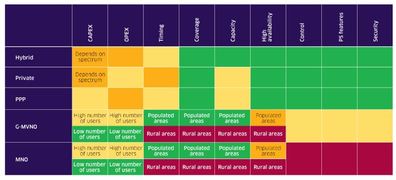
Public safety professionals require the highest level of reliable, multimedia mobile communications to enhance their operational effectiveness. And while standard based long term evolution (LTE) provides the most cost-effective and secure way to support these broadband communications, transitioning to this new technology will demand a complex technical, operational, and business evolution for the public safety community.
Why LTE – and why now?
Public safety communications are at a turning point. The most urgent events – planned and unplanned – require more than mission-critical voice to improve first responders’ efficiency. Real-time imagery, video, geo-localization, and high-speed access to private cloud-based information and applications are becoming essential to fulfill first responders’ missions.
Existing private mobile radio (PMR) systems have limited capabilities to deliver this, because they were designed to primarily support narrowband mission-critical voice.
For LTE, it’s a different story. LTE can complement existing PMR networks to dramatically enhance operational effectiveness and coordination within a secure infrastructure shared by cooperating agencies.
Full Story »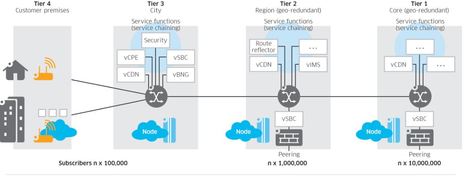
By: Andreas Lemke, Marketing Lead, CloudBand NFV platform, Alcatel-Lucent
From original Alcatel-Lucent TechZine posting
OpenStack isn’t an as-is solution for telco network functions virtualization (NFV) infrastructures. OpenStack is an open-source cloud management technology that provides many of the capabilities needed in any NFV environment. And this has prompted interest among many telco service providers.
But to realize the full benefits of NFV, service providers need NFV platforms that provide additional capabilities to support distributed clouds, enhanced network control, lifecycle management, and high performance data planes.
Full Story »
TCS had a wealth of interesting news at MWC - probably the most interesting was their VirtuMedix solution which is a...
Full Story »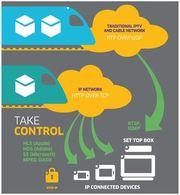
By: Roland Mestric, Director, Video Solutions Marketing, Alcatel-Lucent
From original Alcatel-Lucent TechZine posting
This article provides guidance on network architecture choices for operators considering introducing the time-shifted TV services provided by cloud digital video recording (DVR) solutions. Time-shifted TV services include catch up, restart, pause live TV, and personal recordings. The same guidance applies to those wanting to deliver subscription-based VoD services—either their own or those of partners[1].
Forward thinking providers are already concerned that the coming wave of unicast traffic generated by popular on-demand video services will affect the delivery network from end to end. Clarifying the potential impact of these services on the network is vital as the ramifications could be significant.
Full Story »
Citrix was showing off a lot of interesting solutions at MWC 2015, starting with the MPX 25000, a device which provides ADC...
Full Story »
We all know the M2M and IoT spaces are growing like crazy... Our own growing M2M Evolution and IoT Evolution shows are...
Full Story »
Just drifting along on the wind like a leaf on a stream. You don't control your own destiny. What do you...
Full Story »