Recently in Voice Commerce Category

IPCI%20new%20logo.gif
Jon Arnold and I finally got it all together and are proud to announce the launch of our new portal, IP Communications Insights.

I'll let the announcement we sent over the wire this morning fill you in on the details:


Robins Consulting Group and J Arnold & Associates Announce the Launch of IP Communications Insights


New Web Site is Home to IP Communications Industry Newsletter, Blogs, Podcasts, Newsfeeds, and Market Research and Intelligence

NEW YORK & TORONTO--(BUSINESS WIRE)--Robins Consulting Group (RCG) and J Arnold & Associates (JAA) – both prominent IP communications industry research, marketing and consulting firms – have proudly announced the launch of their new independent Web platform “IP Communications Insights”, located at http://www.ipcom-insights.com.

IP Communications Insights is the culmination of a partnership between the two firms that includes an array of marketing, communications, advisory, consulting and research services for IP communications technology vendors and service providers.

Designed to be an independent platform for industry thought leaders and market intelligence, the goal for IP Communications Insights is to offer valuable coverage, analysis and information not readily available elsewhere.

In addition, IP Communications Insights will publish an ongoing series of industry reports designed to be very topical, highly strategic, concise and affordably priced. One study in the works, “VoIP Mashups - Where's the Money?” is a critical evaluation and insider view of this rapidly evolving space. The possibilities for VoIP mashups are limitless, but the business case scenarios are not. This ground-breaking report will survey today's landscape and provide a strategic roadmap for making VoIP mashups a viable business.

Marc Robins, IP Communications Insights Co-Founder and Chief Technology Evangelism Officer of RCG, has been involved in the IP communications industry since its inception, and has served the industry as a reporter and analyst, conference producer and magazine publisher, and marketing executive and consultant. Mr. Robins also serves as the Managing Director of the SIP Forum, (http://www.sipforum.org), a prominent IP communications industry association that engages in numerous activities that advance and promote SIP technology, such as the development of industry recommendations, the SIPit interoperability and testing events, special interoperability workshops, and general promotion of SIP in the industry.

“I’m extremely proud – and excited -- to be going “live” with IP Communications Insights,” says Marc Robins. “I believe it accurately represents the vision that both Jon and I share, and creates a new environment for independent analysis and thought leadership that we feel is sorely missing in the marketplace of information. I look forward to working with Jon to continuously refine and add value to our platform, and to working with the many extremely talented individuals who have supported our efforts over the past year.”

J Arnold & Associates, founded by Jon Arnold, one of the IP communications industry’s most highly regarded analysts, is closely associated with VoIP, for both consumer and business applications. His marketing and strategy advice on the broader IP communications market is widely sought from vendors, carriers, the investment community, PR agencies and many facets of the media community.

“For some time now, Marc and I have felt there is a void in the market for independent analysis, and together we believe we can address it,” says Jon Arnold. “More than ever, with so much disruption, innovation and competition, we see a need for this type of perspective, and our intention is for the Web portal to become a focal point of clarity.”

About IP Communications Insights

IP Communications Insights is a portal for independent thought leadership and market intelligence not readily available elsewhere. IP Communications Insights hosts an IP communications industry newsletter, blogs, podcasts, and newsfeeds. The portal is also a new source for industry reports that are independent, authoritative, strategic and affordable. For more information about IP Communications Insights, visit www.ipcom-insights.com.

About RCG (Robins Consulting Group)

RCG, founded in 2003 by Marc Robins, is one of the leading consulting firms for companies in the IP Communications industry, offering market intelligence, high-value strategic planning and communications, messaging and branding expertise, and a variety of marketing consulting services including awareness and demand creation, distribution channel strategies and development, public relations support, and market research and intelligence.

Mr. Robins also serves as the Managing Director of the SIP Forum, a leading IP communications industry association. Prior to founding RCG, Marc served as Vice President of Publications and Trade Shows, Associate Group Publisher and Group Editorial Director at TMC (Technology Marketing Corporation).

Over the course of his career, Marc has authored hundreds of articles and columns for leading industry magazines, and he continues to evangelize new IP communications trends and technologies as a contributor to trade, mainstream and business publications. Marc is also a frequent moderator and speaker at leading industry events. For more information about RCG, visit www.robinsconsult.com.

About JAA

Jon Arnold is Principal of J Arnold & Associates, an independent analyst and marketing consultancy with a focus on IP communications. JAA works with a wide variety of clients in this sector, with expertise in VoIP, cable telephony, IPTV, Triple Play, enterprise IP, WiFi/WiMax, Peer-to-Peer, Web 2.0 and Open Source. His views are frequently cited in the business and trade press, and he regularly speaks at leading industry events. He also maintains an active profile through his widely followed blog and podcasts. Previously, he was the VoIP Program Leader at Frost & Sullivan, where he was responsible for managing their subscription service for Global VoIP Equipment Markets. The consultancy was launched in March 2005. For more information about JAA, visit www.jarnoldassociates.com.

IP%20Convergence%20TV%20Logo.GIF


Jon Arnold just let me in on the official "hard" launch of a new Web portal called "IP Convergence TV", of which Jon is Portal Editor. Here's Jon's blog post about it.

IP Convergence TV is a non-profit initiative that Comverse is heading, along with a group of charter sponsors including Intel, AudiCodes, Tilgin, BEA, and Blueslice. All these companies support the initiative by contributing content about all the various aspects of IP convergence - IPTV, Triple Play, FMC, etc.

Already, there's a good chunk of content on the site, and it has a nice, clean layout and very easy navigation. Definitely worth checking out!


Off to VON Tomorrow

| 0 Comments

I'm off to the VON show in San Jose, CA tomorrow morning, and I'm interested to see if there's any truth behind Thomas Howe's brave post today about why he's not attending the event. I'll be meeting with other technologists while I'm there, so I'm curious whether this position is shared by them.

For my part, I'm looking forward to shooting the breeze with my industry friends, making new friends, and (hopefully) discovering new innovative solutions and sussing out relevant industry trends.

Also, let me extend an invitation to those also attending the event to contact me if you're interested in meeting up.

More on Second Life Voice Offer

| 0 Comments

I knew I was onto something hot when I posted about this a short time ago.

Apparently my colleague Jon Arnold agrees, and has this much expanded analysis of the offer - and provides a well-deserved booster shot for the technology masterminds behind the scenes at DiamondWare.


Loyal Blog Readers: Please enjoy this sneak peek at my upcoming Mind Share 2.0 column (more like a mini-whitepaper) -- co-authored by Cbeyond CTO Chris Gatch -- that will be running in the April issue of Internet Telephony magazine:


Managed Services Providers: Delivering on the Promise of High-Value Services

As the IP communications industry continues to evolve and mature, an array of new companies offering highly reliable and robust new products and services have made their way to market, providing users with an uncommon wealth of new productivity enhancing communications capabilities at extremely competitive prices.

Foremost among these new entrants to the marketplace are a breed of companies commonly referred to as Managed Services Providers, or MSPs. These MSPs represent a special type of service provider that leverages new Internet technologies to combine the best of Web service and network service models to deliver a whole new class of hosted services to users, and also represent a new genre of investment opportunity to Wall Street.

MSPs typically provide a unique bundling of various hosted voice and data communications services and applications, often coupled with quality of service guarantees, robust security measures and Web-based administrative features. But what exactly is a managed services provider, and what differentiates an MSP from a Web services and network services company?
 
The Two Types of Integration

Service providers establish their unique identity through integration – using process and technology to make distinct systems work together for the benefit of their customers.
 
When one examines the concept of integration with respect to an IP-based services provider, there are really two distinct types of integration to consider: network integration and application integration. In fact, the types of integration that are practiced in large-part determines whether a provider is a network services operator, Web services provider, or an MSP.
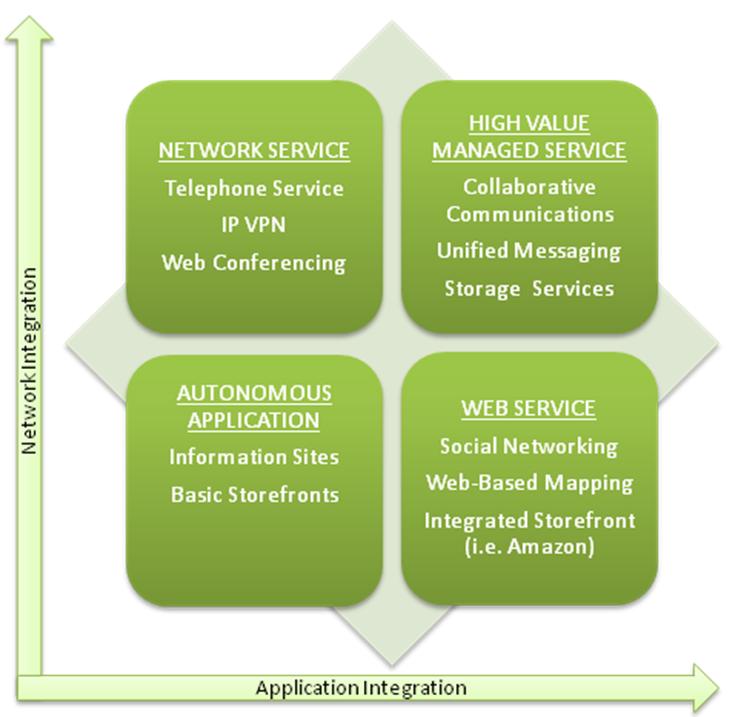
MSP%20Figure%201.JPG The matrix represented in Figure I to the left illustrates the differentiation between these two types of integration as well as the progression of derived value as the degree of integration increases across the two planes.

For example, a basic html-based website represented in the lower left-hand quadrant functions rather autonomously and displays little or no integration with other network resources or other applications running on a network.

As integration with other network resources increases, such as in the upper left-hand quadrant, services such as POTs, Fax-to-Email and other network integration-based services are enabled.

It can be said that if a service provider is high in network integration, but doesn’t pursue application integration, then this provider fits into the Network Service Provider paradigm.

For example, a Web hosting company rates high in network integration: In practice, they’re abstracting infrastructure for their customers, but they don’t really integrate with anybody else. In effect, they outsource the hardware function of running a Web site on behalf of their subscribers.

With respect to a high-degree of application integration as represented by the lower right-hand quadrant, Web-based companies like Ebay and Yahoo! are prime examples. In these cases, it can be said that if a service provider is high in application integration, but low in network integration, then it fits into the Web Services paradigm.

With respect to an MSP, the utilization of both types of integration is a prime differentiator that distinguishes it from a Web services or Network Services provider. In fact, a managed services provider combines both planes of integration, which allows it to provide a number of higher-value services such as CRM and unified messaging – services that rely on the integration of both networks and applications.

In order to fit into this MSP paradigm, it’s not enough for a provider to have a high degree of network integration, because that would still qualify it as a network services provider, and it’s not enough to have a high degree of Web integration – a true MSP has to exhibit both attributes.

The fact that everything is coming down to a common denominator of IP allows a network to support an array of applications in an integrated fashion, and this integration is happening on the information layer as well. Indeed, since most everything now rides over IP, the constraints that affected the types of integration one would have wanted between various applications and network services are rapidly disappearing.

Key Attributes of a Managed Service

Now that we’ve defined an MSP as implementing a high degree of both network and application integration, let’s try to tackle the question about how an MSP must reach beyond integration to create high-value managed services.

We suggest that an MSP delivers new value to users by offering a unique combination of integration, and personalization. An application that exhibits personalization stores personal user data, their preferences relative to the service, and it may even allow them to customize the service itself to meet their specific requirements.
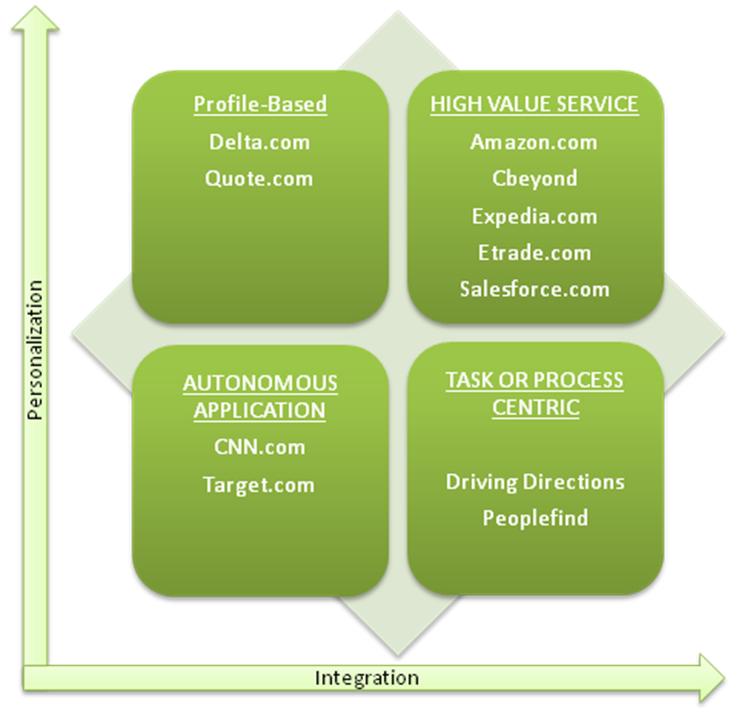
MSP%20Figure%202.JPG The matrix in Figure 2 at left illustrates the progression of service value as the concentration of personalization and integration increases.

For example, early Web-based applications were basically autonomous pursuits – they allowed a user to perform various basic functions such as a database lookup or numeric calculation such as that found in lease rate estimators found on automotive websites.

Other websites pursued complex machine-to-machine integration with other services and data sources and simplified the number of steps involved to solve a complex task.

For example, a site that provides background checks may integrate data from a wide variety of sources, thereby decreasing the time necessary for a thorough background check.

Further up the food chain, some websites began to add additional value by allowing personalization. A good example of such a site is Delta.com, which allows users to tailor individual choices based on their stored profiles – in this case selecting flight itineraries, seating and food preferences, payment methods, etc. Delta.com in effect personalizes user information and enables a transaction -- namely the booking of a flight -- to occur.

As we follow the progression of value to the upper right hand quadrant, we see that some companies have succeeded in combining both personalization and integration to deliver higher value services to their users.

A great example of such a site is Salesforce.com. This unique service outsources the infrastructure demand of managing a CRM system, provides intuitive Web-based configuration of the platform, and extends their platform with a network of almost 400 Web-based partners under their AppExchange partner program.

Now you may be asking, what does this have to do with VoIP? We stated that personalization includes not only personalized data and preferences, but control of the service by a user. An MSP provides the ability for users to conduct transactions – in terms of allowing users to subscribe/unsubscribe to services, and enable/disable various service features and functions.

 In effect, users are provided with a high degree of control regarding what services and features get delivered to them and what network resources they have access to – but the upshot is that this control not only includes access to information but it also includes customization of the service itself, including real time communications services.

The key point we are trying to make here is that the same degree of personalization and customization that is occurring in the Web services realm is being enabled in the real-time communications services realm, and it’s at the junction of both that MSPs are leading the charge.

Web Information and IP Communications Mashups -- The Network as a Web Service

With the wealth of new Web 2.0 and IP communications technologies currently available, there is an incredibly rich opportunity for MSPs to combine a variety of services to create even more valuable and meaningful “super” services for users. By employing Web 2.0 access to information and application resources, while simultaneously relying on communications networks as a key resource, MSPs are making telephony (voice and video) an integral part of the mash-up phenomenon (see sidebar “Web 2.0 Technology Toolbox for Managed Services”.

In fact, we believe that the combination of network-based information and applications with other content and applications makes the managed services opportunity almost limitless.

For example, XML by itself is an invaluable Web 2.0 tool as it provides an easy mechanism to describe and label data being exchanged between two Web-based entities. In effect, it offers up a standard format for presenting Web-based content. Furthermore, there are numerous examples of standardized XML schema that allow one to easily digest more common forms of data such as contacts (vCard-XML), secure identity (SAML) BLOGS (Atom), etc.

There are many examples of useful information available in the standard XML formats including Yahoo maps, e- Bay auctions, professional sports teams game calendars, etc.

Beyond the revolution in content and data, we believe service provider networks will eventually be accessible via web services APIs. This includes wireline and wireless networks, as the progression of VoIP standards promises to make the network an accessible resource of higher programming languages. Today, VXML is a good example where basic call and IVR functions can be accessed on a service provider network using a basic markup language.

Many other service provider networks already support call control or other resource manipulation through RPC type APIs. Some modern platforms like the popular Broadsoft Broadworks Application Server allow subscription to call information and manipulation of calls via a Web Services API.

While examples in this arena are not as plentiful as content examples, one need only look at some interesting developments like Voxeo’s IVR services, Cbeyond’s SIP trunking and converged fixed-mobile services or AOL’s plan to expose network call control to developers to gain an appreciation of the potential that exists for the managed services industry..

Conclusion

We believe that if a provider is simply building on the information of other providers, they’re a Web services company, not a true MSP. For example, in our view an eBay is a great Web Services company, but not an MSP. AT&T is a network service provider of tremendous scale, but it is without an application strategy, and therefore not an MSP.

To truly qualify as an MSP, a provider must provide both network and application integration, and in most cases will extend broad capabilities of service configuration and personalization to the users of the service. This demanding distinction makes MSPs a rare breed among service providers.

The good news is we are truly on the leading edge of a golden era of high-value managed services. The unique combinations of technological building blocks and new combinations of services – the mash up if you will – has created a new platform for the creation of new services and new capabilities. While the current list of companies one should consider a true MSP is limited, expect to see this change in a dramatic way in coming years.

Technology Toolbox for Managed Services

A host of new technologies are making new types of integration and improved user interfaces possible. These technologies present a ripe opportunity for managed services providers because they provide a programmatic way to use the resources of the underlying network (for example, like SIP does for the network integration plane.)

It’s not essential for a company to use all of these technologies or only these technologies to qualify as an MSP, but from our perspective these are the most interesting developments that are fueling innovation.

IP
Stands for Internet Protocol. A common network protocol that makes the convergence of disparate media (voice, video and data) on a single network infrastructure and the combination of many services into a single managed services bundle possible. It is the “lingua franca” of today’s network infrastructures.

SIP
Stands for Session Initiation Protocol. A simple, text-based protocol for IP communications session establishment that makes the creation and enhancement of voice, video, IM, gaming and other session-oriented communications possible.

XML
Stands for Extensible Markup Language. A simple and extensible means of communicating information between various Web-based applications and services – a standard way to describe information that’s exchanged between Web services. XML is extremely powerful because everything from calendar information to contacts to emails to documents can be appropriately labeled in an XML schema.

APP

Stands for the Atom Publishing Protocol. A replacement for Really Simple Syndication (RSS), APP is a simple HTTP-based protocol that allows one service to subscribe to another and automatically receives new, relevant information when available.

REST
Stands for Representational State Transfer. An emerging new tool, an architectural principal that represents the various states of an application in a standard URL format that can and often is combined with XML. This technology represents a replacement for an older generation of “APIs” that were based on remote procedure calls (RPC). Consider an e-mail platform based on REST: every e-mail on the server is represented as a unique URL with the content set forth in a defined XML schema. REST makes the use of that information very easy in other enhanced services.

AJAX
Stands for Asynchronous JavaScript and XML. AJAX is a web development technique for creating interactive web applications. The intent of AJAX is to make web pages feel more responsive by exchanging small amounts of data with the server behind the scenes, so that the entire web page does not have to be reloaded each time the user requests a change. This is meant to increase the web page's interactivity, speed, and usability.

AJAX brings it all together with a whole new set of capabilities that allows an MSP to produce desktop quality web interfaces.

(About Chris Gatch)

Chris Gatch is the CTO and a founder of Cbeyond (NASDAQ: CBEY), a small business focused managed services provider that started in 1999 and is now publicly traded on the NASDAQ. Chris is a contributor to the industry effort to standardize SIP Trunking and serves as an editor of the SIPconnect technical specification published by the SIP Forum. He has served on the Service Provider Board of the International Packet Communications Consortium (IPCC), and he presently serves on the Board of the SIP Forum.


It's "Prime" Time for Skype

| 3 Comments
skype-prime.jpg
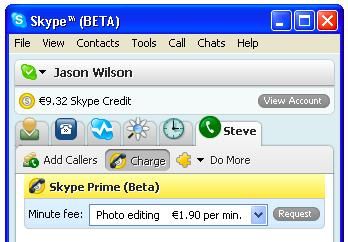
Josh Lowenstein, over at the Webware blog from cnet.com, recently posted about a new paid-by-the-minute service from Skype called Skype Prime.

According to the post, Skype Prime is aimed at consultants and other professionals that need to monetize their phone time. Such users can set their own per-minute rates that get charged to the caller. Skype Prime takes 30 percent of the fees to pay for the service, and users can set up as many types of paid-for calls as they want, with short descriptions and custom pricing.

Each type of call gets listed on the users Skype profile for others to see, and there are two options for pricing: a one-time fee, or charging by the minute. Setting up the service requires signing up with PayPal, which handles the fees.

FYI, if you're interested in signing up for this new service, you need to use the latest Windows-based Skype client, which apparently is not the version that is available for download off of Skype's home page. You need to dig a bit to get to the right one.

Second Life Trials Voice Chat

| 1 Comment

second_life_logo.jpg The popular, virtual reality site "Second Life", run by Linden Labs, will shortly unveil a new limited service beta trial in which they will give users the option of chatting up other avatars with voice instead of text.

Prior to this announcement, Second Life users wanting to communicate with one another have had two basic choices: text chat (either personal or in a group setting) or the use of third-party voice applications like Skype.

Linden Labs  has teamed up with VoIP technology partners Vivox and DiamondWare to engineer the service, which goes live on March 6 for a limited group of users. By the end of the month, Linden Labs hopes to extend the feature to all Second Life inhabitants.

Second Life's new integrated voice chat feature will offer a group mode that lets users hear voice conversations in their immediate proximity, and personal and regular group voice chat, where users don't need to be near each other to have a conversation.

After There.com added voice chat to its site in late 2003, many Second Life users have been clamoring for the same feature.  And after seeing users add Skype and other applications like TeamSpeak or Ventrilo into the site, Linden Labs apparently got serious about development.

The plan is to initially provide voice free of charge during the beta. Down the road, Linden Labs is considering limiting the offering to mainland property owners and island owners who pay a $295 monthly maintenance fee, and charging users living on the wrong side of the virtual train tracks an additional fee or making them upgrade to the current plan.

It's clear the site is at the very early stages of incorporating real-time voice chat, and it will be interesting to see what emerges from the user community and how people incorporate it into their virtual business and personal lives.

Since Second Life has become a bona fide marketplace, where buy/sell transactions occur on a constant basis -- and we're talking real money made here, not Monopoly currency -- I'm particularly interested to see what intrepid developers come up with.

How about virtual phone companies, including virtual payphone, mobile and landline services. Or community-wide news and radio "channels".

Just as long as it's not some virtual telemarketing business that calls me during virtual dinnertime...


Ebay's Year-End Earnings Report

| 0 Comments

I had to chuckle -- and scratch my head -- when I heard about the "glum" news regarding the financial performance of Ebay's VoIP operation, a.k.a. Skype. According to Ebay CEO Meg Whitman, "The monetization efforts we outlined at the time of the acquisition are not developing as quickly as we had hoped." During 2006, Skype generated $195 million in revenue -- after Ebay laid out $2.6 billion for the company in 2005.

Am I missing something here? A lackluster "monetization" result was basically guaranteed given the decision to give away free Skype Out calls for the entire 2006 calendar year for North American subscribers. But what this announcement implies is that Meg or the Ebay staff in charge of overseeing Skype's bottom line either were not included in the initial decision to provide free calling (which I have a hard time believing), weren't exactly completely in agreement with the strategy (a distinct possibility given the recent management shake ups at the company), or were completely clueless about the net results of such a strategy (which I also have a hard time believing.)

I always believed that the Free Year was a shrewd strategy to boost Skype's subscriber count, and based on the disclosure that Skype managed to triple the number of registered users to 171 million over the course of the year, it seemed to work as planned. I also believed that Ebay was willing to forgo short-term profits in order to grow market share (given Ebay's deep pockets, not an unreasonable strategy.)

Now that Skype has announced a variety of new plans -- most notably a $29.95 all you can eat annual package for U.S and Canadian customers -- revenues are picking up. Apparently, Skype generated $66 million in the fourth quarter of 2006 -- up a whopping 164% from the year-ago -- so it seems as if Skype has some opportunity to mine its installed and growing base of customers to generate some good revenue numbers in the near future.
 
In fact, I expect the company will accelerate the introduction of new "for pay" features, functions and associated plans to goose cash flow in the months ahead.

Back from Sunshine and IT Expo

| 0 Comments

Fort%20Lauderdale.jpg I just returned from travels south, to Fort Lauderdale and Internet Telephony EXPO -- and arrived in Winter in New York. It was bound to arrive at some point (although I thankfully missed the deep freeze, eight-degree temperatures of a couple of days ago).


The show was great -- well-attended and full of good content in the conferences.  Jon Arnold and I spent some time together basking in the glow of our recent announcement.  See Jon's post about show highlights.

sunburn.jpgAnd yes, I did spend a little time in the sun -- and barely escaped serious harm. I keep forgetting that the Florida sun can burn you alive -- even in the dead of winter...

  

Here are a few takeaways from the show  -- a mix of events, observations, and the like:


Peering is Hot:

Apparently the VoIP Peering Fabric sessions had to be relocated to larger quarters due to the overflow turnout.  Greg Galitzine has more on this and other happenings in his show recap.


SIP Trunking Adoption Gaining Momentum

The other standing-room-only crowds I saw were soaking up as much as they could about SIP Trunking. A number of sessions, including the SIP Trunking Series hosted by Ingate with presenters from BandTel, Cbeyond, Sphere, Ericsson, Objectworld, Level 3, pingtel, and Shoretel, covered everything from a basic introduction to SIP and SIP trunking, to deep dives into the service provider and enterprise networks, a look at SIP trunking in Latin America, and case studies showing SIP trunking actually at work -- delivering real-world benefits.

I've been covering the SIP trunking movement for a while -- here's a link to a whitepaper I authored a ways back -- so, I'm glad to see the excitement over it -- and the adoption rate -- is building nicely.


VoIP Security Issues Finally Getting Respect

Some really good education came out of the sessions covering VoIP Security. It's an area I've covered before in blog posts and columns, and I'm glad that not only is information about current VoIP vulnerabilities coming into the light, but awareness is also growing about the ways to effectively deal with them. Greg also wrote up a nice review of the issues that were presented by Mark Collier, CTO of VoIP security specialist SecureLogix and VoIP security blogger.


Billing Takes Front and Center

I had the pleasure to moderate the session, "VoIP and NGN Billing: A Primer" last Thursday at the show, and was very impressed by each and everyone on the panel, which included  Bruce Trvalik, Director, Product Management at Sonus Networks; Joe Hogan, CTO and Founder of Openet Telecom; Jim Dalton, CEO, TransNexus, Inc.; and David McNierney, VP of Market Development at Highdeal Inc.

The discussion was lively and insightful, and I found it very interesting to hear that billing and other "back office" functions are starting to migrate to the "front office" of providers -- all the way into the executive suite -- as they start to play a bigger and bigger strategic role and become integral in various marketing, cross-selling, and promotional activities. 

For more about current billing trends, you should check out Rich Grigonis' terrific article in the January issue of Internet Telephony magazine.


Great Drawings

harley.jpg I was sure the Harley was mine. Then the next day I was sure I was driving the Toyota TJ Cruiser home. But alas, this did not come to pass...

The bike and SUV were in close approximation to Internet Telephony yellow -- and were definite crowd-pleasers -- and great choices for grand giveaways.

Jon Arnold and I figured that since most everyone else was making some sort of announcement, issuing press releases and generally making noise  -- especially to pull in the crowds at Internet Telephony Conference & EXPO East going on right now -- that it was OK to make some noise of our own.

Hopefully it will be music to your ears


Robins%20Consulting%20Group%20Text%20with%20Logo.JPG          JArnold_logo.jpg


Robins Consulting Group and J Arnold & Associates Announce New Partnership

Two Prominent IP Communications Industry Research and Consulting Practices Join Forces to Offer an Array of Services and Co-Develop New Sources of Industry Intelligence

NEW YORK, TORONTO, and FORT LAUDERDALE, January 23, 2007-- Robins Consulting Group (RCG) and J Arnold & Associates (JAA) – both leading IP Communications industry research, marketing and consulting firms – have proudly announced a new partnership that includes the two firms joining forces to provide an array of marketing, communications, strategy consulting and market research services to their growing roster of IP communications technology vendors and service providers.

In addition, RCG and JAA will be jointly developing new information resources, including an electronic newsletter and related Web site, which will offer unique industry analysis, a healthy dose of opinion, provide a new platform for other industry thought leaders, and offer valuable coverage and information not readily available elsewhere about the rapidly evolving IP communications industry.

Veteran industry thought leader Marc Robins, RCG's founder and Chief Evangelism Officer, has been involved in the IP communications industry since its inception, and has served the industry as a leading reporter and analyst, conference producer and magazine publisher, and marketing executive and consultant.

“I’ve known Jon for several years, and have come to consider him one of the best minds in the industry,” says Marc Robins. “I’m thrilled to be forging this new partnership with Jon and JAA, as I believe the unique combination of our highly complementary capabilities will allow us to deliver even more value to our clients and to the industry at large. I also look forward to working with Jon to create exciting and compelling new resources of industry intelligence to help industry professionals navigate the constantly shifting sands of this dynamic, fast-moving industry.”

J Arnold & Associates, founded by Jon Arnold, one of the IP communications industry’s most highly regarded analysts, is closely associated with VoIP, for both consumer and business applications. His marketing and strategy advice on the broader IP communications market is widely sought from vendors, carriers, the investment community, PR agencies and many facets of the media community.

“Marc brings a rich perspective to this space, and is an independent voice that is widely followed,” says Jon Arnold. “Together, I think can we offer a valuable resource that can benefit anyone involved in the IP communications market. In a nutshell, I’d like to think of us as the go-to-guys for all things IP.”

About RCG (Robins Consulting Group)

RCG, founded in 2003 by Marc Robins, is one of the leading consulting firms for companies in the IP Communications industry, offering market intelligence, high-value strategic planning and communications, messaging and branding expertise, and a variety of marketing consulting services including awareness and demand creation, distribution channel strategies and development, public relations support, and market research and analysis. Prior to founding RCG, Marc served as Vice President of Publications and Trade Shows, Associate Group Publisher and Group Editorial Director at TMC (Technology Marketing Corporation.)

Over the course of his career, Marc has authored hundreds of articles and columns for leading industry magazines, and he continues to evangelize new IP communications trends and technologies as a regular contributor to trade, mainstream and business publications, and as the author of his popular column “Mind Share 2.0” for Internet Telephony® magazine and blog “Beyond VoIP”. Marc is also a frequent moderator and speaker at leading industry events. For more information about RCG, visit www.robinsconsult.com.

About JAA


Jon Arnold is Principal of J Arnold & Associates, an independent analyst and marketing consultancy with a focus on IP communications. JAA works with a wide variety of clients in this sector, with expertise in VoIP, cable telephony, IPTV, Triple Play, enterprise IP, WiFi/WiMax, Peer-to-Peer, Web 2.0 and Open Source. His views are frequently cited in the business and trade press, and he regularly speaks at leading industry events. He also maintains an active profile through his widely followed blog and podcasts. Previously, he was the VoIP Program Leader at Frost & Sullivan, where he was responsible for managing their subscription service for Global VoIP Equipment Markets. The consultancy was launched in March 2005. For more information about JAA, visit www.jarnoldassociates.com.
1 2 3 Next

Subscribe to Blog

Blogroll

Yearly Archives

'06 '07 '08
  Jan  
  Feb  
  Mar Mar
Apr Apr  
May    
Jun    
     
Aug    
Sep    
Oct Oct  
Nov    
Dec    

Around TMCnet Blogs

Latest Whitepapers