 Ok, now my head is getting dizzy from the number of times Microsoft Windows Live Messenger/MSN Messenger has had outbound VoIP-to-PSTN calling (2006), then pulling outbound VoIP calling (early 2008), and then putting it back in. Also, I believe it was 2004 when the Messenger client used Net2Phone before they pulled the plug. Well, apparently outbound PSTN dialing using VoIP is back in!
Windows Live Messenger has now teamed up with Telefónica to offer VoIP services. Previously Net2Phone and Verizon have had exclusive deals with Microsoft's Messenger client.
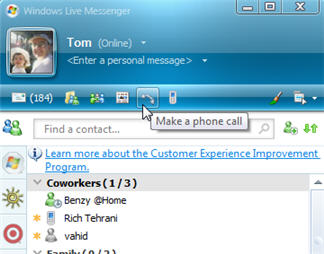
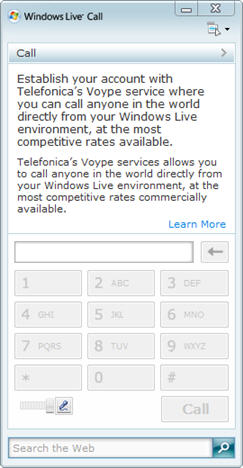
When you click on Make a Phone Call you see the dialpad window and it explains you can sign up with Telefonica's Voype service to call directly from within Windows Live Messenger.
Telefónica's rates seem decent as compared to SkypeOut. For instance,Telefónica charges $0.014 per minute for the U.S. comparaed to $0.021 SkypeOut calls. Unfortunately, there is no dial-in (DID) capability equivalent to SkypeIn with Telefónica's service.
The service uses prepaid amount in dollars. Increments of $5, $10, and $20 are available and you can set it up to automatically recharge the account when it reaches a certain threshold. To use it you just need Windows Live Messenger 8.0 and above.
If Microsoft really wants to compete with Skype what they should do is partner with all the major SIP trunking service providers (Bandwidth.com, DIDX, Junction Networks, Packet8, etc.) and offer them all as a drop-down list within Windows Live Messenger for quick and easy configuration. After all, unlike Skype which is proprietary, Windows Live Messenger is based on the SIP protocol. Further, Microsoft could allow Windows Live Messenger users to manually enter their existing SIP trunking service provider account info, essentially making Windows Live Messenger a SIP softphone client able to make and receive calls. Microsoft could even do revenue sharing with the SIP trunking service providers.
Even better, Microsoft could offer the ability for users to enter in custom SIP credentials to use with the user's SIP-based IP-PBX!
 Since in this scenario the connection is direct to the IP-PBX no revenue sharing is required. Of course, since SIP is SIP, a user could simply go into manual mode, and enter in, for example, their Bandwidth.com SIP trunking info thus bypassing the drop-down list, connecting directly to Bandwidth.com and eliminating any revenue share Microsoft might receive.
However, Microsoft could restrict the manual SIP credentials entered simply by having a database of their SIP trunking providers' URLs or Microsoft could simply stick something into the SIP header which the SIP trunking service providers can parse and detect and then give credit/revenue to Microsoft for sending the call from Live Messenger onto their network. So many ideas, I should write a book.