SIP Trunking, Security a Hot Topic at ITEXPO
January 31, 2008
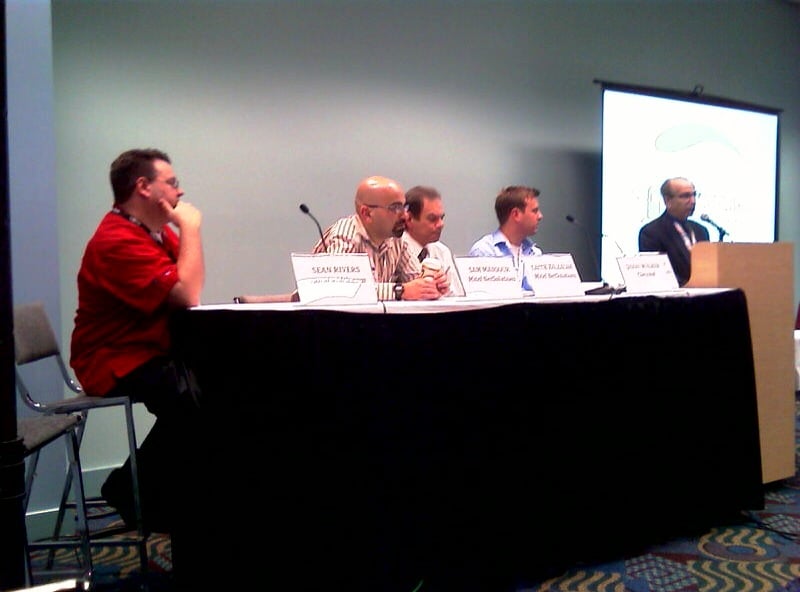
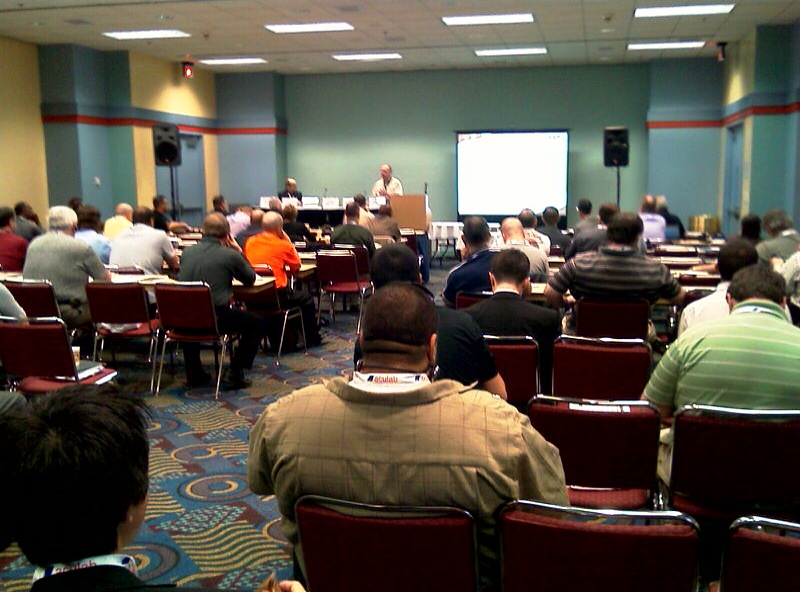
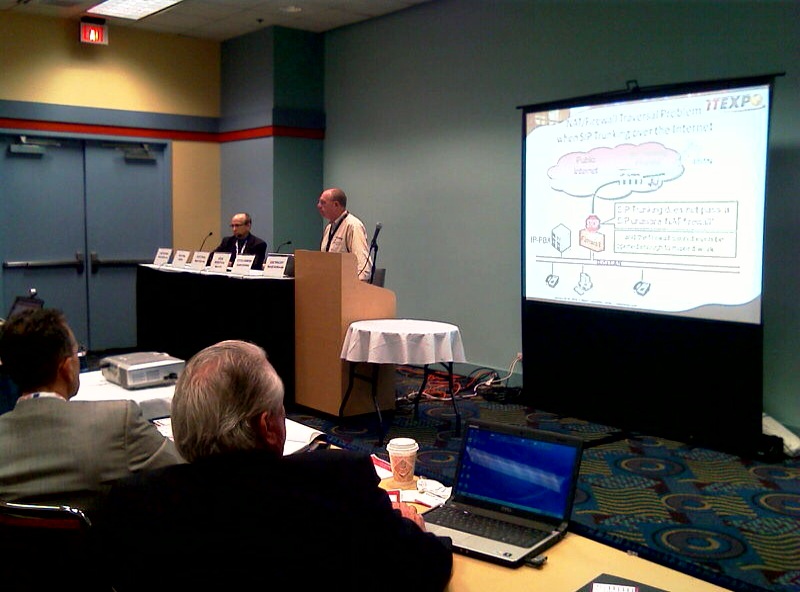
I hope you had a chance to join us at the fourth installment of the SIP Trunking Seminars at the ITEXPO.
Many of the sessions were filled to capacity. Clearly, there is still a strong demand for information about SIP trunking. When we started offering these educational seminars, it was because people didn’t know enough about the technology. The focus was on the “what” and “why” of SIP trunking.
Today word has certainly spread, and attendees were eager for information about SIP trunking on a more detailed, deeper level. But enterprises are still challenged with implementation and interoperability issues. Our seminars demonstrating how to set up a SIP trunk connection live – on-site in the Miami Beach Convention Center – were clearly some of the most popular sessions. Two IP-PBX vendors set up their systems with an Ingate, connected to an ITSP over the Internet and made a call to a cell phone in the audience.
Another key topic for attendees was security. That was no surprise, as security is a particularly important issue for the enterprise community.
On a side note: a sincere thank you to the esteemed speakers who participated in the Miami seminars. Your expertise and enthusiasm make these sessions invaluable. Thanks go to BroadSoft, Avaya, BandTel, Bandwidth.com, Bluesocket, Broadvox, Cbeyond, Objectworld and ShoreTel. Thanks also to the thought leaders from the SIP Forum, VoIP Security Alliance (VOIPSA) and NeuStar/ENUM IETF.
And of course, many thanks to TMC for once again arranging a wonderful, successful event.
If you attended last week’s seminars, we’d love to hear from you – your suggestions and comments are all welcome.
- Olle


Many of the sessions were filled to capacity. Clearly, there is still a strong demand for information about SIP trunking. When we started offering these educational seminars, it was because people didn’t know enough about the technology. The focus was on the “what” and “why” of SIP trunking.
Today word has certainly spread, and attendees were eager for information about SIP trunking on a more detailed, deeper level. But enterprises are still challenged with implementation and interoperability issues. Our seminars demonstrating how to set up a SIP trunk connection live – on-site in the Miami Beach Convention Center – were clearly some of the most popular sessions. Two IP-PBX vendors set up their systems with an Ingate, connected to an ITSP over the Internet and made a call to a cell phone in the audience.
Another key topic for attendees was security. That was no surprise, as security is a particularly important issue for the enterprise community.
On a side note: a sincere thank you to the esteemed speakers who participated in the Miami seminars. Your expertise and enthusiasm make these sessions invaluable. Thanks go to BroadSoft, Avaya, BandTel, Bandwidth.com, Bluesocket, Broadvox, Cbeyond, Objectworld and ShoreTel. Thanks also to the thought leaders from the SIP Forum, VoIP Security Alliance (VOIPSA) and NeuStar/ENUM IETF.
And of course, many thanks to TMC for once again arranging a wonderful, successful event.
If you attended last week’s seminars, we’d love to hear from you – your suggestions and comments are all welcome.
- Olle


SIP Trunking Seminars at ITEXPO
January 9, 2008
This month in Miami, we at Ingate will once again host informative seminars on SIP trunking at ITEXPO. SIP trunks are a critical next step in the road to global connectivity. They are also a cost-efficient option in which enterprises reap the benefits almost immediately.
But are they a part of your communications strategy?
Learn all you need to know about deploying SIP trunks in an enterprise environment with Ingate, BroadSoft, TMC and a whole list of key players in the IP communications industry. Free for all ITEXPO attendees, these seminars are always extremely popular – most discussions are standing room only.
This season promises to be better than ever. Participants include:
• Avaya
• BandTel
• Bandwidth.com
• Bluesocket
• Broadvox
• BroadSoft
• Cbeyond
• NeuStar/ENUM IETF
• Objectworld
• ShoreTel
• SIP Forum
• VoIP Security Alliance (VOIPSA)
New tracks on “Shattering the Myths of SIP Communications” will delve into VoIP security and simplifying enterprise deployments. In addition, a SIPconnect Compliance Workshop, presented by the SIP Forum, will provide an overview of SIPconnect and its value proposition, a step-by-step SIPconnect compliance tutorial and lessons learned from actual SIPconnect deployments.
We’ll also demonstrate how easy it is to set up a SIP trunk by deploying one live, on-site, in 20 minutes or less.
I look forward to seeing you in Miami January 23-25. For more information and a detailed schedule, visit www.ingate.com/SIP_Trunking_seminar.php
Pre-register at http://www.ingate.com/SIP_Trunking_Registration.php
- Olle
Related Tags: SIPconnect, trunking, sipconnect, ingate, seminars, Trunking
But are they a part of your communications strategy?
Learn all you need to know about deploying SIP trunks in an enterprise environment with Ingate, BroadSoft, TMC and a whole list of key players in the IP communications industry. Free for all ITEXPO attendees, these seminars are always extremely popular – most discussions are standing room only.
This season promises to be better than ever. Participants include:
• Avaya
• BandTel
• Bandwidth.com
• Bluesocket
• Broadvox
• BroadSoft
• Cbeyond
• NeuStar/ENUM IETF
• Objectworld
• ShoreTel
• SIP Forum
• VoIP Security Alliance (VOIPSA)
New tracks on “Shattering the Myths of SIP Communications” will delve into VoIP security and simplifying enterprise deployments. In addition, a SIPconnect Compliance Workshop, presented by the SIP Forum, will provide an overview of SIPconnect and its value proposition, a step-by-step SIPconnect compliance tutorial and lessons learned from actual SIPconnect deployments.
We’ll also demonstrate how easy it is to set up a SIP trunk by deploying one live, on-site, in 20 minutes or less.
I look forward to seeing you in Miami January 23-25. For more information and a detailed schedule, visit www.ingate.com/SIP_Trunking_seminar.php
Pre-register at http://www.ingate.com/SIP_Trunking_Registration.php
- Olle
Related Tags: SIPconnect, trunking, sipconnect, ingate, seminars, Trunking
Predictions for 2008
December 21, 2007
The New Year is almost upon us and I can’t help but wonder – what’s next for IP communications? What’s in store for all of us in 2008?
My predictions, based on extensive conversations with customers, partners and media-folk:
An Increased Focus on Security: Of course enterprise network security has always been a priority. While up until now we have seen much back-and-forth about VoIP and security in general, in 2008 I imagine the security discussion will get even louder as adoption of SIP-based communications continues to rise. As security vendors we must remain vigilant in meeting interoperability standards to enable VoIP to actually become as widely used as other Internet-based applications as email or Web surfing and in developing innovative, best-in-breed solutions. We must also work together to educate the industry about which threats are genuine and which are just marketing spin to sell ineffective products.
SIP Trunking: One of the reasons for the continued increase in VoIP deployments is SIP trunking. It’s a fast and easy-to-deploy solution that has opened the door for smaller enterprises – as well as the mid-to-large-sized – to adopt SIP-based VoIP. It’s also a low-cost option in which enterprises reap the benefits almost immediately.
We at Ingate have been helping to spread the word about SIP trunking through the ITEXPO seminars (http://www.ingate.com/SIP_Trunking_seminar.php), and let me tell you, attendance goes up significantly every time. Why? Because there’s still a great need for information on SIP trunks and for solutions roadmaps.
There’s also a need for dispelling myths. Can VoIP really be secure? Truth be told, SIP-based communications like VoIP can be more secure than those over the PSTN. Are SIP Trunks difficult to deploy in an enterprise setting? Nope. And we’ll prove it at our upcoming SIP trunking seminars at the ITEXPO in January, where we’ll deploy a SIP trunk right there, on-site, in 20 minutes or less. Twice.
VoIP 2.0: OK it’s not really VoIP 2.0, but in 2008 I predict that we’ll see an interest in other SIP-based applications – not just VoIP – grab some headlines. We’ll also see a surge in the use of these realtime applications beyond the LAN, a significant jump in connecting remote workers and even customers with SIP.
From all of us at Ingate Systems, we wish you a wonderful holiday season and a happy and healthy New Year!
-- Olle
Related Tags: based, security, trunking, deploy, applications, ingate
My predictions, based on extensive conversations with customers, partners and media-folk:
An Increased Focus on Security: Of course enterprise network security has always been a priority. While up until now we have seen much back-and-forth about VoIP and security in general, in 2008 I imagine the security discussion will get even louder as adoption of SIP-based communications continues to rise. As security vendors we must remain vigilant in meeting interoperability standards to enable VoIP to actually become as widely used as other Internet-based applications as email or Web surfing and in developing innovative, best-in-breed solutions. We must also work together to educate the industry about which threats are genuine and which are just marketing spin to sell ineffective products.
SIP Trunking: One of the reasons for the continued increase in VoIP deployments is SIP trunking. It’s a fast and easy-to-deploy solution that has opened the door for smaller enterprises – as well as the mid-to-large-sized – to adopt SIP-based VoIP. It’s also a low-cost option in which enterprises reap the benefits almost immediately.
We at Ingate have been helping to spread the word about SIP trunking through the ITEXPO seminars (http://www.ingate.com/SIP_Trunking_seminar.php), and let me tell you, attendance goes up significantly every time. Why? Because there’s still a great need for information on SIP trunks and for solutions roadmaps.
There’s also a need for dispelling myths. Can VoIP really be secure? Truth be told, SIP-based communications like VoIP can be more secure than those over the PSTN. Are SIP Trunks difficult to deploy in an enterprise setting? Nope. And we’ll prove it at our upcoming SIP trunking seminars at the ITEXPO in January, where we’ll deploy a SIP trunk right there, on-site, in 20 minutes or less. Twice.
VoIP 2.0: OK it’s not really VoIP 2.0, but in 2008 I predict that we’ll see an interest in other SIP-based applications – not just VoIP – grab some headlines. We’ll also see a surge in the use of these realtime applications beyond the LAN, a significant jump in connecting remote workers and even customers with SIP.
From all of us at Ingate Systems, we wish you a wonderful holiday season and a happy and healthy New Year!
-- Olle
Related Tags: based, security, trunking, deploy, applications, ingate
The Remote Worker
November 21, 2007
As many as 9 out of 10 employees now work at locations other than company headquarters, according to recent research from Nemertes Research LLC. Businesses need to consider the best ways to support this mobile workforce to help them “get things done.”
Internet-based remote connectivity solutions are a natural place to start, as most professionals find themselves connected to the Internet around the clock (working from their homes or any other place in the world).
What if remote workers could utilize the capabilities of their corporate IP-PBX from home, or while at a satellite office or on the road? VoIP, of course, is likely the first thought. But what about IM? Video? Conferencing? Whiteboarding applications? These, too, would be a tremendous asset to the remote worker. And it’s all possible, right now.
There are several issues IT managers must address when enabling remote workers:
Solving the NAT traversal issue at the remote sites: There are many solutions available. The IETF has recommended ICE (Interactive Connectivity Establishment) to resolve NAT traversal issues. However, other methods of traversing common NATs are available on SIP-aware firewalls that employ far-end NAT traversal techniques to maintain a connection with a remote site. This at the same time as they solve near-end NAT traversal at the headquarters/corporate site.
Security: Utilizing equipment that secures the SIP traffic is essential. Choose solutions that support Secure Real Time Protocol (SRTP) and Transport Layer Security (TLS). Used with voice data, SRTP and TLS provide one of the most secure environments for Internet telephony and VoIP applications available.
In addition, equipment must also secure the network/users from attacks and intrusion. SIP-aware firewalls are a great solution here as they can serve as enterprise-class firewalls for traditional data, while at the same time providing SIP capabilities (and securing them as well, too).
While there are certainly additional issues, these two are the most urgent to address. Once a remote worker is up and running, they can enjoy a wide variety of SIP-based applications – in collaboration with their corporate office – to improve productivity and develop a rich working environment.
One of the most exciting aspects about remote workers is deploying the same technology with customers. Imagine providing your best customers access to call your tech team for free, from anywhere in the world. In this context, IM is an invaluable business tool (as are presence applications). The opportunities are limitless when we broaden the way we think about IP communications.
- Olle
Related Tags: remote workers, remote worker, remote, traversal, applications, worker
Internet-based remote connectivity solutions are a natural place to start, as most professionals find themselves connected to the Internet around the clock (working from their homes or any other place in the world).
What if remote workers could utilize the capabilities of their corporate IP-PBX from home, or while at a satellite office or on the road? VoIP, of course, is likely the first thought. But what about IM? Video? Conferencing? Whiteboarding applications? These, too, would be a tremendous asset to the remote worker. And it’s all possible, right now.
There are several issues IT managers must address when enabling remote workers:
Solving the NAT traversal issue at the remote sites: There are many solutions available. The IETF has recommended ICE (Interactive Connectivity Establishment) to resolve NAT traversal issues. However, other methods of traversing common NATs are available on SIP-aware firewalls that employ far-end NAT traversal techniques to maintain a connection with a remote site. This at the same time as they solve near-end NAT traversal at the headquarters/corporate site.
Security: Utilizing equipment that secures the SIP traffic is essential. Choose solutions that support Secure Real Time Protocol (SRTP) and Transport Layer Security (TLS). Used with voice data, SRTP and TLS provide one of the most secure environments for Internet telephony and VoIP applications available.
In addition, equipment must also secure the network/users from attacks and intrusion. SIP-aware firewalls are a great solution here as they can serve as enterprise-class firewalls for traditional data, while at the same time providing SIP capabilities (and securing them as well, too).
While there are certainly additional issues, these two are the most urgent to address. Once a remote worker is up and running, they can enjoy a wide variety of SIP-based applications – in collaboration with their corporate office – to improve productivity and develop a rich working environment.
One of the most exciting aspects about remote workers is deploying the same technology with customers. Imagine providing your best customers access to call your tech team for free, from anywhere in the world. In this context, IM is an invaluable business tool (as are presence applications). The opportunities are limitless when we broaden the way we think about IP communications.
- Olle
Related Tags: remote workers, remote worker, remote, traversal, applications, worker
Setting up a SIP Trunk in 15 Minutes Flat
September 25, 2007I hope you had a chance to join us at the third installment of the SIP Trunking Seminars at the ITEXPO. While there, we had the opportunity to demonstrate with colleagues from ShoreTel and Bandwidth.com how fast and easy it can be to set up a SIP trunk. Our goal was to be up and running within a half hour. We did it in 15 minutes.
This demonstration illustrates one of the most important keys to success for enterprise VoIP, and IP technologies in general: solutions have to be relatively easy, and fast, to implement. The speed and ease of deployment of SIP trunks help bring this technology from the abstract world of theory – “it would be great to do this” – to rapid, real-world deployments.
This is the path to success we must follow as we sprint toward unified communications and all the possibilities that entails. I believe, as many of my colleagues do, that interoperability will pave the way to making rapid deployments possible. Our good friend Greg Rothman from Cbeyond joined us at the Seminars, and discussed how the SIPConnect standard is helping to make this possible, at least from the SIP trunking point of view.
I wanted to thank all of our participants for helping to make the Seminars such a big success in Los Angeles. If you attended, we’d love to hear from you – your suggestions and comments are all welcome.
Next week I’ll talk about enabling remote workers to access the enterprise IP-PBX.
- Olle
Related Tags: Seminars, seminars, success
A Snapshot of Day 1: Ingate's SIP Trunking Seminars at ITEXPO
September 11, 2007Once again, the Ingate SIP Trunking seminars are a huge success. So far, we’ve seen more people than ever before attend these popular, informative seminars – and in case you’re not in Los Angeles right now at the show, wanted to give you a snapshot of yesterday’s rousing success.
The seats were full at every session, where nearly 65 participants attended each seminar. Our moderator Rich Shockey of NeuStar and ENUM IETF Working Group did a wonderful job keeping speakers on point, and commented that the audiences were truly engaged in the discussions.
It is clear to me, and to all of us participating in the seminars, that SIP trunking has gained quite a bit of traction in the enterprise space. More of our attendees already know about SIP trunking; at this stage, many are now looking for deployment solutions.
This is why we feel it is critical to provide these informative sessions on SIP trunking. Whenever there is a new, important technology, it is absolutely imperative to communicate the benefits – not just the “why” but the “how to” -- to the entire enterprise community.
Today, Tuesday September 11, we’ll hear from our distinguished colleagues Acme Packet, ShoreTel, VOIPSA, Level 3, Objectworld, TMC and of course Ingate for more best-in-class education on SIP trunking. Some of the panels may be a bit thought provoking, so be there early in room 501 A/B to get a good seat!
Here’s the schedule for today:
9:30am
Enterprise Security and VoIP
12:30pm
Beyond SIP Trunking
3:00pm
Network Architecture and Design for VoIP
- Olle
Related Tags: trunking, seminars, enterprise, Trunking, Ingate, ingate
SIP Trunking Seminars at ITEXPO
September 5, 2007
A year ago at the IT Expo in San Diego, Ingate arranged the first round of SIP Trunking seminars. Next week will be our third. I believe that SIP trunks are a critical next step in the road to global connectivity. Are they a part of your communications strategy? If so, find all you need to know about SIP trunks next week, at our SIP Trunking Seminars at the ITEXPO in Los Angeles.
We are looking forward to a big turnout this season. The last round of seminars was a tremendous success, with standing room only for most of the discussions. This season promises to be bigger than ever, with some of the world’s leading companies – and the industry’s foremost experts – participating:
• 360 Networks
• Acme Packet
• Bandwidth.com
• Cbeyond
• Central Touch
• Digium/Asterisk
• Level 3
• NeuStar/ENUM IETF
• Objectworld
• Pingtel
• TMC
• ShoreTel
• Sphere Communications
• VoIP Security Alliance (VOIPSA)
New tracks will address some of the most pressing issues for today’s business, including a seminar on “Enterprise Security and VoIP” with VOIPSA. A discussion on “Beyond SIP Trunking” will address what’s next in the world of realtime IP communications.
I look forward to seeing you in Los Angeles Sept. 10-11 for these free seminars. For more information and a detailed schedule, visit www.ingate.com/SIP_Trunking_seminar.php
Pre-register at http://www.ingate.com/SIP_Trunking_Registration.php
Related Tags: trunking seminars, trunking, Trunking, seminars, ingate, communications
We are looking forward to a big turnout this season. The last round of seminars was a tremendous success, with standing room only for most of the discussions. This season promises to be bigger than ever, with some of the world’s leading companies – and the industry’s foremost experts – participating:
• 360 Networks
• Acme Packet
• Bandwidth.com
• Cbeyond
• Central Touch
• Digium/Asterisk
• Level 3
• NeuStar/ENUM IETF
• Objectworld
• Pingtel
• TMC
• ShoreTel
• Sphere Communications
• VoIP Security Alliance (VOIPSA)
New tracks will address some of the most pressing issues for today’s business, including a seminar on “Enterprise Security and VoIP” with VOIPSA. A discussion on “Beyond SIP Trunking” will address what’s next in the world of realtime IP communications.
I look forward to seeing you in Los Angeles Sept. 10-11 for these free seminars. For more information and a detailed schedule, visit www.ingate.com/SIP_Trunking_seminar.php
Pre-register at http://www.ingate.com/SIP_Trunking_Registration.php
Related Tags: trunking seminars, trunking, Trunking, seminars, ingate, communications
Global Connectivity and SIP Trunking
August 17, 2007
The communications protocol SIP (Session Initiation Protocol) not only enables VoIP, but also other forms of realtime communications over the Internet. The beauty of this protocol is that it facilitates “global connectivity:” everyone reachable anywhere, at anytime. The true vision behind SIP was to bring the global business community together for collaboration, to improve productivity and generally help everyone work smarter, together.
I see global connectivity starting to happen in three steps: first, the adoption of SIP trunking, a technology that rapidly reduces communications costs by eliminating redundancies and making a connection between VoIP and the traditional telephony network (PSTN). The next step is allowing remote workers to utilize their corporate VoIP, IM etc. by accessing these features from anywhere, as long as there is access to an Internet connection. Last, this revolution toward global connectivity will happen as enterprises communicate with each other, freely and in real time over the Internet. And in doing so they are choosing the most appropriate form of communications for each situation.
SIP Trunking: An Immediate Impact on Communications Costs
A SIP trunk is the use of SIP to set up communications between an enterprise IP-PBX and a service provider where voice becomes just another application over the Internet. Unlike in traditional telephony, where bundles of physical wires were once delivered from the service provider to a business, a SIP trunk is a logical connection from one point to another over an IP connection, like the public Internet.
The emergence of service providers offering SIP trunks to enterprises means that enterprises can outsource their PSTN connectivity to a third party – the service provider. All calls including long distance calls are carried over the Internet and the break out point to the PSTN is as close as possible to the party you are trying to reach. The call is passed over the PSTN from that breakout point to its final destination. For companies doing business globally on a regular basis, this can have a significant impact on long distance communications costs.
The most immediate way SIP trunks reduce telephony costs is that they make it unnecessary to purchase BRIs (Basic Rate Interfaces), PRIs (Primary Rate Interfaces) and local PSTN gateways. SIP trunks also produce long-term savings by supporting business growth. Using IP, there is typically excess bandwidth already included in the Internet connection, making it unnecessary to purchase additional capacity. There is often more than enough bandwidth to handle VoIP calls.
There are a number of important issues to touch on regarding SIP trunks, including security, infrastructure needs, the various ITSP service plans etc. Join Ingate and leading IP-PBX vendors, ITSPs and other industry influencers at the INTERNET TELEPHONY Conference & Expo in Los Angeles Sept. 10-11, for “SIP Trunking: Everything You Need to Know,” a series of educational seminars that are free to conference attendees. Click on for more info: http://www.ingate.com/SIP_Trunking_seminar.php.
Next week I’ll talk about remote connectivity, the next stage in developing true enterprise global connectivity.
- Olle
Related Tags: global connectivity, communications costs, service provider, internet, Internet, communications
I see global connectivity starting to happen in three steps: first, the adoption of SIP trunking, a technology that rapidly reduces communications costs by eliminating redundancies and making a connection between VoIP and the traditional telephony network (PSTN). The next step is allowing remote workers to utilize their corporate VoIP, IM etc. by accessing these features from anywhere, as long as there is access to an Internet connection. Last, this revolution toward global connectivity will happen as enterprises communicate with each other, freely and in real time over the Internet. And in doing so they are choosing the most appropriate form of communications for each situation.
SIP Trunking: An Immediate Impact on Communications Costs
A SIP trunk is the use of SIP to set up communications between an enterprise IP-PBX and a service provider where voice becomes just another application over the Internet. Unlike in traditional telephony, where bundles of physical wires were once delivered from the service provider to a business, a SIP trunk is a logical connection from one point to another over an IP connection, like the public Internet.
The emergence of service providers offering SIP trunks to enterprises means that enterprises can outsource their PSTN connectivity to a third party – the service provider. All calls including long distance calls are carried over the Internet and the break out point to the PSTN is as close as possible to the party you are trying to reach. The call is passed over the PSTN from that breakout point to its final destination. For companies doing business globally on a regular basis, this can have a significant impact on long distance communications costs.
The most immediate way SIP trunks reduce telephony costs is that they make it unnecessary to purchase BRIs (Basic Rate Interfaces), PRIs (Primary Rate Interfaces) and local PSTN gateways. SIP trunks also produce long-term savings by supporting business growth. Using IP, there is typically excess bandwidth already included in the Internet connection, making it unnecessary to purchase additional capacity. There is often more than enough bandwidth to handle VoIP calls.
There are a number of important issues to touch on regarding SIP trunks, including security, infrastructure needs, the various ITSP service plans etc. Join Ingate and leading IP-PBX vendors, ITSPs and other industry influencers at the INTERNET TELEPHONY Conference & Expo in Los Angeles Sept. 10-11, for “SIP Trunking: Everything You Need to Know,” a series of educational seminars that are free to conference attendees. Click on for more info: http://www.ingate.com/SIP_Trunking_seminar.php.
Next week I’ll talk about remote connectivity, the next stage in developing true enterprise global connectivity.
- Olle
Related Tags: global connectivity, communications costs, service provider, internet, Internet, communications
About Me
July 9, 2007
Welcome to “The Next Step in Enterprise VoIP” blog. The business community is changing rapidly with the introduction of new IP technologies. It’s an exciting time, with VoIP seen almost as a standard application – a “must-have” – for any business mapping out their communications future.
Yet there’s a great deal more to realtime communications over the Internet than just VoIP. SIP, the de facto standard protocol for realtime communications, opens up a world of possibilities, of new ways for businesses to interact within the organization, as well as with partners, customers and others outside the enterprise (this is the idea of what we call “Global Connectivity” -- where everyone can be reached and reach others in realtime as long as there is a connection to the Internet). IM, realtime video conferencing and other exciting applications only scratch the surface of what’s possible.
And that’s where this blog comes in. I’ll keep an eye out for new developments in the industry, adding my two cents on how they impact businesses. I’ll also talk about the issues that many IT folks and end users have about VoIP itself – topics like VoIP security, interoperability, standards etc.
But first, let me tell you a little about myself. I’ve been in the technology sector – and especially telecom -- for more than 20 years. I’ve seen the business from every perspective, from working hands-on in software development to senior management positions as Ericsson, DSC Communications and Alcatel. Today I serve as CEO of Ingate Systems, a company that’s been on the cutting edge of SIP since the Internet Engineering Task Force first introduced the protocol.
No stranger to the technical side of things, I earned my MSc in Engineering from The Royal Institute of Technology (Stockholm) and a Master of Business Administration from the London Business School.
Again, welcome to the blog. All input is appreciated – email any questions you want addressed to me at olle@ingate.com or directly by posting comments to the blog itself.
- Olle
Related Tags: business, communications, realtime, internet, Internet
Yet there’s a great deal more to realtime communications over the Internet than just VoIP. SIP, the de facto standard protocol for realtime communications, opens up a world of possibilities, of new ways for businesses to interact within the organization, as well as with partners, customers and others outside the enterprise (this is the idea of what we call “Global Connectivity” -- where everyone can be reached and reach others in realtime as long as there is a connection to the Internet). IM, realtime video conferencing and other exciting applications only scratch the surface of what’s possible.
And that’s where this blog comes in. I’ll keep an eye out for new developments in the industry, adding my two cents on how they impact businesses. I’ll also talk about the issues that many IT folks and end users have about VoIP itself – topics like VoIP security, interoperability, standards etc.
But first, let me tell you a little about myself. I’ve been in the technology sector – and especially telecom -- for more than 20 years. I’ve seen the business from every perspective, from working hands-on in software development to senior management positions as Ericsson, DSC Communications and Alcatel. Today I serve as CEO of Ingate Systems, a company that’s been on the cutting edge of SIP since the Internet Engineering Task Force first introduced the protocol.
No stranger to the technical side of things, I earned my MSc in Engineering from The Royal Institute of Technology (Stockholm) and a Master of Business Administration from the London Business School.
Again, welcome to the blog. All input is appreciated – email any questions you want addressed to me at olle@ingate.com or directly by posting comments to the blog itself.
- Olle
Related Tags: business, communications, realtime, internet, Internet
Technorati
Del.icio.us
Slashdot
Digg
Furl
Spurl
RSS feed