


It has been about a month since I started using Google Voice (the relaunched service formerly known as GrandCentral) and I am impressed. I am always reluctant to use superlatives, but Google's spin on a 'one number' service is far and away the best implementation I have seen so far. It has the potential to be a game changer on several levels.
Although the service is not available to the public yet (only existing GrandCentral users get access for now) I would be very surprised if customer uptake does not surge when it becomes generally available.
Here are some of the highlights:
While Google's record is a mixed bag when it comes to non-search services (think of Google Video, Lively or Orkut), I predict that Google Voice will be a killer app. They have taken an inherently difficult task (managing inbound phone calls) and made it easy. Given the already large base of Gmail users who will benefit with almost no learning curve tax, this can only mean success in terms of both user adoption and revenue generation (through more finely targeted advertisements).
Importantly, the implications of Google Voice for other service providers (including VoIP service providers, the LECs, and cellcos) will be more profound than even Skype. I intend to address that topic in my next post to this blog.
Although the service is not available to the public yet (only existing GrandCentral users get access for now) I would be very surprised if customer uptake does not surge when it becomes generally available.
Here are some of the highlights:
- The essence of the offering is a 'follow-me' service that allows you to filter, screen or direct inbound calls to the phone of your choice. Google Voice provides a local number at no cost. Calls to the local number can then be handled in several different ways: forwarded to one or more phones (including SIP phones, see below); sent to voicemail, screened, or recorded.
- The best part of the service is that it is free (at least in pecuniary terms). There is no charge for the local number that gets assigned, or for outbound calls to the U.S. Every other follow-me service that I am aware of charges a monthly fee for the former, and a per-minute fee for the latter. The quid pro quo is that you must sacrifice yet another level of privacy to the great Google machine. Google will undoubtedly use this service as another means of targeting advertisements (more on this later). If you are still operating under the delusion that anything you do is private, then this is not the service for you.
- The user interface closely resembles Gmail, so it is both familiar and intuitive. It seems obvious that Google plans to merge the Voice interface into Gmail at some point in the future, which would conveniently place all incoming messages in a single screen.
- The interface displays all of the contacts from your Gmail account. This makes it very easy to manage your contacts as well as to select a contact name and create handling rules. You can also create custom greetings so that every caller in your address book will hear a unique and personalized message. The screenshot below shows the special greeting I created for family members.

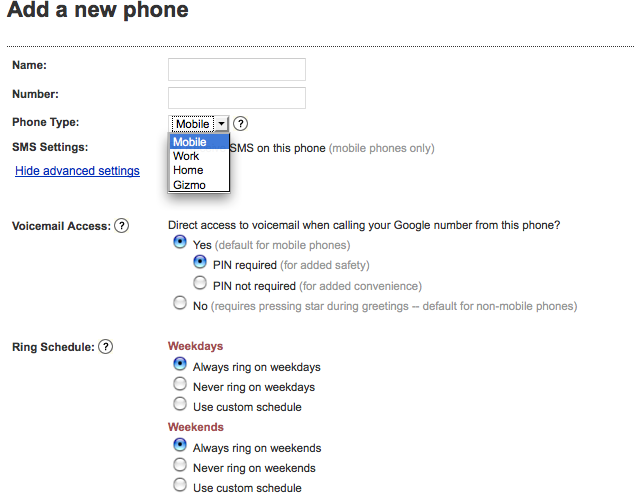
- The call handling screen gives you an option to forward calls to one or more phones, and one of the options is a Gizmo SIP account. Gizmo is a paid service, but offers a free version that allows you to register a SIP phone and receive calls from other on-net users. The SIP option promises to open up a lot of flexibility, although I was unable to make it work with my own Gizmo account (It's possible that Gizmo disables inbound calls from Google Voice since this would compete directly with their own inbound call service, which is not free). It would be nice if Google added an option to forward calls to any SIP URI.

- The most useful new feature is voice transcription, which will convert an audio message left to voicemail into text. The resulting text transcript is then visible in your inbox and is searchable. While the voice recognition software used for the transcription is not perfect, it is definitely good enough to facilitate keyword searches. In the example shown in the screenshot below, the brand name was garbled, but I was able to locate the message by searching for "sale" and "tractor" (the lawn tractor is still for sale, in case anyone in the Fairfield county area is interested).

- It is possible to make outbound calls from within the user interface. Calls within the U.S. are free, while international calls can be made using a prepaid account. Rates for international calls are lower than you would expect to pay your cellco, but not as low as are available from specialty service providers. Calls originated through the Google Voice servers will first ring your phone, and then the phone of the called party. This gives you the very convient option to record outbound conversations (although it is not currently possible to get a transcript of these calls).
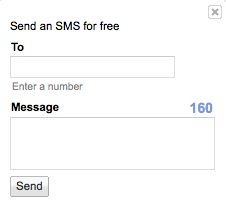
- For good measure, Google Voice also includes an SMS short text service. This allows you to receive SMS messages into your Google Voice inbox, which are then searchable, just like voicemail messages. You can also send SMS messages from inside the user interface using a lightweight ajax interface.
- All of the web UI functions, including placing an outbound call or SMS, can be used from a mobile browser. The already utilitarian interface is rendered more sparse to make access from slow mobile data connections more tolerable. Testing with the Blackberry mobile browser and the Opera mobile browser was surprisingly easy. And, I would be very surprised if access was not made even easier from future Android phones.
While Google's record is a mixed bag when it comes to non-search services (think of Google Video, Lively or Orkut), I predict that Google Voice will be a killer app. They have taken an inherently difficult task (managing inbound phone calls) and made it easy. Given the already large base of Gmail users who will benefit with almost no learning curve tax, this can only mean success in terms of both user adoption and revenue generation (through more finely targeted advertisements).
Importantly, the implications of Google Voice for other service providers (including VoIP service providers, the LECs, and cellcos) will be more profound than even Skype. I intend to address that topic in my next post to this blog.

 Technorati
 Del.icio.us
 Slashdot
 Digg
Digg twitter













Leave a comment