
January 2008 Archives

Today's Juniper announcement marks their entry into the Ethernet switching space, one which is dominated by Cisco. In my view, it makes enterprises think twice about procurement strategies which rely on a single vendor (Cisco) solution, with lost agility and poorer price/performance.

That said, Juniper will be challenged on a number of fronts:
#1 Enterprise is not carrier. Juniper has been successful in taking away Cisco share in the carrier router market, but their recent entry into the enterprise router market has resulted in a 1% share (according to Dell'Oro). One reason is that enterprise requirements and drivers are very different than those of carriers. A stock exchange is far more demanding in terms of real-time reliability and performance requirements than any mass market consumer application.
#2 Ethernet switching is not routing. Success requires competencies such as understanding the L2/L3 switched network architecture, intelligence distribution for optimal performance and lowest TCO, wiring closet environments including green IT and PoE, resilient stackability and powering, wireless LANs security, roaming etc, and much more (just look at the breadth of 802.1 standards). These core competencies come with years of experience in building highly scalable Ethernet networks with thousands of wiring closets.

#3 Convergence is not just a multimedia bit stream. Enterprises are moving to VoIP and UC and expect their networking suppliers to have the ability to deliver end-to-end solutions, and the experience in designing and deploying converged networks.

Enterprises should demand choice, and choose vendors that best meet their business needs. From our side, we welcome the opportunity to demonstrate to enterprises that our solutions deliver improved network resilience, better network performance and lower TCO, than either Cisco or Juniper.

Hyperconnectivity Cs and Os

January 28, 2008 9:04 AM | 0 Comments

Last week, I presented a keynote at ITExpo in Miami.

I joked with Rich Trehani, after he introduced me, that the conference should be renamed from “Internet Telephony Expo” to “In-transition Technologies Expo”. Why? Because there are huge things happening in the industry that will transform corporations and government agencies into Hyperconnected Enterprises (yes, the theme of this blog!).

In case you missed it, Hyperconnectivity is a growing megatrend through which everyone and everything that can benefit from being connected to the network will be connected. But it’s not panacea, and comes with its challenges.

This table nicely summarizes the challenges and opportunities of Hyperconnectivity.


Hyperconnectivity%20Cs%20and%20Os2.jpg

These drive everything from network simplification while delivering improved network resilience, better network performance and lower TCO; to telecom and UC as an application and communications enabled applications in a SOA environment.

Sure, you can use this at the front end of your next strategic plan.

35% respondents to CIO Insight survey identified improving business processes as a business priority in 2008, making this area top of mind only behind delivering better customer service. A similar number identified collaboration and workflow technologies as the #2 technology (behind BI) that will make the most significant contribution to their business strategy.

This bodes well for expanded unified communications solutions that include communications enablement of business processes to reduce the impact of human delay. I call this reduction in time to X, where X is whatever is important to your business (decision, service, problem resolution, revenue, lower costs).

Realizing these CIO priorities requires unified communications capabilities to be delivered as software services across a SOA-enabled agile communications environment. Agility can only be achieved through multi-vendor systems that cross enterprise and service provider domains, reaching your people and customers wherever they may be.

Maybe you want to listen on your next commute to an interview I did discussing the relationship between unified communications and SOA.

Consolidation, centralization and virtualization of storage and processing are the generally accepted paths to increased agility, to lower TCO and to the greening of IT.

With Microsoft making its virtualization play, the focus will shift during the remainder of the decade from servers and storage virtualization in the data center to virtualization in the network, to meet business, organizational and governance requirements; for example, federations across partners and suppliers; common infrastructures across separate entities; and security, sensor and telemetry domains in a hyperconnected enterprise.

I'm not talking about just partitioning a router or firewall device. I'm talking about a new level of virtualization that allows dynamically controllable isolation of routing, security and performance of multiple logical network topologies on a single IP network.

Inherent in this concept is the ability to configure intelligent services on a just-in-time basis without the inherent delays of stacking, cabling and configuring racks and racks of equipment.

What's your take on virtualization in your real world environment?

Check out this smart cart technology for your neighborhood grocery store.

smart%20marketcart_040720.300w.jpg

Don’t get discouraged by the date (July 2004) and do watch the video- it works for me if it helps me find what I need faster. But read on. There’s a lesson here.

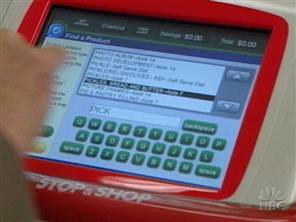
These smart carts are basically equipped with an IBM PC equipped with touch sensitive screens, WiFi, RFID and a scanner. The shopper can identify themselves, manage shopping lists, be directed to favorite products, and check out in real-time as they load up his/her cart.

In 2004, Stop and Shop announced that they would roll out these smart cards (they call them ‘shopping buddies’) in some 170 stores by the end of 2005. But if you check the store web site today, you’ll find that only some 20 stores are listed.

What might have gone wrong? I can only guess that maybe the business case wasn’t there (retail is a thin margin business), consumers didn’t see enough value, and real-time check out was replaced by more secure self-check out on exit.

Jump ahead to the present. MediaCart and Microsoft just rolled out the next generation of smart carts, with plans for a pilot in ShopRite stores. What’s the big difference? There appears to be a much heavier focus on advertising as a source of revenue- basically to get the shopper to buy more.

Lesson learnt: With Hyperconnectivity, everything that can benefit from being connected will be connected. In retail, that means shopping carts will only be connected when they either save money or make money.

Are you seeing any of these technologies in your neck of the woods?

If you had been at the National Retail Federation conference (this week in NYC), you would have seen a a really neat demo of the IBM Retail Integration Framework, featuring the Nortel Agile Communication Environment and the Extenda Retail application.

The demo showed what could be done across this SOA based environment leveraging a communications enabled retail application, recognizing that many sales are lost because of a time-wasting sales process.

In the demo, a customer uses her cell phone and clicks on an item (i.e. clothing) on a website, and gets information of the nearest store location via the Nortel Agile Communication Environment Location service capability. When the customer walks into the store, the Nortel Agile Communication Environment downloads the mobile version of the Extenda retail application to the customer’s phone. At the same time, it enables an IM “Click to Call” function to get the requested information to a sales associate, who has a PDA and is handling the pick ups in the appropriate department.

This agile and open SOA-enabled environment brings the shopper and what they want to buy more quickly together in a more effective, friendly manner.

How have retailers successful drawn you back for more business?

Is Cisco worth the premium?

January 16, 2008 11:29 AM | 0 Comments

That’s the headline in NetworkWorld after they read my last posting.

Couldn’t have said it better myself;)

I haven’t tracked Ethernet share numbers for a while. Recent Gartner Dataquest information (3Q07) on the enterprise Ethernet market surprised me: Cisco share by ports has dropped to 37%.

So what gives?
Firstly, vendors other than Cisco have collectively shipped twice as many Ethernet ports as Cisco, and so two thirds of enterprises are either just saving money or, in the case of Nortel customers, recognizing improved network resilience, better network performance and lower TCO.

Secondly, given that Cisco’s share by revenue is 73% (not a typo), Cisco customers are paying way too much to Cisco; and customers who continue blindly buying from Cisco (just because “that’s what we have always done”) will continue to unnecessarily fill Cisco’s coffers.

Cisco is not going to lower their prices any time soon since they could lose 15% of their revenue base if their revenue share tracked their port share! In fact, as a mature technology, one would expect Ethernet prices to come down over the years …. my friends at Gartner tell me this is generally true but NOT for Cisco.

So what’s the bottom-line? If Cisco is only a 400 pound guerilla, then don’t feed him as if he were a 700 pound one! It may be time to look at how you can get more for your IT dollars.

This overweight guerilla roams the world. Have you put him on a diet in your neck of the woods?

Google vs MSFT in Enterprise

January 11, 2008 9:42 AM | 0 Comments

In my interview with Rich Tehrani of TMCnet (Hyperconnectivity Is Permeating Everything), I was asked how Google, Apple and Microsoft change the telecom space? I replied that in enterprise, of the three, Microsoft is the most significant change agent (in telecom) with its entry into unified communications as a software application. Google is certainly a company to watch and an innovation powerhouse. However, its Google Apps is still a feature-poor second cousin to Office. I then went on to say that Nortel has a vision of software-centric UC (contrasted with Cisco’s network-centric approach), and is executing on this vision through the Nortel Microsoft Innovative Communications Alliance.

Since the interview (see the news item), Microsoft upped the ante against Google in enterprise search, by agreeing to acquire Fast Search & Transfer ASA for $1.2 billion.

I hadn’t heard of Fast before this, but this will certainly help MSFT in this critical market segment.

It will be interesting to watch how Google (never to be discounted) will increase its relevance in the enterprise market.

Nice to talk about Hyperconnectivity in the consumer space, but let’s turn back to business.

In his blog, Michael Krigsman highlights the fact that the preliminary design of the Boeing 787 Dreamliner had the passenger in-flight internet access network connected to the plane’s control, navigation and communication systems.

This is a good example of Boeing engineers ignoring the fact that ‘just because you can do something, should you’. Sure you can use various techniques to provide logical separation between any two environments (e.g. using firewalls, VLANs, VPNs etc), but I, for one, would be more comfortable flying, knowing that there is total physical separation between passenger and flight control networks. Boeing seems to agree and says the problem will be solved before the first commercial flight. Phew;)

Hyperconnectivity creates immense opportunities, but whatever way you choose to leverage these opportunities has to achieve the right balance between risk and benefit.

Another example of hyperconnectivity at home.

A friend of mine received a digital picture frame from his daughter for Christmas. A key feature, or so she thought, was the ability to wirelessly connect to a PC and display any photo or video on the PC. My friend, a computer literate environmental scientist, read the manual and concluded that the supplier was more interested in selling hosted photography services than in giving any reasonable guidance on how to make the wireless connection actually work.

Lesson learnt: just because something can technically be done, it’s not going to happen unless it’s simple. It shouldn’t require a PhD, though my friend has one!

My personal Christmas experience was much better. I got a gizmo that takes audio input from anything and allows me to use any radio as a speaker. I just tuned in on an unused channel and bingo I could listen to the podcasts I downloaded on my personal WiFi-enabled PDA on my car radio. Now that’s Hyperconnectivity made simple!

Have you recently become more hyperconnected?

Hyperconnectivity Hits Home

January 7, 2008 9:06 AM | 0 Comments

Welcome to 2008 and all the best to all my fellow bloggers for the new year, wherever you are around the world.

Interesting offer from my local utility.

They will install a smart thermostat in my home for free, and will allow me to adjust my thermostat settings over the Internet. In exchange, the utility may remotely raise the temperature in my home by one or two degrees for a brief period of time, on the hottest weekday afternoons during the summer, when the use of air conditioners is greatest.

At the same time, the utility will be replacing my electric meter with a smart one to enable the future implementation of time-of-use pricing.

Is Hyperconnectivity hitting home with you?

Recent Comments

  • Tony Rybczynski: David Greenfield seems to echo my sentiment http://blogs.zdnet.com/Greenfield/?p=241 read more
  • GJA networks: Why are the Nortel current SNA products being compared to read more
  • Martin B.: You sure have it "in" for Cisco don't you? ................... read more
  • Mark Stevens: Very Cool. Sounds like could technology for dual mode handsets read more
  • Svetlana Gladkova: Hm, that's very interesting and really too bad to hear read more
  • https://me.yahoo.com/a/s0MG6dphl.Rp36czgK5lMWWfBj4YC9.T#370a1: Tony - good post! I have experienced some rough edges read more
  • Another Nortel Watcher: You think a Jabber acquisition is a bad move? Interesting. read more
  • Dan: Like Microsoft doesn't use alot of servers for their "UC" read more
  • Dan: Nortel in hospitals? Considering that they are getting out of read more
  • Rich Strickler: Go Nortel... It's a creative and competitive edge, and it's read more

Around TMCnet Blogs

Latest Whitepapers

TMCnet Videos