Recently in Hyperconnectivity Category

The Flying Carrot

June 2, 2009 4:34 PM | 0 Comments

That's the name of what is the most technologically advanced row boat ever built.
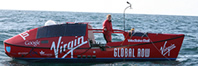
flying carrot.jpg

"For what purpose?" you might ask.

Last January, Oliver Hicks, a Brit, set off solo from Tasmania on his 18,000 mile (29,000 km) journey around the world. If completed (Oliver is now in New Zealand!), this will be a world first and take between 18 and 22 months to complete.

Hicks is hyperconnected via email, Picasa, YouTube, Friend Connect and Blogger, Google Analytics, and Google Moderator, the latter to field questions from the many hundreds of people following his adventure. This is all done through his laptop, two PDA's, and three satellite phones, powered by a wind generator, solar panels and a fuel cell.

Row, row, row your boat...

Friendly FiRe

May 29, 2009 11:46 AM | 0 Comments

Nova Spivack, technologist and cofounder of one the first Internet companies (EarthWeb in 1984), spoke earlier in the month at the Future in Review FiRe conference in San Jose, CA.

He made the following observation: "We're moving from a web that was like a refernce library to a web that's increasingly like radio or TV".

Right on. This reflects a move from the Internet being a bunch of pages you surf to a set of self-describing objects that you 'tune into in terms of interest areas'.

This is the world of the semantic web, and will create opportunities for new semantic web apps, such as Nova's own twine.com, which has been described as your own artificially intelligent personal web assistant.

The semantic web technology has been talked about for several years, but the question is when will it become mainstream.

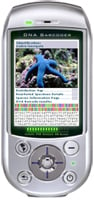
It's not a new cell phone or music player, but a DNA barcoder reader you might be able to actually buy in 10-15 years!

barcorder1.jpg

Why would you want one?

Let's say you are mushroom picking, and want to know whether a particularly delicious looking specimen you have found will kill you. Or you are fishing, and catch a fish that you are unfamiliar with. Or are an amateur botanist and want to identify a flower. Just scan a speck of the mushroom, or fish or flower with the DNA barcoder, which will search a database on the Internet and display the information you need and more!

What you have just done is identified a species by analyzing a short DNA sequence from a uniform locality on the genome. The science of DNA barcoding was pioneered only 6 years ago at the University of Guelph, but has since gone global under the international Barcode of Life (iBOL) project.

Miniaturization and hyperconnectivity will make this an indispensable tool... and toy. I'm told that the technology exists... but first we need an integrated desktop unit!

The applications of this technology are truly endless.

Hyperconnectivity hit home personally when my daughter, a paleomammoligist, called home last summer via a satellite phone from an island in the far north in the region of the North Pole. A storm was raging and she was confined to her tent. Nice to hear her crystal clear voice as if she were down the street!

But the story doesn't end there.

She was leading an expedition that had just found the skull of a 20 million year old fossil that they had found the year before, making her find 65% complete. Extensive research established it as a 'missing link fossil', dubbed puijila darwini, the walking ancestor to seals, sea lions and walruses. Darwin predicted just such an animal when he wrote "A strictly terrestrial animal, by occasionally hunting for food in shallow water, then in streams or lakes, might at last be converted in an animal so thoroughly aquatic as to brace the open ocean."

puijila.jpg

This made world news yesterday (Earth Day), culminating in an article in today's issue of Nature magazine.

But you (and/or your children) may want to get a more layman's explanation, which you can do at the Canadian Museum of Nature website.

A proud dad.

Reblog this post [with Zemanta]

Mobile Signing

April 17, 2009 7:43 AM | 0 Comments

Many hearing-impaired people use email and text messaging to communicate. Some, I'm sure, are using 3G wireless phones equipped with video cameras to communicate via sign language. Great idea, but high cost and battery life are real problems that are a bottleneck to wide adoption.

Until now!

A team of engineers from University of Washington in Seattle and Cornell have just about completed a functional prototype, they dub 'mobile ASL (American Sign Language)'.

I applaud this initiative to extend the value of hyperconnectivity to more people.

Reblog this post [with Zemanta]

Hyperconnectivity for Science

April 12, 2009 12:54 PM | 0 Comments

Hyperconnectivity is brought to you by an explosion in cell phones and in networked sensors for everything.

Eric Paulos of Carnegie Mellon University is proposing to converge these two hyperconnectivity trends by shifting cell phones from being purely personal communications devices to being "networked mobile personal measurement instruments."

For example, many cell phones have GPS positioning capabilities and many are starting to integrate motion detectors (e.g. for Wii-style gaming). Combining these two into a massively distributed, earthquake early warning system may reap huge benefits for science and mankind.

Innovation comes from interdisciplinary thinking such as exemplified by Dr Paulos.

Reblog this post [with Zemanta]

I will be retiring on April 10 after 37 years in Nortel. The decision was actually made pre-filing, but I decided to stay on to participate in one last VoiceCon, my swan song so to speak.

I have spent my career help create networking for a hyperconnected world.

Back in the 70s (what I called my pioneering years), when the world was circuit switched and flat, and when the ARPAnet was running on minicomputers over 4.8Kbps lines (not a typo), I was part of the team mandated to develop a carrier-grade packet switch that could support 56 Kbps trunks. This created the opportunity to interact with some of the networking visionaries of the time: Vint Cerf, Larry Roberts, Louis Pouzin, Derek Barber to name a few. Nortel delivered a switch that could handle 10 packets per second, but test equipment of the day could only measure 1 packet per second! Remember, the IBM PC came in the next decade!

One highlight was writing a technical paper (co-authored by Bell, France Telecom, Telefonica and Telenet) that was accepted by the IEEE Communications Conference and the National Computer Conference a month later. This was the start of IT Convergence.

We have all experienced the enormous technology changes that have occurred over the years. Let me illustrate this in dollars per bit terms. Back in the early 80s, I built an Apple II clone. Memory was a huge chunk of the cost, all 48 Kbytes of it. Last year, I received a 1Gig USB memory stick (a standard give-away these days) for speaking at a Microsoft OCS launch event... in early 80s dollars, this was worth $250,000,000. Wow!

I will now leave it to others to create applications that live in this hyperconnected world, like the web.alive application that I demo'ed at the Nortel booth (nothing like working the booth at a trade show... one last time).

Interestingly, my retirement has entered the social networking space, in the form of a blog by Rich Tehrani who attended a surprise dinner Nortel threw for me at VoiceCon earlier this week. Also attending were several Nortel execs and four leading industry analysts. Rich is my mentor at TMC and always has his camera handy. It was a lovely evening with lots of shared memories and a great send-off.

O yes, dear reader, while the joy of retirement comes from not having any plans, I do plan to continue this blog.

Digital Detoxing

March 19, 2009 10:23 AM | 0 Comments

A recent IDC study sponsored by Nortel found that the percent of respondents willing to send business text messages on vacation varied from 52% in China and 67% in the United Arab Emirates to 11% in Canada and 17% in Japan.

Another survey of city workers in the U.K. by CREDANT Technologies found that 83% plan to take their mobile phone or BlackBerry with them on vacation, while 65% plan to make contact with the office.

This may be just fine for you, but if you feel that you are suffering from cellphonitis, help is at hand.

The Fairmont Hotel and Resorts in the Canadian Rockies has just launched "electronic rehab get-aways" for mobile phone addicts. When you sign up for the weekend package, you hand over your cell phone, BlackBerry or other mobile device. Then sit back and smell the roses (if in season) and take in the great vistas (year round).

Does it have to come to this? Unified Communications should provide you the tools to personalize who reaches you and how and when.

One option is the off switch!

Virus in Orbit

February 24, 2009 10:18 AM | 0 Comments

Hyperconnectivity, as we all know, has a dark side in the form of new security threats. Now a computer virus (specifically the W32.Gammima.AG worm) has gone where no virus has ever gone before.... hitting laptops on the International Space Station.

This is a level 0 gaming virus intended to gather personal information. Is the message that the ISS is a technology game?

Al Warden, who spoke at the Nortel Technical Conference, has a unique perspective on this question. He was the command module pilot for the Apollo 15 moon mission in 1971, and expressed his own concern of the scientific value of the ISS program.

I diverge. The reality is that whether in your enterprise network or in orbit, hyperconnectivity is with us bringing its challenges (including security) and presenting tremendous opportunities for increased personal, team and business productivity.

4B + 1M = Hyperconnectivity

February 16, 2009 8:40 AM | 0 Comments

The number of wireless phones worldwide just crossed the 4 billion mark. Maybe 10% of these are currently connected to the Internet, but this is going to go way up, led by developments from Nortel and others.

How about another milestone?

There are now 1 million industrial robots, with the highest density in Japan with 295 robots for every 10K workers in manufacturing. Roughly, a third of these are in the automotive industry (they may be on paid leave!). The next nearest countries are Singapore, South Korea and Germany, each with between 163-169.

Two radically different forms of connectivity--- one hyperconnected world.

Previous 1 2 3 4 Next

Recent Comments

  • Jeff Martin: Does Sipex have billing solution to provide multi-tenet application. TonyRyb: read more
  • debt reduction: hahaha funny pic read more
  • EyePOD: The Current product being marketed under that name, The EyePOD read more
  • Joshua Parker: Would an internal social network for small businesses fit into read more
  • Bo Gowan: Very cool Tony. I just saw a local story last read more
  • mike: Hey, I like your site. I was wondering if Nortel read more
  • Nortel Non-Advocate: Nortel has some good technology - the most detrimental problem read more
  • It Does really matter: Okay, and now Mr. Twain, are you dead yet? read more
  • Marc N: You can check out http://www.usedcisco.org for more used cisco products read more
  • hawkins44: You should read more because your comments are incorrect. Careful read more