May 2009 Archives

Friendly FiRe

May 29, 2009 11:46 AM | 0 Comments

Nova Spivack, technologist and cofounder of one the first Internet companies (EarthWeb in 1984), spoke earlier in the month at the Future in Review FiRe conference in San Jose, CA.

He made the following observation: "We're moving from a web that was like a refernce library to a web that's increasingly like radio or TV".

Right on. This reflects a move from the Internet being a bunch of pages you surf to a set of self-describing objects that you 'tune into in terms of interest areas'.

This is the world of the semantic web, and will create opportunities for new semantic web apps, such as Nova's own twine.com, which has been described as your own artificially intelligent personal web assistant.

The semantic web technology has been talked about for several years, but the question is when will it become mainstream.

The Consumer Effect

May 27, 2009 7:06 AM | 0 Comments

The "consumer effect' is hitting the enterprise.

This is happening in multiple ways and goes well beyond reaching out to consumer customers through the devices and applications they use, or accepting the iPhone as an enterprise mobility tool..

For example, music players such as iPods (and features of cell phones) are becoming important employee educational and communications tools. Netbooks are becoming business tools squeezing in on laptops. Social networking which had its beginnings in the consumer space are likewise entering the enterprise space, and are increasingly being viewed as part of the UC space. What's interesting is that in many cases, employees want to the use these capabilities for both business and personal use.

Bottom-line: IT needs to understand that the personal and business identities of employees are blurring and that it must accept the inevitability of the consumer effect, and address security and other policy issues associated with it.

Opportunity knocks to lower costs, and increase employee effectiveness.

Reblog this post [with Zemanta]

It's not a new cell phone or music player, but a DNA barcoder reader you might be able to actually buy in 10-15 years!

barcorder1.jpg

Why would you want one?

Let's say you are mushroom picking, and want to know whether a particularly delicious looking specimen you have found will kill you. Or you are fishing, and catch a fish that you are unfamiliar with. Or are an amateur botanist and want to identify a flower. Just scan a speck of the mushroom, or fish or flower with the DNA barcoder, which will search a database on the Internet and display the information you need and more!

What you have just done is identified a species by analyzing a short DNA sequence from a uniform locality on the genome. The science of DNA barcoding was pioneered only 6 years ago at the University of Guelph, but has since gone global under the international Barcode of Life (iBOL) project.

Miniaturization and hyperconnectivity will make this an indispensable tool... and toy. I'm told that the technology exists... but first we need an integrated desktop unit!

The applications of this technology are truly endless.

A while back, I commented on Cisco's Nexus announcement, challenging its capacity and reliability claims.

Well Nortel has responded to Cisco with its own solution: the Virtual Services Platform 9000.

Unlike the Nexus, it supports a reliability scheme that is not restricted to 10 GigE links; Nortel's approach is based on Multi Link Trunking technology that is a key differentiator of Nortel's entire Ethernet solutions. The VSP 9000's virtualization capabilities are second to none- Zeus Kerravala of the Yankee Group says. "this switch is way ahead of its time in handling virtual environments.' And it supports VRF-Lite supporting multiple routing domains on a single VSP 9000, without MPLS complexity. Nortel claims it has designed VSP to scale to 100 Tbit/s in a quad switch cluster config.

The technology is great. But why did Nortel announce this a full year ahead of GA?

I can see three possible objectives:
1) Hold onto existing data center customers and get some trials going
2) Continue to demonstrate technology innovation to increase the value of Nortel's enterprise business
3) Provide some lead time to develop data-center-skilled go-to-market partners.

No mean task, but John McHugh, who lead Norte'ls data business, is bullish about the business.

Siemens Enterprise Networking (SEN) admits it's thinking about acquiring Nortel's Enterprise business.

No surprise, as the rumors to this effect have been rampant.

Three things make this an interesting option.

Firstly, Nortel and SEN very much have complementary installed bases, with Nortel particularly strong in North America. Consolidation would result in a stronger, more viable, player.

Secondly, combining SEN's Enterasys data unit with that of Nortel would finally result in a clear #2 to Cisco in the switching space.

Thirdly, both companies have a technology strategy targeting communications as an application.

But SEN is not the only one seeing the value of Nortel Enterprise: its customer base, and its UC, applications and data technologies. Avaya has been mentioned, as have private equity firms.

Let's watch as this story unfolds.

Reblog this post [with Zemanta]

IEEE at 125

May 15, 2009 7:07 AM | 0 Comments

The IEEE, of which yours truly is a Senior Member, is celebrating 125 years of success.

In the networking space, the development of the IEEE802.3 Ethernet standard in 1983 has certainly been a key milestone for this worldwide professional organization.

Starting at a lowly 1.25Mbit/s, Ethernet has evolved to 10 Gbit/s in its wired mode and over 100Mbit/s in its wireless incarnation.

I would highlight three attributes of Ethernet:
1) It is a truly global INTEROPERABLE standard. We experience this plug-n-play interoperability everyday, wherever we are on the planet. This is an outstanding example of what all standards need to strive for.
2) But it's not only about networking. The IEEE 802.3af Power over Ethernet standard has created a universal power plug- who hasn't experienced the pain of having to carry a bag of AC adaptors to be able to plug in their AC powered devices.
3) 1522- this is the maximum Ethernet frame size in bytes that is hardwired into the standard. This is arguably the biggest constraint of the Ethernet standard. So far, the industry has lived with it, though some proprietary implementations have supported jumbo frames.

In spite of #3, Ethernet has proved to be highly extensible and now has become the global physical device and backbone interface for wired and wireless, in-building and wide area, and voice and data environments.

Congrats to the IEEE and to the engineers who have dedicated their lives to Ethernet success.

Reblog this post [with Zemanta]

Telepresence Can Disconnect

May 13, 2009 7:30 AM | 0 Comments

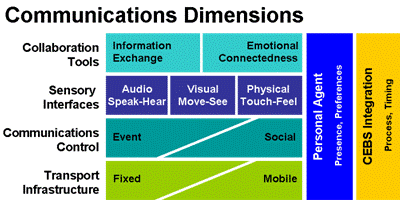
Phil Edholm has been writing an extended blog about his concept of Communications Dimensions.

In his recent posting, Phil Edholm wrote that "telepresence systems have four distinct disadvantages; the cost of the base system, the cost of bandwidth and operation, the challenges to interoperability among vendors, and eye contact."

The first three are well understood, which is why telepresence solutions have become the executive jets of the board room.

But the last point exposed for me a key current limitation of these systems- even though they use HD full size video, the lack of eye contact creates a large barrier to effective interpersonal communications. In fact, my experience has been that a sense of lack of connectedness and aloofness is created when a remote speaker is talking to you with his eyes looking somewhere else.

This is clearly an opportunity for eye ball processing technology research.

But then, you don't want the system to automatically adjust a speaker's eyes when he's lying through his teeth by NOT looking you in the eye!

Reblog this post [with Zemanta]
Nortel just published its 1Q09 results, and, in my mind, held its own in the highly competitive enterprise market. Why do I say this given that its enterprise revenues dropped some 40%? Consider: 1. Cisco revenues went down 20% in the quarter, so that's the new benchmark in these hard economic times. 2. New customers are generally not going to go with Nortel given it's in creditor protection, though there are some noted exceptions such as the M Resort, Las Vegas' latest resort. Applying the 80/20 rule, there goes 20% right there. 3. Existing Nortel customers are investing in Nortel; though, like Cisco and Avaya customers, are slowing down major new initiatives. Meanwhile, product innovation continues: it just launched its new Ethernet Routing Switch 5600 and Release 6 of its flagship CS 1000 IP/hybrid PBX, and its recently announced BCM 450 reached 1,000 units sold in February ( the fastest-selling Nortel product ever). In fact, Nortel has once again gained recognition by Frost & Sullivan as Enterprise Telephony Vendor of the Year in the 2009. But time is running out. Nortel needs to finalize its over-due business plans so that enterprise customers can confidently invest in Nortel solutions going forward.
Reblog this post [with Zemanta]

The PUE Factor

May 8, 2009 4:53 PM | 0 Comments

If you are in the data center business, get to know PUE: Power Usage Efficiency. PUE is a measure of how much additional electrical power is needed for cooling to deliver computing power. A PUE of 1 means all power being used for computing and none for cooling.

A 2007 US EPA survey put the PUE for your average data center at 2.

On the other hand, Google claims a PUE of less than 1.21 for six large scale Google-designed data centers.

Now vendors are responding to the need with self-contained low PUE computing systems packaged in shipping-style containers. SUN was first with their MD S20 with 280 pizza servers in one container, while the Verari Systems solution has 1400 blade servers.

Very large low PUE data centers such as required by Google, Microsoft and Yahoo! can be built by deploying warehouses with potentially hundreds or even thousands of these containers. In fact, that's happening today.

I wrote awhile back that there were three problems with Energywise:
1) It is a security breach waiting to happen.
2) Apps should run on IP networks not be slave to them.
3) Painting Cisco switches with EnergyWise paint doesn't make them any more energy efficient. The Cisco Energy Tax lives on.

Now, Mike Fratto talks to a fourth major problem, when he says
"Cisco's EnergyWise, which proposes building-wide energy management, should have gone to the International Telecommunication Union three years ago."

So buyer beware.

Mike continues on a differnet front:
"Take network access control. Cisco has all but abandoned its NAC framework and partner program. Microsoft threw some of its Network Access Protection specifications to the Trusted Computing Group, but Cisco consistently has refused to even acknowledge the TCG's legitimacy. So much for interoperability."

Need I say more?

Reblog this post [with Zemanta]

Communications Dimensions

May 1, 2009 12:10 PM | 0 Comments

Phil Edholm, the enterprise CTO at Nortel, has an uncanny capability of synthesizing complex issues.

Across multiple blog postings, he talks to a simple graphic of what he calls Communications Dimensions.

Edholm's Comms Dimensions.gif

I like the way he breaks out event and social driven interactions. I see these very much as two sides to the unified communications coin.

IBM has embraced this view with their Unified Communications and Collaboration (UCC) strategy, as has Nortel who have led the way in leveraging virtual reality for business with their web.alive solutions.

Recent Comments

  • Joshua Parker: Would an internal social network for small businesses fit into read more
  • Bo Gowan: Very cool Tony. I just saw a local story last read more
  • mike: Hey, I like your site. I was wondering if Nortel read more
  • Nortel Non-Advocate: Nortel has some good technology - the most detrimental problem read more
  • It Does really matter: Okay, and now Mr. Twain, are you dead yet? read more
  • Marc N: You can check out http://www.usedcisco.org for more used cisco products read more
  • hawkins44: You should read more because your comments are incorrect. Careful read more
  • Mike: Nortel has fallen to #3, behind Cisco and HP. Check read more
  • Tony Rybczynski: David Greenfield seems to echo my sentiment http://blogs.zdnet.com/Greenfield/?p=241 read more
  • GJA networks: Why are the Nortel current SNA products being compared to read more

Around TMCnet Blogs

  • Communications and Technology Blog - Tehrani.com:
    Happy Thanksgiving 2009
  • On Rad's Radar?:
    Open Neutral Fair
  • VoIP & Gadgets Blog:
    Nokia N900 Maemo 5 Bakes in Skype
  • Communications and Technology Blog - Tehrani.com:
    Interop New York 2009 Videos
  • First Coffee:
    Helpstream and CRM, Scalable Video Coding, Gemalto, Samsung Mobile
  • On Rad's Radar?:
    Mainly Cellular News Tidbits
  • The Readerboard:
    Want To Make Money? Shape Up Your Voice Self-Service
  • VoIP & Gadgets Blog:
    iLive ISP209B Portable Speaker System Review - Alarm Clock
  • Latest Whitepapers

    TMCnet Videos