Recently in Mobility Category

Last December, I blogged on the fact that I had unplugged my desktop phone (replacing it with a LG-Nortel USB phone 8501), though I observed that this wasn't for everyone!

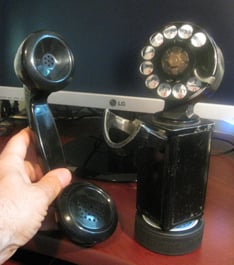
Well I attended the Nortel Technical Conference, and in fact hosted the final day, and won a new desktop phone- sort of.

Bluetooth retro handset.jpg

Actually, the handset is a Bluetooth device married to my cell phone. Look carefully- no flexicord of olde.

What could have been my grandfather's rotary dial phone is my improvisation for a handset cradle- some place to put my new handset. Fits perfectly!

Visitors get a puzzled look when I answer a call (with my cell on vibrate) using this handset.

No geekier, IMHO, than people who wear cyber ear buds and walk down the street talking into the air;)

A recent Goldman Sachs survey of IT executives found that "17% expect to support iPhone 3G in the next year".

How should we interpret this result?

It says that iPhone will join RIM and Windows Mobile for the hearts and wallets of enterprise users. If the latest iPhone meets IT security and management requirements, it surely will.

But there's another message. It has been observed that iPhones generate 20x the traffic of traditional smart phones. Why? Because the iPhone's user interfaces makes it so simple for users.

The corollary is that the simplicity of the iPhone epitomizes the path to what we call the "True" broadband experience, providing seamless low latency access to any business application.

That bodes well for mobile UC, and for 4G wireless whether in the form of LTE or WiMax.

You might have seen the news that Nortel was shifting more 4G wireless R&D into something called LTE- Long Term Evolution.

Up until recently, enterprises saw Nortel as championing WiMax as a "true broadband" solution for enterprise, with key technologies such as MIMO and OFDM coming from Nortel. WiMax really resonated with these customers:
- It has the right name which spells Internet economics
- It has the right name which spells IP-optimized application performance;
- It operates in both licensed and unlicensed bands;
- It was being integrated into handhelds, thanks to the likes of Intel;
- It was going to be offered soon by wireless service providers like Sprint and possibly by cablecos and new operators; and
- It brings more competition to the wireless marketplace.
Nortel is still championing WiMax as a here-and-now opportunity and has partnered with Alvarion to strengthen its position.

So what about LTE?
- It has a dismal name (a name that would embarrass any marketer)
- It is another 4G technologies that will deliver IP-optimized application performance, and can be even faster than WiMax;
- It is based on MIMO and OFDM technologies that were largely invented by Nortel;
- It operates only in the licensed band;
- It will also be integrated into handhelds; and
- It is in the plans of most major incumbent wireless service provider.

Basically, while WiMax is starting to be offered today by some service providers today, expect to see LTE as an offering from an incumbent wireless service provider near you (towards the end of the decade after the standards are finalized).

Both WiMax and LTE are 4G technologies that will deliver the "true broadband" mobile experience to enterprise users (and consumers).

Together with 802.11n, the 100+Mbps WiFi draft standard, these 4G wireless solutions will deliver on Nortel's Unwired Enterprise vision.

Cisco Motion Sickness

| 1 Comment

Sorry for the word choice, but Cisco Motion vision marketing can make you dizzy;)

The marketing folks at Cisco have been busy creating a mobility vision, in response to real enterprise challenges of Hyperconnectivity. The formula is all too familiar. Identify all the right user challenges... Spin a vision story around a not-so-exciting product announcement.... Usually add a five phase picture (magically you're already at phase 3!) and .... Create industry buzz around the works.

But Cisco's recent Motion vision announcement (and related 'phase 0' product announcement of a glorified location-based WiFi controller) raises more questions than it answers.

For example:
Why would enterprises want to invest in a network-centric approach at the expense of application agility?
What if you want to deploy best-of-breed wireless intrusion prevention from another vendor?
Will you be constrained in your RFID or UWB vendor selection under Motion?
How does a WiFi-centric appliance 'unify disparate networks' and 'facilitate collaboration'?

But the biggest question in my mind is that Motion is an architectural no-man's land (or is it sea?).

Cisco says that their vision 'abstracts the application layer from the network layer'. This sounds like SOA but it's not! SOA is software centric and network agnostic. Application developers don't want to know about appliances.

Cisco has introduced a network embedded appliance that is specific to the in-building wireless- actually to the WiFi- network. This sounds like SONA, but it's not- maybe Cisco is giving up on SONA, which has had minimal traction anyway!).

Application developers tell us they want a SOA-enabled framework into which to work, that is totally independent of the underlying infrastructure, whether wired or wireless, enterprise or carrier. For example, does it make any sense to bring public network location-based information into the enterprise via a WiFi appliance? Among other things, this seems to create a bottleneck for application innovation and scalability.

There are already solutions that offer context/location aware services, roaming and FMC, end point security and wireless IPS. A key differentiator in our approach to Communications Enabled Applications, is the Nortel Agile Communication Environment (ACE).

Nortel ACE truly abstracts the application layer from the network layer; supports aggregated presence, and in-building and wide area context (location, policy, identity) services; has adaptors to various network infrastructures (including Nortel and Cisco Call Manager), and is built on SOA (in fact, integrating IBM's Websphere today and other frameworks in the near future).

Are you starting to feel a little queasy about Cisco's Motion vision marketing?

What if your cell could have two numbers: one for your business use (in fact, the same as your office number), and one for your personal use? Whenever you made a business call, the called party would see your business number or name. Whenever you are on your cell, presence would show you ‘on the phone’. If you had a smart phone with a UC client, the experience would be even richer. And you could save up to 30% on your cell charges by using fewer cell minutes, bypassing roaming charges and leveraging WiFi, if you had a real dual-mode phone with cell and WiFi capabilities. Does this sound to good too be true? Check this out.

Some of the tricks of the trade?

The PBX maintains control of the mobile device, hence the ability to assign a business number to a cell phone.

When a mobile user receives an incoming call notification, the user can chose to accept the call on his/her mobile device, or re-direct the call to any number shown on the pop-up menu.

When initiating a call from the mobile phone, the user can chose to have the communications server call them first at any specified number.

When in WiFi coverage, the user can select to use VoIP bypassing the cell network altogether.

These type of UC mobility solutions deliver more efficient and affordable mobile communications that are simpler to use and manage.

Microsoft recently showed off a touch-screen technology (using MacOS!) for mobile devices. To solve the problem of using your finger to point to what you want on a small screen, they teamed up with Mitsubishi Electric Research Labs to develop Lucid Touch, a transparent touch sensitive screen that allows the user to see what he/she is doing by pointing from behind.

Is this neat or what?! But will it fly?

Transparent%20touchscreen.jpg

Experts tell us that the tablet PC was also a friendlier human interface, but this wasn’t enough to make it anything more than a niche solution today.

What is clear is that mobility and small screens go hand in hand.

So is the solution in something like Lucid Touch, or iPhone-style interfaces, or voice recognition or eyeball tracking?

According to a new survey of 900 SMB and enterprise decision-makers in the US, France and the UK, Converged Mobility (also called Fixed Mobile Convergence or FMC) is the new service SMBs are most likely to consider from a service provider. Converged mobility is the ability to make phone calls over WiFi and cellular networks via a dual-mode phone.

There are a couple of important reasons why SMBs and enterprises are interested in Converged Mobility. One is that employees of big and small companies are increasingly mobile and want a true broadband experience for voice and data wherever they are. The other is that people who pay the bills in these organizations need to manage their costs better and gain control over their mobile environments. It’s staggering- the average enterprise spends 4x more every year on mobility services than on depreciation expenses for networking gear (routers, switches PBXs and the such).

So hopefully, service providers can meet these expectations in their Converged Mobility offers. If not, there are always solutions from suppliers such as Nortel that don’t rely on service provider services.

Are Cell Phones a Racket?

| 1 Comment

I presented at the New York City Technology Forum and sat in on Dave Pogue’s keynote. Dave is the New York Times Personal-Technology Columnist and prolific author. He obviously has a flair for acting, dramatizing his technology insights, including ‘cell phones are a racket. You have to bet on how many minutes you are going to use, and if you guess too low you are … and if you guess too high, you are ….”.

My data tells me that enterprises around the world give service providers about $500M every year in exchange for bandwidth and connectivity services- well over 35% of this goes for cell services! While there is a lot of value in mobility, enterprises are looking at ways to reduce and at least better manage these recurring costs.

What you don’t know, you can’t manage.

Do you know how much your company is spending on cell charges? If the answer is no, then you better get a handle on this significant expense and, in any case, look at ways to reduce it.

IT-101 tells you that managing your service providers is a good place to start. Technology can help on two fronts: reducing local and LD minutes, and reducing out-of-plan roaming charges. Extending PBX features to your cell allows you to carry your calls over your internal network, thus avoiding toll charges. Any way to leverage the Internet (at home, at hotels, and hotspots) can also be the path for lowering your cell charges. This includes using your laptop or leveraging dual mode devices.

In either case, the end user is king. You have to incent him/her to change their behavior by delivering benefits that outweigh the pain.

Yearly Archives

'07 '08
  Jan
  Feb
  Mar
  Apr
  May
  Jun
  Jul
  Aug
Sep  
Oct  
Nov  
Dec  

Around TMCnet Blogs

Latest Whitepapers