Recently in Speech Technologies Category

ITEXPO Keynoters Announced

November 5, 2009 5:44 PM | 0 Comments

We are thrilled to announce a slew of top notch keynoters for the upcoming ITEXPO which takes place in Miami, FL Jan 20-22, 2010. I will share them with you by first explaining why they were invited:

A keynote picture from ITEXPO East 2009 in Miami

itexpo-east-2009-keynote.jpg


Open Source

One of the biggest trends in tech this last decade has been open source and while you may not know this, I was a UNIX (the Linux precursor) system admin at TMC back in 1982 or so and I am a big fan of this OS which is reliable, stable and the strong basis for cost-effective solutions in a number of fields. Without a doubt, Asterisk is the major force in the open-source communications space and as such, Digium's CEO Danny Windham (the company behind Asterisk) was the perfect choice to address the audience of businesses, carriers and resellers. By the way, Digium Asterisk World (DAW) is collocated at this show and I hear it just sold out of exhibit spaces and my team is looking for ways to get the waiting list
of companies into an expanded DAW pavilion on the exhibit hall floor.

Digium Asterisk World Photos from ITEXPO East 2009 this year

itexpo-east-2009-digium-asterisk-world.jpg


Google Voice vs. AT&T

Google Voice has been one of the most disruptive influences in telecom these past years and this service has single-handedly become a point of public argument between the search leader and Apple and AT&T - with the FCC acting as referee of sorts. The argument revolves around net neutrality - the concept that carriers will apply discrimination to traffic on their networks based upon traffic, application type or source. Google obviously wants their services to run on any network in an unencumbered fashion while AT&T has said since 1995 when they were SBC that they want to charge for their pipes. AT&T actually then pointed out to the FCC that Google Voice does not terminate all calls on its free Google Voice service meaning it is not adhering to the principles of net neutrality. The reason of course as Google points out is traffic pumping and bizarre intercarrier compensation rules which allow some rural carriers to charge exorbitant rates for calls terminating in their areas. Craig Walker founded Grand Central, the company purchased by Google and the basis for Google Voice and as the Group Product Manager for the Real Time Communications Group at Google, he was a natural person to invite to speak with us at the show. It seems his accomplishments have unleashed a firestorm of controversy which should hopefully clean up some of the ugly mess that is telecom policy and regulation.

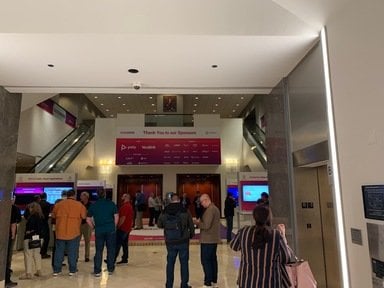
Exhibit hall pictures from ITEXPO East 2009 in Miami

itexpo-east-2009-exhibit-hall.jpg itexpo-east-2009-exhibit-hall-aisle.jpg


HD Voice/SIP and Video

Another major trend in our markets is that of HD voice, video adoption and of course SIP endpoints. AT ITEXPO last year, we had the first panel in the world focusing on HD voice (video) and since then I am excited to see other conference organizers throwing their hat in the HD ring. A major player in all of the above spaces is Polycom and they have done an amazing job of working with disparate vendors on interoperability issues which has moved the market forward by reducing the friction caused by proprietary endpoints. In the world of video, the company has been a major player - developing telepresence systems all the way down to video phones. To get a bead on where this market is heading we invited Polycom Co-Founder, and the CTO of the Voice Communications Group Jeff Rodman to join us as a keynoter.

HD Voice Panel I moderated from ITEXPO East 2009 in Miami


Skype

No matter how you break out the IP communications market, Skype is likely a factor in changing the market in a pro-consumer manner. By giving away global voice calling with quality which far exceeds the PSTN, they have disrupted while getting users used to better voice quality. On top of that, they give away video calling as well, making them a company which excites consumers and scares carriers and anyone else who dares compete with their network of hundreds of millions of subscribers.

Interview I had with Skype's Ian Robin


Skype has been making a major push into the enterprise and is working on enhancing relationships with carriers as well. They are even looking for channel partners who can share in the newly created revenue streams from a number of products like Skye for SIP. When you take all of this into account, it does make great sense to invite Skype Chief Strategy Officer Christopher Dean to speak, doesn't it?

Smartphones, Wireless and Smart Ecosystems

One of the biggest trends in the world of communications is smart devices and ecosystems. What is an ecosystem you ask? Well it is a group of companies who develop products which work with a product or service offered by a host company or companies. The iTunes App Store may be the best example but certainly Avaya's DevConnect or Cisco's Partner Programs are good examples as well. You may know that TMC has focused a tremendous amount of resources on educating the world on smart ecosystems via our new SPEC site. I truly believe ecosystems have a bright future.

In order to bring attendees up to speed on all these topics we invited two top keynoters to present on the matter. Sprint's Mathew Oommen is the vice president of device and technology development at the company and uniquely positioned to share with us his company's view on the future of wireless technology. Oh and by the way, be sure to check out my recent interview with Sprint's Wayne Ward who heads up the company's M2M activities (did I mention there is a collocated M2M conference at ITEXPO?).

To get a handle on wireless devices as they pertain to ecosystems we invited Brian Higgins the Executive Director for Ecosystem Development within Verizon Wireless to join us so we can learn where the company thinks the market is headed. Verizon has been very ambitious in its goal to develop an ecosystem of products and applications which interoperate in the hope of one-upping the iTunes App Store.

We continue to work to add fantastic new speakers to our roster and you can expect this ITEXPO to be the most comprehensive and educational ever and a must-attend. I personally hope to see you there.

Oh and by the way, we have secured great rates this year at the Loews Miami Beach Hotel - you can save $150/night if you book now - the rate is $249 vs. what is typically a $399 rate at prime season. There are many advantages to staying at the show hotel such as networking, etc - and I have always been a fan of the Loews. In fact I was a guest the first day the hotel opened about ten years ago or so.

Adtran Acquires Objectworld

November 2, 2009 11:40 PM | 0 Comments

I got a tip that Adtran was acquiring Objectworld. My take? Objectworld is a company with great UC technology and no brand recognition. Adtran is a company with a product line similar to Cisco but much smaller. Still, with a market cap of over $1.4 billion, Objectworld can really get a boost from Adtran's access to capital, infrastructure, reseller network, carrier relationships  and improved branding.

Here is a link to a cached page mentioning the acquisition. Keep it tuned to TMCnet and my blog for more.

Just a kid, that's all I was in the early eighties in high school as I took a class in BASIC. I was always fascinated by all things electronic and whether it was video games or advanced scientific calculators, I couldn't get enough. At Westhill high School, they had a Prime minicomputer and it was on this machine where I was instructed how to program. I also had a Commodore 64 at home and with it I wrote my own video games at night and on weekends.

In the early eighties, Route. 128 in Boston was the stuff of legend... It is where all the minicomputer companies lived - Wang, Prime Computer, DEC and many others. Prime was my link to this area and it seems like it was yesterday when I wrote a math quiz program on the schools's minicomputer which I used to better prepare me for the math portion of the SAT. Today, Rt. 128 is a distant second to Silicon Valley in terms of technology and of course all the minicomputer companies missed the PC altogether and are gone.

If you are wondering why Silicon Valley took the lead over Boston, you may want to refer to this article from Vivek Wadhwa which discusses how the Valley follows a more open model where innovation is more readily shared with small companies and moreover spread through job hopping. In addition, he points out a book from AnnaLee Saxenian (which was published in 1994 predicting that Boston would be the loser in the tech race

Here is an excerpt from the article:

She noted that Silicon Valley had an amazing dynamism about it. There were extensive professional networks, job hopping was the norm, information was exchanged openly, and the culture encouraged risk taking. The Silicon Valley ecosystem supported entrepreneurial experimentation and collective learning. In other words, Silicon Valley was a very open network--a giant social networking site working in analog before the concept of such a thing even existed.

This organizational mechanism was in sharp contrast to that of Route 128. Dominated by large, vertically integrated, and secretive minicomputer producers such as DEC, Wang, Prime, and Data General. Technology, skill, and know-how were trapped within the boundaries of the large corporations.

The differences were evident at many levels: venture capitalists in Silicon Valley had deep roots in local networks and were far more nimble than their east coast counterparts; educational institutions and research labs in the West partnered with local startups as well as more established firms, while those in the East worked only with the largest corporations; and the meritocratic openness of Silicon Valley made it a magnet for non-traditional talent and immigrants.

By the mid-1990s the east had missed the shift from minicomputers to personal computers as the flexible Silicon Valley ecosystem sped ahead with innovation across a diversifying range of components and systems going from chips, routers, and application software to ecommerce and search engines. Today Silicon Valley is the leading location for cleantech venture activity, an area widely considered to be the next big value creation engine for the U.S. and the world.

Boston, however, is no slouch. The Route 128 community remains the second biggest in the U.S. in terms of venture funds committed. Boston has powerful research institutions, still, and lots of very strong companies. In some areas, such as biotech, Boston may even rival Silicon Valley. But overall, its pretty clear that the Valley has not only won but is racing further ahead.

Most entrepreneurs and engineers that come to Silicon Valley, come to experience this network and to embrace the culture it has created. That's why I came, too. Network effects don't just work for fax machines. But then again, most of them knew that intrinsically. University guys like me need to do a bunch of surveys to figure it out. They voted with their hearts and feet.

At this point the game is even tougher to win if you aren't in Silicon Valley due to the propensity for exit strategies to present themselves more readily where the acquirers are. Yahoo, Google, Cisco and Oracle are just a few of the companies responsible for billions of dollars worth of M&A dollars. And as this these companies have grown, they  have made so many millionaires that they in turn go out and launch new companies and/or invest in others which are nearby.

If you are looking for a lesson here it is that a company which mirrors Silicon Valley and is more open, flexible and shares information more readily will likely always beat the company which is inflexible and contains many silos.

Blackberry Storm 2 Analyzed

October 28, 2009 2:44 PM | 0 Comments

I spent some time analyzing a Blackberry Storm 2 in a Verizon store in Norwalk, CT where I chatted with prospective customers as well as Verizon store employees and management. First the phone itself is improved with WiFi support, a capacitive touchscreen and worldphone support. I think typing on the device is about as good as it is on the iPhone at this point. Although a common feature of smartphones I really like the ability to go back to my last application. As you would expect the device is fine for applications like email where it does a good job of understanding what is typed and autocorrecting text, it still comes up short as a web browser.

Although faster than the previous device, the delay in browsing graphically rich sites and those with JavaScript continue to be its undoing (yes, JavaScript rendering is now faster -- thankfully) and it is evident that the mobile browser is the major Achilles heel for device manufacturers. They should all partner with companies like Opera until they figure out how to do mobile browsing correctly.

Prospective customers I spoke with were not extremely impressed by the device and most I spoke with were in the store to compare the phone with - you guessed it, the iPhone.

By the way, reasons given to me to not buy the iPhone include the AT&T network and the fact that applications like Loopt (the iPhone needs to allow background apps for it to function properly) and Blackberry Messenger don't work on it.

Store employees were eager to volunteer that Droid is coming out in a few weeks and is worth a look. They also mentioned that there was interest in the latest RIM phones and many are selling but unlike the rollout of the first version of this device, they aren't seeing the long lines. Then again, it was a cold and rainy day which could have been part of the problem as nearby Stew Leonard's, that world famous supermarket had half the normal amount of cars in its parking lot.

My take? People have already purchased their iPhones and other smartphones and if they weren't out in force today to see their Storm 2, they aren't coming out in force to see the Droid. Besides I haven't seen much if any consumer promotion for this gadget - could this be a sign of Verizon giving up and hoping for better results from the new Google Powered Motorola phone? If the Droid is the iPhone killer Verizon store representatives say it is, the death will be very slow as word of mouth and advertising get more people to trade up. Time will tell.

Google Maps Navigation Analysis

October 28, 2009 11:05 AM | 3 Comments

As Om Malik points out, turn-by-turn GPS navigation with voice guidance has come to Google Maps and carriers can't be happy about it. Who is even less happy? TomTom and Garmin. According to Google, less than 1% of navigation devices are connected to the cloud and ironically my TomTom Go 740 Live with Google local integration is one of these devices and it is limited - it really only allows you to query Google for local establishments and it does receive real-time traffic data.


As the video above explains, Google Maps navigation was built from the ground up to be internet connected meaning you can get the latest maps and business data automatically over the net without having to download new maps manually. Google touts lots of features which they say most GPS units don't have such as voice recognition, the ability fix spelling errors and of course infinite points of interest. Other benefits touted include the ability to navigate via search meaning you can ask your device to navigate to a museum with a specific exhibit.

google-tricycle.jpg

Other benefits include real-time traffic data and the ability to choose alternate routes. The software also allows you to search for POIs on your route and you can also leverage satellite and street view as you navigate. By the way, I bet you didn't know some Google Street View data comes from a tricycle (pictured and courtesy of AP/MSNBC)

The video above also references the new Droid phone which has an available car dock which when connected goes into car mode which makes it easier to access features you need while driving.

Om is right that carriers are likely not happy about this new and free service from Google but I wonder if at the moment carriers aren't just more frenzied about not having the iPhone which includes tens of thousands of applications in its device ecosystem.

From Verizon's point of view, this new relationship with Google is a defensive land grab and will slow down the onslaught of the iPhone by making their devices more attractive and simultaneously cutting the legs off of Garmin and TomTom. It should be noted that TomTom does have a $99 iPhone GPS app which is pretty slick but can they keep this price point when the competition has a lot more features and is free?

Google's challenge remains, do they ignore the iPhone when they come out with leading edge applications like this one so they can artificially boost their Android OS sales or do they try to get all apps they produce to work on as many devices as possible so they can boost ad revenue? It has to be a constant debate for the search leader and for now, if you have an Android 2.0 device you can get a real nifty GPS app for free. What's not to like about that?

Oh, and one other point. If we have known mobile search is coming and will be he and Microsoft and Yahoo! are trying to take on Google in this space and finally have an opportunity to become a leader in at least one niche of search, why haven't either of these companies jumped on this opportunity? Why is it that Google is the only company to take advantage of an opportunity we all saw coming. I realize Yahoo is trying and so is Microsoft but Google seems to be in a position to have even greater marketshare in mobile search than they do in PC search. And it seems unacceptable that the competition just let them take it so easily.

I really excited to speak at the Illinois Institute of Technology Rice Campus for the VoIP Conference and Expo 2009. This will be my first time to this event and interestingly the third time in recent weeks in which I am in Chicago instead of Vegas for a show. Maybe the city didn't get the Olympics but they certainly seem to have gotten all the shows - WiMAX World, Supercomm and now this event.

Getting back to my talk - I am moderating a Keynote Panel titled: Are the "Bells" ringing for Carrier VoIP? And my panelists include Carl Ford, Crossfire Media; Anne Lee, ALU; Gaston Ormazabal, Verizon and Henning Schulzrinne, Columbia University at 4:00 pm this Thursday 10/29/2009. I hope to see you there. Here is the schedule with my panel in yellow at the bottom.

Here is the website for details.


Day 1 Wednesday October 28
 
Room 163
Room 166 
Room 103
7:30 to 8:30 AM               Registration - Breakfast  - Exhibit Booths
8:30 to 8:50
Conference Greetings: Carol Davids, IIT: Bridging the Islands of VoIP
Room 166
9:00 to 10:30 AM  Over the Top  VoIP
Co-chairs:  Warren Bent, Maureen Stillman
E911 VoIP Emergency Services Miniconference
Co-Chairs:  Chuck Hunnicutt, Barbara Kemp
VoIP in the Enterprise
Co-chairs: Maureen Stillman, Anup Manchanda
  9:00 to 9:45 AM
Cloud Telephony
Irv Shapiro, IfByPhone
9:00 to 9:30AM
Bridging the Islands for Emergency Service
Jeff Robertson,  Principal, Robertson and Associates

9:00 - 9:30 AM
Unifying Communications: A 360-Degree Approach
Speaker:Matt McGillen, Microsoft
  9:45 to 10:30 AM
The Rise of Telecom Development Frameworks
Greg Bond and Eric Cheung, AT&T
9:30 to 10:00 AM
The i3 specifications - Blueprint for Bridging
Brian Rosen, NENA
9:30 to 10:00 AM 
Implementing Unified Communications Solutions
Huzefa Mustaly, Tellabs
 
10:00 to 10:30 AM
Title: NG911 Interoperability Testing
Bill Mertka, RedSky
10:00 to 10:30 AM
SIP Trunking - Ready for Prime Time
Joel Maloff, BandTel
10:30 to 11:00 AM  Break / Exhibitor booths
11:00 to 12:30 PM
Over-the-Top Applications - VoIP2.0
Co-chairs:  Warren Bent, Maureen Stillman
E911 VoIP Emergency Services Miniconference
Co-Chairs:  Chuck Hunnicutt, Barbara Kemp
VoIP in the Enterprise
Co-chairs: Maureen Stillman, Anup Manchanda
 
11:00 to 11:30 AM
Emerging 2.0 Communications
Jose De Francisco Lopez, Alcatel-Lucent
11:00 to 11:30AM
Telematics
John Kimmins, Telcordia
11:00 to 11:30 AM 
The NEC Unified Communications Solution
Greg Nemec, NEC
 
11:30 to12:00 AM
Deploying VoIP over Wimax
Peisong Huang, Motorola
11:30 to 12:00 AM
i3 - The US DOT Trial
Chris Norton, TAMU
11:30 to 12:00 PM
SIP Trunking Service Interoperability Update
Bob Blair-Smith, Cbeyond
 
12:00 to12:30 PM
Title: TBA
Brian West, FreeSWITCH

12:00 to 12:30 PM
i3 - Demonstrations
Chris Norton, TAMU
12:00 to 12:30 PM
Avaya Technical Roadmap
Jane Montemayor, Avaya
12:30 - 1:30 PM   Lunch         
1:30 to 2:15PM
Henning Schulzrinne, Columbia University
Scaling up VoIP  - Congestion Control for SIP
Room 166
2:15 to 3:00PM
Jim Argiropoulos: NG911 and the Chicago PSAP
First Deputy, Chicago Office of Emergency Management and Communications
Room 166
3:00 to 3:30 PM Break / Exhibitor Booths  and  City of Chicago's OEMC Unified Command Vehicles - 911 Satellite Trucks
3:30 to 5:00 PM
VoIP Challenges
Chair:  Carol Davids
E911 VoIP Emergency Services Miniconference
Co-Chairs:  Chuck Hunnicutt, Barbara Kemp
Bridging SIP communities
Co-chairs: Warren Bent, Carol Davids
 
3:30 to 4:00 PM 
Keeping SIP Adaptable:
Specifications for the Digital Age
Ken Krechmer, SIIT09 
3:30 to 4:00 PM
Location Devices and the LoST Server
Mark Grady, InDigital
3:30 to 4:00 PM  
Inter-Carrier Wideband Communications
John Butz, Neutral Tandem
 
4:00 to 4:30 PM 
VoIP: Voice Only Instigates Problems
Steven Fair, Phybridge
4:00 to 4:30 PM
The Story of the Jackson County, IL PSAPS
Pat Lustig, Jackson County
Ken Smith, Williamson County 9-1-1 Coordinator 
4:00 to 4:30 PM
Building SIP Communities with IMS
Brett Brock, Cox Communications
 
4:30to 5:00 PM 
SIP Flooding Detection
Jin Tang, PhD Candidate, IIT
4:30 to 5:00 PM
Designing and Building the City of Chicago's Unified Command System
David Beering, Morgan Franklin
4:30 to 5:00 PM
Voice Services through HD Networks
Rich Poole , Dialogic
5:00 to 6:00 PM 
Happy Hour
Beer, Wine, Hors D'ouevres
Day 2 Thursday October 29
 
Room 163 
Room 166 
Room 103
8:00 to 8:30 AM           Breakfast and Exhibitors Booths
 8:30 to 10:00 AM
Architectures, Operations and Test
Co-Chairs: Dave Staub, Maureen Stillman
VoIP and NGN Networks Mini-conference
Chair:  Suresh Borkar
N11 and VoIP Networks
Chair: Rick Jones
**Free Webinar to NENA Associates**
 
8:30 to 9:00 AM
Distributed monitoring of residential and mobile VoIP and IPTV services
Alan Clark, Telchemy
8:30 to 9:15 AM 
Verizon's Integrated Vision for Next Generation Services and Deployment
Gaston Ormazabal, Verizon
8:30 AM - 9:15 AM
The Technical side of N11
Brian Rosen, NENA Long Term Definition Working Group, Neustar


9:00 to 9:30 AM 
NGN Networks - Transitions and operations
Manuel Vexler, Huawei
9:15 to 10:00 AM
Convergence!  LTE, SAE, and IMS enabling Applications & VoIP
Anne Lee, Alcatel-Lucent
9:15 - 10 AM
Policy and Implementation
Rick Jones
Walt Magnusen
 
9:30 to 10:00 AM
The Impact of Various HFC Noise Types on Upstream VoIP Traffic
Ayham Al-Banna, Arris
10:00 to 10:30 AM                  Break / Exhibitors booths
10:30 AM to 12:00 PM
Architectures, Operations and Test
Co-chairs:Dave Staub, Maureen Stillman
VoIP and NGN Networks Mini-conference
Chair:  Suresh Borkar
VoIP and Security
Co-chairs:  Warren Bent, Paul Sand
 
10:30 to 11:00 AM
The Common Log File (CLF) Format for SIP
Vijay Gurbani, Alcatel-Lucent

10:30 AM to 12:00 PM
Panel Discussion:
Moderator
Ken Zdunek, IIT
Speakers:
Mario DeRango, Motorola
Barlow Keener, Keener Law Group
Mike Khalilian, IMS/NGN Forum
10:30 to 11:30  AM 
Panel Discussion: The Practical Side of VoIP Security
Moderator: Paul Sand, Salare Security
Speakers:
Tom Grill, Verisign
Paul Salva, HSBC
Peter Thermos, Palindrome
Carl Herberger, IPevolve
 
11:00 to 11:30 AM 
Connecting the SIP Islands: The SIPForum Experience
Richard Shockey, SIPForum
 
11:30 to 12:00 Noon
Leveraging a VoIP Infrastructure - Going beyond the Dial-Tone
Bill Wolfe, Cisco

11:30 to 12:00 Noon
Authenticated Identities within SIP Call Control: Interoperability Test Results
John Nix, InCharge Systems 
12:00 to 1:00 PM        Lunch  / Exhibitor booths
1:00 to 2:00 PM
Keynote Address: Henry Sinnreich, Adobe
Applications on the Web vs. Network Application Protocols: RIA and SIP
Room 166

2:00 to 2:30PM        Break  / Exhibitor booths
 2:30 to 4:00 PM
Architectures, Operations and Test
Chair: David Staub
VoIP and NGN Networks Mini-conference
4G and VoIP
Chair:  Carl Ford, IMHO 
VoIP and Security
Co-chairs:  Warren Bent, Paul Sand
 
2:30 PM - 3:00 PM
Holistic Testing of IMS Networks: SIP and Diameter
Thomas Maufer, Mu Dynamics
2:30 PM - 3:00 PM
4G and Voice - When worlds divide
Carl Ford, IMHO
2:30 to 3:00 PM 
VoIP-UC Security - Best Practices
Ravi Varanasi, Sipera
 
3:00 PM - 3:30 PM
Voice Quality Enhancements for VoIP Networks
Rafid Sukkar, Tellabs
3:00 PM - 3:30 PM
4G Security - The truth is out there
Ed Guy, Truphone
3:00 to 3:30  PM
Mobile Secure and Private Communications

Thomas Gluzinski, IDRank Security

 
3:30 PM - 4:00 PM
SMS over LTE - Integrating Old and New
Yigang Cai, Alcatel-Lucent
3:30 PM - 4:00 PM
E-commerce, VoIP and NGN
TMCNet
3:30 to 4:00 PM 
Automated tools to support VoIP Networks
Paul Sand, Salare Security
4:00 to 5:00 PM
Keynote Panel: Are the "Bells"  ringing for Carrier  VoIP?
Moderator: Rich Tehrani, TMCNet
Panelists include: Carl Ford,  IMHO; Anne Lee, ALU; Gaston Ormazabal, Verizon; Henning Schulzrinne, Columbia University
5:00 to 6:00 PM 
Happy Hour - Drawing - Prizes
Beer, Wine, Hors D'ouevres

I wanted to alert my readers to some exciting news happening at TMC. As you likely know TMC is among a handful of media companies growing at a time when the media landscape is in dramatic decline. As you might imagine this growth is primarily online. Over the last decade and especially in the last few years we have focused on building online communities (Channels and GOCs) for customers who sponsor these areas as they rapidly attract focused decision-makers from around the world.

The visitors who come to these communities benefit from a massive amount of free content which helps them make informed purchasing decisions. For example people looking for products in Call Recording, Smart Data Centers, IP communications, HD Voice, Fixed Mobile Convergence or Next Generation Communications can come to the respective communities focused on these topics and have access to hundreds and in most cases thousands of TMC written articles detailing the news in their specific area of interest. Our business model is straightforward; aggregate massive amounts of focused and quality content using custom-built content targeting technology - make it relevant and pertinent so as to attract the right readers who need this information as they research the products and services they are looking to buy.

For our sponsors, these communities allow them to rank high organically on search engines to get their message out to a focused audience while simultaneously being able to measure the traffic to ensure they can justify their spend to the sales and executive management teams.

Basically, this suite of communities replicates the trade show model online and just like a trade show that attracts more attendees as the exhibitor base grows; the 120 monthly sponsored communities on TMCnet attract a massive audience which in turn attracts more sponsors.

In short, I am very confident we can continue to provide free quality content in all the areas we enter. Meaning while other media companies are beginning to charge for their once free content and many others are reducing their editorial teams, TMC is adding to its editorial, sales and marketing teams as we have a model which works exceptionally well for our readers and sponsors.

We are growing our team as we enter a slew of new markets with our business model of providing laser-focused content - backed by over a decade of proprietary content targeting technology; essentially building targeted online communities which rank high on search engines as they attract large amounts of focused traffic.

Here is my quote from a press release we put out today mentioning the hire of a brand new position - VP of Business Development. Matt Weiner is filling this position and his background of working for Penton and Yahoo! make him a good fit for the position."Over the last decade, TMC has invested in the technology and people necessary to build a next-generation media company which creates communities online, in-print and in-person," Tehrani continued. "By providing our audience with top quality news, training and information, we have attracted global purchasing decision-makers to our communities. As TMC's global communities have increased in size and quality, they have attracted hundreds of advertisers and sponsors who receive regular measurable results for their marketing and SEO budgets. Our future strategy involves continuing to build communities which draw large amounts of targeted traffic as we continue to connect buyers and sellers -- and adding Matt to the team is an integral element of that strategy."

Aside from Matt, we have added a number of other positions and just as importantly we continue to ink partnership after new partnership as we enter new spaces where we leverage our community building engine in combination with the thought leadership of individuals and/or corporations in new markets.

Thank you for continuing to support our rapid growth - thanks to our readers and existing and news sponsors - we look forward to helping all of your companies grow with ours.

Supercomm 2009 Update

October 20, 2009 4:43 PM | 0 Comments

I am here in Chicago for Supercomm 2009 where I have numerous video interviews and meetings set up. I will be attending a few receptions and the first one is this evening in celebration of Genband's 10-year anniversary. We have a booth at the show where we will be filming live interviews with industry executives and thought leaders and we are excited that TMC's Paula Bernier will be participating in the conference portion of the event. Genband is participating on the panel she will be moderating and will be sending out a press release which I feel objectively describes the session. Hopefully you will get a chance to stop by and see Paula in action.

Here is a photo of Supercomm 2009 Chicago exhibit hall and the release:

supercomm-2009.jpg


GENBAND to Participate in Transcoding Panel with Verizon, Nokia Siemens Networks at SUPERCOMM 2009

Conference session explores transcoding requirements, challenges, insight for voice and multimedia interplay

Plano, TX, October 19, 2009 - GENBAND Inc., a market-leading developer of next-generation IP infrastructure solutions, today announced it will join with Verizon Communications Inc., and Nokia Siemens Networks for SUPERCOMM 2009's programming session: The Transcoding Path to IP Network Interoperability. Taking place on Wednesday, Oct. 21 from 3:10 p.m. - 3:55 p.m. in room W183b, the panel will discuss interworking complexities at network borders and how the industry is addressing these challenges through transcoding.

"As challenges arise from managing and routing VoIP and multimedia sessions, service providers are increasingly using transcoding to address interconnections at network borders," said Paula Bernier, Executive Editor at TMC and moderator of the session. "I look forward to discussing this timely topic, including both the service provider and equipment manufacturer perspectives as they supply and deploy transcoding solutions across IP networks. We will discuss successes and challenges of implementation as well as the roadmap for transcoding and its relationship to trends such as IMS and FMC."

Ms. Bernier will moderate a panel comprised of Tim Dwight, Principal Member of Technical Staff in Verizon's Core Network Technology organization; Al Young, Account Director at Nokia Siemens Networks; and Andrew Bender, Vice President of Technology at GENBAND.

SUPERCOMM 2009's conference program focuses on broadband solutions, in the form of real-world examples and case studies that feature the users of technologies and services as presenters, along with the service providers implementing the technologies in their networks and deploying the applications those technologies enable.

The Transcoding Path to IP Network Interoperability session will explore the requirements for transcoding and the strategies to resolve challenges that arise from combining networks with varying voice and multimedia traffic types.

Carrier consolidation, the convergence of fixed and mobile networks, and the prevalence of all-IP network architectures are all driving a growing need for transcoding in today's communications networks.

The traditional approach to connecting IP networks uses gateways to convert traffic to a common TDM format, which resolves media compatibility but increases cost and can impair voice quality. GENBAND offers a unique solution that avoids these issues by enabling direct IP-IP transcoding with support for fixed, mobile, and satellite codecs.

Partnering for SEO Success

October 13, 2009 5:21 PM | 2 Comments

In the last two weeks I drove (well I was in the car anyway) for more than 1,500 miles meeting with tech companies in Montreal, Ontario, Massachusetts, Rochester, NY, Los Angeles and San Diego. The last stop on my latest trip was at CTIA where I saw dozens of companies from around the globe.

Most of my travels involve learning about companies in the communications and technology space and often advising them on how they can be more successful. Sometimes I get to see some very innovative solutions which I can't share at the time for a multitude of reasons (embargos, etc) and other times I get a firsthand look at things which I share as soon as I can. In many cases, companies ask me about TMC's experience in helping companies with their thought leadership, branding and lead generation activities.

As CEO of a media company which builds online, in-person and print communities for millions of global purchasing decision-makers each month, I have an unusual role of also writing about many of the companies, products and services I see. What is fun for me is finding new ways to bring buyers and sellers together. Buyers want to quickly learn about which products they should consider before purchasing and sellers are looking to sell as much as they can while spending the least amount in doing so.

It is an amazing place to sit because extremely often I see industry-changing technology which languishes because an engineer sets the marketing budget and has the corporate communications skills of sheetrock. Remember, I have an engineering degree so I feel I am uniquely qualified to beat up my brethren. Then there are the companies I visit where their products shouldn't be accepted for free, yet they sell in volume and make massive margins because they are able to communicate the benefits properly.

Then there are a slew of "Hail Mary" companies which have really cool products but no business model to speak of. Sometimes I can convince the founder of such a company to modify their offerings to actually make money but other times the companies die on the vine because they think they know best - after all, I just meet a thousand companies plus like them a year - what do I know?. Sometimes though the amazing happens and they  get purchased by a Google, Cisco or Oracle and thus the "Hail Mary" designation.

I am thrilled to act as a trusted advisor on PR and marketing issues and I figured it is unfair for me to only share information with people I choose to visit and subsequently I spoke on a webinar a month or so ago about hosted SEO which was well-attended and generated lot buzz in the industry. So many companies wonder about search engine optimization and what the trick is to ranking high. While there are lots of factors to consider, the basic premise is to write lots of content which people want to read and share with others.

SEO consultants get paid to help companies rank higher and in some cases they can boost a company's search rank for a while. But in the end, steady and relatively large amounts of content are what companies need to generate to rank high on various terms.

I could go on about building communities and improving SEO for hours - I am truly passionate about figuring out how to instantly bring a group of people with similar interests together on a single web portal. Coming from the world of magazines, it used to take TMC six months to build a mailing list and in many cases you really needed 18 months to do it right. Oh and did I mention you had to mail at least half a million subscription offers and it would cost you about $400,000 at a minimum to rent lists, print and mail your subscription forms? To show you how much things have changed, TMC has been involved in projects in the past few months where we built communities on new topics which are up and running and attracting hundreds of thousands of people in a matter of a few weeks. It is truly amazing to see how media has evolved through the use of news-generated, laser focused community building.

Again, these topics are a major passion of mine and something my team at TMC has gotten great at focusing on. The next webinar I will speak on takes place Thursday of this week, October 15th at 12:00 PST and on it I will discuss how you can partner to boost your search engine marketing. I look forward to seeing you there. Be sure to register now so you don't miss it. As a reminder, you can view the archive if you aren't around at this exact time. Just be sure to register. Also, be sure to bring any questions you have. I look forward to answering them this week.

Where is my Mobile Data?

An overwhelming amount of wireless, communications and tech news is the best way to describe the last few weeks. Perhaps one of the most important nuggets is a catastrophic loss of T-Mobile USA Sidekick customer data and if you have one of these nifty little gadgets, be aware the wireless carrier asks that you not reset it. This issue highlights the problems with SaaS and cloud-based services. Google, thought to be the gold standard of hosted data companies has suffered outages and so have Amazon and Salesforce.com. The one constant here is cloud-based services seem to be as error-prone as CPE equipment which makes sense. If it can better, it will gain a larger share of the data center pie.

Android is Everywhere

But for Google, cloud computing is just one of many projects they have their hands in. Last week at the CTIA show in San Diego I witnessed Google Android everywhere... Android has even caused Verizon to start getting along with the search leader. And you wondered why that Nobel Peace Prize was awarded. At the same time, Microsoft rolled out Windows Mobile 6.5 and this platform is just not cutting it as it is tired and old. Once upon a time I marveled at this OS but then again I did the same with my Commodore 64 back in 1982. Yes it's getting better, but I used it myself and wasn't too impressed. One thing for sure is the web browsing on an iPhone 3GS seems to be far superior to either competitive mobile OS.

Will a Mobile Search for "Microsoft" Show Results?

The scary part of this equation for Microsoft has to be that they are in danger of losing the mobile device OS race altogether. And this is where Google and Microsoft will tell you the future of search is. In fact, Google is looking to tightly couple search with mobility in a way which will offset their inability to effectively compete with the sheer slickness and elegance of the iPhone.

AT&T Hates Google and Apple Learns From Decades of Defeat

Two points worth mentioning are that AT&T may be distancing itself from Google (hint, they aren't friends) and moreover, Android has some challenges ahead of it - primarily figuring out what Android really means in a world where open source platforms are able to grow in various and competing directions quite rapidly. The problem of course is for users and developers looking to easily roll out apps across a broad range of platforms which are all supposed to be equivalent. In reality they aren't and developers have to deal with individual phone models when programming for Android. The process is not as easy as it should be. Finally the concept of Apple owning the hardware shows how this can be superior to the open hardware scenario. Sure, it can cost more for non-open hardware which is controlled by a single provider but Apple seems to have learned from its experience of getting kicked in their rear by Microsoft in the eighties. They have realized it makes sense to price mobile devices reasonably (or have the carrier chip in as needed) so they can profit from software and music. Back in the eighties when we were all listening to Journey, Apple didn't get a cut of every piece of software on their platform. Now (what do we listen to nowadays?) they do. So for Apple, they have to be price competitive with their phones as they make it up on the backend.

Microsoft's Acquire or Die Mobile Strategy?

Going forward, Microsoft has its work cut out for it if it wants to be a major player in mobile search. After all, they are losing share and quickly in the mobile world. It seems they need to try and pick up Nokia and/or RIM and tell those pesky regulators this is the only way they can compete effectively with Google Android.

Why Develop a Revenue Strategy, We are having too much fun Prematurely Aging Ballmer?

Then again, some will point to the fact that Google hasn't figured out their mobile search strategy - and to some degree they are right. But to me the model is pretty obvious. Dominate the apps and service market by giving it away and then experiment endlessly by showing ads in various formats until you find a way to make money without upsetting (too many) users or advertisers. This is not rocket science as Adwords was born in this manner and YouTube is the latest Guinea pig. Just recently in fact, the company started to insert ads in the Google Maps application of the iPhone. Of course this is likely the reason Apple decided to buy a mapping company - they either don't like the idea of the company behind Android profiting from their platform or they are interested in getting a piece of the advertising pie for themselves. Maybe both - stay tuned.

Spare some Change? Here's a Decade's Worth

The one constant in communications is change and more change. We have ourselves an industry where new paradigms are invented constantly and new competitors emerge from unlikely areas. All the while, existing players have to learn how to navigate alliances and competitive sets to emerge as credible and profitable players in a mobile, broadband and fixed-line ecosystem of dizzying complexity.

From where I stand, fewer things can be more exciting. But for the companies making the products and those looking to partner and purchase, try not to blink or you could miss major and ground-breaking news. This is not Internet time, we have gone to the next level - things are happening at optical or photonic speed. Boy is it exciting. I'll have more to discuss soon but for now I need to brew a fresh pot.

1 2 3 4 5 6 7 8 9 10 11 12 13 14 15 16 17 18 19 20 ... 41 Next

Recent Activity

Today

Friday

More...

Recent Comments

  • chezhanson: Wrong as usual Marc. The photos, the waveforms, the test read more
  • anon: Sorry pal, you know nothing. read more
  • Rich Tehrani: Rich, you deleted a lot more than just the usual read more
  • cram: I think it´s great you have your info from FCC read more
  • cram: Rich, you deleted a lot more than just the usual read more
  • Backbooner: Looking how much TMC is writing about xG doesn't make read more
  • Bart: Rich, What was offensive or racist about the discussion about read more
  • Ermod Yapı: http://www.ermodyapi.com/ read more
  • Rachale Kelley: When using the @ sign Ex: @rachalek, you are replying read more
  • Rachale Kelley: When using the @ sign Ex: @rachalek, you are replying read more

Subscribe to Blog

Blogroll

Recent Entry Images

  • itexpo-east-2009-exhibit-hall-aisle.jpg
  • tmc-halloween-2009-tom-keating.jpg
  • google-tricycle.jpg
  • benioff-apple-behind-the-cloud.jpg
  • happy-cell-phone.jpg
  • sip-forum-logo.jpg
  • blackberry-watch-real-2[1].jpg

Category Archives

Around TMCnet Blogs

Latest Whitepapers

TMCnet Videos