
Takeaways
- The United States continues to hold significant advantages in frontier AI, advanced chip design, private investment, hyperscale cloud infrastructure and access to technical talent.
- China has established substantial momentum in open-weight AI, lower-cost models, domestic deployment and the integration of AI into industrial systems.
- Meta helped establish US leadership in open models through Llama, but its recent strategic direction has created uncertainty about whether it will continue challenging China in this part of the market.
- Both governments are intervening more aggressively, including through chip restrictions, model-access controls, data center policy, energy development and domestic technology mandates.
- The claim that China simply “banned Claude” misses the role of Anthropic’s own restrictions, US national-security policy and Chinese concerns about foreign software.
- The eventual outcome may not produce one clear winner. The United States could lead in frontier intelligence while China gains influence through open models, affordability and industrial deployment.
The AI race is no longer one race
The competition between the United States and China is often described as though both countries are racing toward a single finish line: the creation of the world’s most capable artificial intelligence model.
That framing is becoming increasingly misleading.
The two countries are competing across several connected but different layers. These include frontier models, open-weight models, semiconductors, data centers, electricity generation, cloud infrastructure, developer platforms, robotics, autonomous systems and industrial applications.
The United States remains strongly positioned at the frontier. OpenAI, Anthropic, Google and Meta have access to enormous amounts of capital, advanced computing infrastructure and many of the world’s leading AI researchers.
China, however, has made substantial progress in another area. Chinese companies have released capable open-weight models that can be downloaded, modified and operated without relying continuously on an American AI provider.
That distinction could become strategically important.
The country producing the most advanced model does not automatically control the most widely used AI ecosystem. A model that is somewhat less capable may spread further when it is less expensive, easier to customize and available for local deployment.
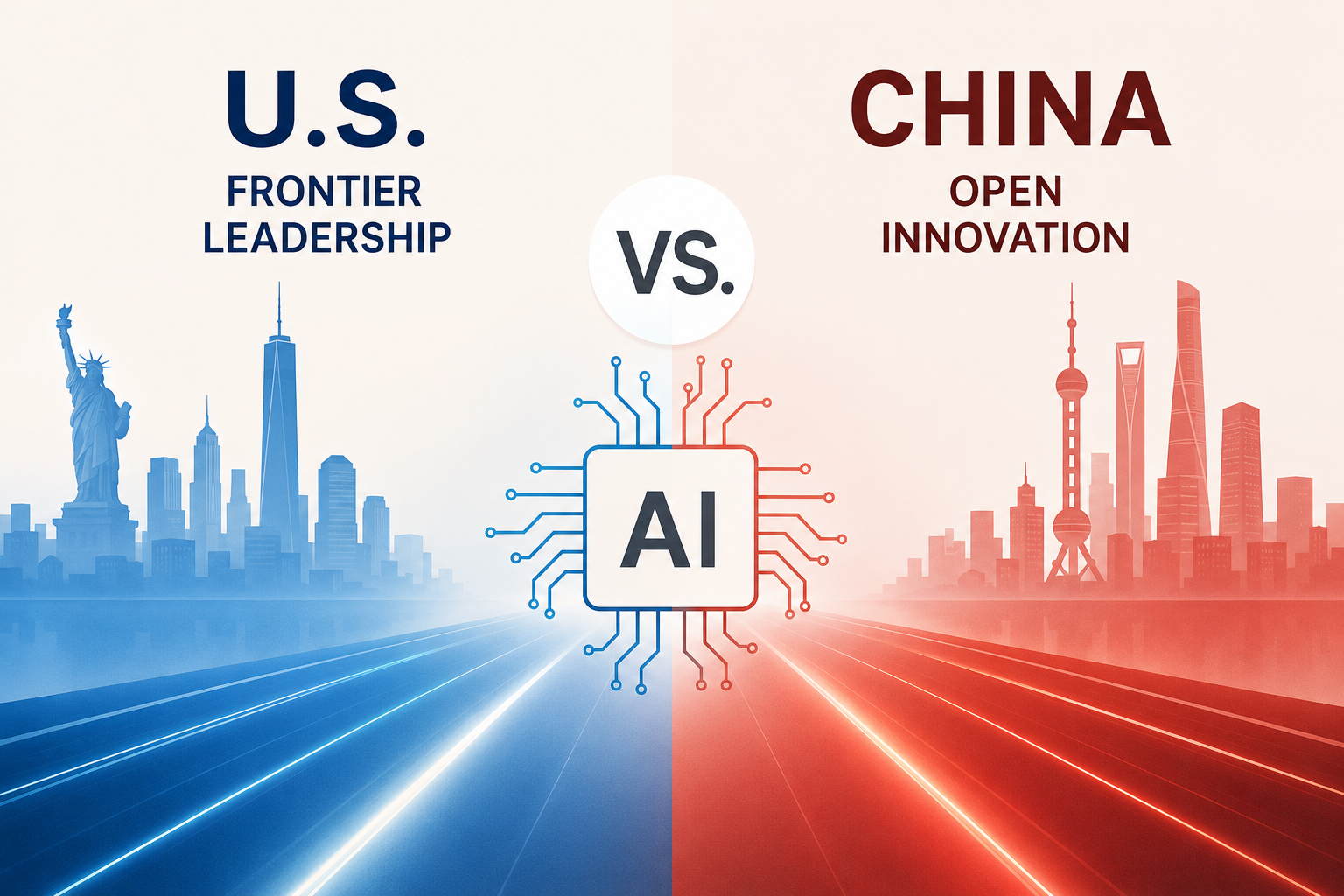
The contest is therefore developing into a struggle between frontier intelligence and accessible intelligence.
The United States currently has the stronger position in the former. China is increasingly competitive in the latter.
America’s frontier advantage remains substantial
The US AI ecosystem benefits from a combination of resources that is difficult to reproduce.
American AI laboratories can raise billions of dollars from venture capital firms, technology companies and public markets. They can purchase or reserve enormous quantities of computing capacity from Microsoft, Amazon, Google, Oracle and specialized infrastructure providers.
They also benefit from chips designed by Nvidia, AMD, Broadcom and other US companies. Even when semiconductor manufacturing occurs outside the United States, American companies control much of the design software, intellectual property and commercial ecosystem supporting advanced AI processors.
Research universities, a large enterprise software market and the ability to recruit international talent provide additional advantages.
These strengths reinforce one another.
A capable model attracts customers and investment. That capital pays for additional researchers, chips, data centers and energy. The expanded infrastructure supports more ambitious models, which can attract more developers and enterprise users.
This flywheel has helped American companies remain highly competitive in general-purpose AI, coding, scientific analysis, multimodal systems and increasingly autonomous AI agents.
The United States also has a deep field of potential leaders.
OpenAI has broad consumer awareness and a large developer ecosystem. Anthropic has developed a strong position in enterprise AI, software development and safety-focused deployments. Google combines frontier research, proprietary data, custom processors, cloud infrastructure and global product distribution.
Meta can integrate AI into Facebook, Instagram, WhatsApp, Messenger, advertising systems and wearable devices. Microsoft and Amazon can capture substantial value through cloud infrastructure even when another company develops the underlying model.
The US advantage is not dependent on one company. It is based on an ecosystem of laboratories, cloud providers, chip designers, investors and enterprise customers.
China is competing through efficiency and openness
China faces a different set of constraints.
US export controls have restricted Chinese access to some of Nvidia’s most advanced processors and to equipment needed for leading-edge semiconductor manufacturing. These measures have made it more difficult and expensive for Chinese companies to reproduce the largest American computing clusters.
China’s response has not been limited to trying to obtain restricted chips.
Chinese developers have focused on model efficiency, software optimization, domestic hardware and open-weight distribution. DeepSeek became an important symbol of this approach by demonstrating that a Chinese laboratory could produce highly competitive results while emphasizing lower training and inference costs.
Alibaba’s Qwen family has also gained international adoption. Qwen models are available in different sizes and configurations for coding, reasoning, multilingual applications, devices and enterprise deployments.
Research examining activity on the Hugging Face model platform found that US corporate dominance in open-weight AI declined sharply during 2025 as DeepSeek, Qwen and other Chinese model families gained adoption. The researchers described a broader rebalancing of influence within the open-model economy.
The strategic value of these systems is not limited to their benchmark performance.
An open-weight model can be downloaded by a company, university or government. It can be fine-tuned using proprietary or local information. It can operate in a private data center and be adapted for a specific language, industry or regulatory environment.
For organizations concerned about sovereignty, privacy or dependence on American cloud platforms, these characteristics can be highly attractive.
Chinese models do not necessarily need to outperform every system from OpenAI, Anthropic or Google. They need to be capable enough, affordable enough and available under terms that encourage adoption.
That may be sufficient to gain meaningful usage across Asia, the Middle East, Africa, Latin America and parts of Europe.
Did Meta drop the open AI ball?
Meta was once positioned to keep the United States at the center of the open-model ecosystem.
In 2024, Mark Zuckerberg argued that open-source AI represented a path toward making advanced technology broadly available. Meta released Llama 3.1, including a 405-billion-parameter model it described as a frontier-level open system.
Llama gave developers an American alternative to closed platforms from OpenAI, Anthropic and Google. It also gave Meta influence over the software tools, fine-tuning practices and applications developing around open-weight AI.
By March 2025, Meta said Llama had been downloaded more than one billion times. The company continued arguing that broadly available models could stimulate economic development, research and product creation.
However, the strategic environment has changed.
Training frontier systems requires increasingly large investments in computing, energy and technical talent. When a company releases model weights, competitors can study the system, adapt it and potentially use its outputs or architecture to improve their own models.
Safety controls can also be modified or removed. A released model may be used for cyberattacks, surveillance, influence campaigns or other applications the original developer cannot monitor.
Meta has therefore faced a difficult choice.
It can continue releasing advanced models and help sustain an American open ecosystem, or it can reserve more of its capabilities for proprietary products and services that may generate a clearer financial return.
Meta has not abandoned Llama. It has continued supporting open deployments, including government and enterprise applications. Its recent messaging, however, increasingly emphasizes product integration, consumer AI and differentiated capabilities within Meta’s own ecosystem.
That creates uncertainty about whether Meta will continue releasing open models capable of matching the strongest systems available from China.
From Meta’s commercial perspective, a more controlled strategy is understandable. The company is investing heavily in data centers, custom chips, researchers and energy infrastructure. It has incentives to protect some of that investment.
From a broader US perspective, the shift carries risk.
If American frontier systems are available primarily through controlled, premium APIs while Chinese companies continue releasing capable open-weight alternatives, global developers may increasingly build on Chinese foundations.
Meta may not have dropped the entire ball. It may have decided to play a different game while China continued running with the open one.
China’s open lead may not last forever
China’s growing position in open AI should not be treated as permanent.
As Chinese models become more capable and internationally important, Beijing is confronting some of the same concerns that caused American companies to reconsider unrestricted releases.
Recent reporting indicates that Chinese officials are considering tighter controls on the international distribution of advanced Chinese models. Possible measures include additional reviews, delayed public releases and restrictions on foreign access to sensitive model technology.
The concern is familiar.
Open releases can expand global influence and encourage developers to adopt Chinese technology. They can also allow foreign companies and governments to benefit from Chinese research without making comparable investments.
Highly capable models could be adapted for military, intelligence or cybersecurity purposes. Chinese officials may also worry that unrestricted distribution will allow American companies to analyze and reproduce Chinese breakthroughs.
China may therefore be moving toward the same strategic tension Meta encountered.
Openness generates adoption, but control protects strategic technology.
Should Beijing significantly restrict Chinese models, the decision could slow international adoption and disrupt companies that have built products around low-cost Chinese systems. It could also give American or European developers another opportunity to compete in open AI.
Open and frontier models serve different needs
Closed frontier systems offer several advantages.
The provider can monitor usage, update safety systems, protect model weights and improve the service centrally. Enterprise customers receive a managed platform rather than files they must secure, optimize and maintain themselves.
The recurring revenue generated by closed APIs and subscriptions can also fund future training runs.
The weakness is dependency.
Customers rely on the provider’s prices, policies, infrastructure and geographic availability. A sanctions rule, export restriction, security review or change in commercial strategy can limit access.
Sensitive prompts and business information may also pass through infrastructure controlled by a foreign provider.
Open-weight systems reverse many of those tradeoffs.
They provide portability, customization and local control. They can operate on private infrastructure and be modified for specialized applications.
They also create significant risks.
Once a capable model is released, safeguards may be removed. Developers have limited ability to prevent the system from being adapted for cybercrime, surveillance, biological research, financial fraud or political manipulation.
The open-versus-frontier debate is therefore not simply a contest between freedom and control.
It is a practical disagreement over which capabilities should be distributed, who should control them and whether governments should be able to restrict access.
The United States is intervening more than its mythology suggests
The American technology story is commonly associated with entrepreneurs, private markets and limited government interference.
The current AI strategy is considerably more interventionist.
Washington has restricted exports of advanced chips and semiconductor manufacturing technology. It is encouraging domestic chip production and treating AI computing capacity as a national-security asset.
The federal government is also accelerating permitting for data centers, power plants and transmission infrastructure. These policies recognize that the AI race will be constrained not merely by algorithms, but by electricity, transformers, cooling systems, land and access to the power grid.
Government intervention can address legitimate problems.
Data centers require years of planning and construction. Electrical infrastructure is often delayed by fragmented permitting and disputes among federal, state and local agencies. Coordinated policy can help the United States add computing capacity more quickly.
The downside is that rapid data center development can shift costs onto communities and electricity customers. Large facilities may consume significant amounts of electricity and water while creating fewer permanent jobs than other major industrial projects.
State and local governments are increasingly considering whether data center companies should pay a greater share of grid upgrades and disclose more information about their environmental impact.
Washington is also moving toward greater control over advanced models.
The emergence of Anthropic systems such as Claude Mythos has intensified debate about whether the most capable models should undergo government testing or face restrictions before broad international distribution. Anthropic says Mythos has demonstrated advanced cybersecurity capabilities, including the ability to identify previously unknown software vulnerabilities.
The argument for restrictions is that a highly capable system could assist foreign intelligence services, military organizations or cyberattack groups.
The argument against restrictions is that international customers may view American technology as politically conditional. They may respond by adopting open models that can be downloaded and operated beyond the reach of US policy.
A restriction intended to protect American leadership could therefore accelerate demand for Chinese alternatives.
China’s government offers coordination, but also control
China’s government plays a more direct role in AI infrastructure, financing, content rules and industrial development.
State policy can align data centers, electricity generation, universities, manufacturers, local governments and technology companies around national objectives.
Government procurement can create demand for domestic chips and AI platforms, even when those products initially trail foreign alternatives. Public financing can support infrastructure projects that private investors might consider too risky or slow to generate returns.
China’s manufacturing base provides another strategic advantage.
The next phase of AI will extend beyond chatbots and office software. It will include robots, vehicles, warehouse systems, industrial equipment and AI-controlled supply chains.
China can connect models with physical production at a scale few countries can match.
This coordinated approach also produces weaknesses.
State-directed investment can generate duplicate facilities, underused data centers and projects designed to satisfy political priorities rather than commercial demand.
Government content rules can limit how Chinese models discuss politics, history, human rights and other sensitive subjects. A model may perform strongly in mathematics, coding or manufacturing while remaining unreliable for journalism, political research or open-ended analysis.
China’s regulatory environment may therefore help domestic deployment while limiting international trust.
The myth that China simply banned Claude
The claim that China banned Claude is incomplete.
Anthropic does not officially offer commercial Claude access in mainland China. In 2025, it expanded its restrictions to include companies controlled from China and certain other jurisdictions, even when those businesses operate through foreign subsidiaries. Anthropic cited security risks and legal requirements that could compel organizations to share information with their governments.
In February 2026, Anthropic said it had detected attempts by Chinese laboratories to use large numbers of accounts to extract Claude outputs and train competing models through distillation. The company reiterated that it does not commercially provide Claude in China or to subsidiaries of Chinese-controlled companies abroad.
OpenAI also does not list mainland China as a supported location for ChatGPT or its API.
These are primarily access decisions made by American companies, influenced by national-security concerns and US policy.
Chinese companies and authorities have also pushed back.
Alibaba reportedly instructed employees to stop using Claude Code after Chinese authorities alleged that the software contained functionality designed to identify users connected to China. Anthropic rejected the characterization of the feature as a backdoor and said it was intended to detect unauthorized access and model-distillation activity.
The dispute demonstrates how quickly commercial AI tools are becoming geopolitical assets.
American companies worry that Chinese laboratories are using their systems to accelerate competing models. Chinese organizations worry that American software can identify users, transmit sensitive information or be withdrawn for political reasons.
The result resembles a ban from a practical standpoint, but the separation is being driven by both countries.
Who is likely to lead in the United States?
There is no obvious permanent winner in the US market.
OpenAI has brand awareness, developer usage and a broad consumer presence. Anthropic is influential in coding, enterprise deployments and advanced cybersecurity research. Google combines models, cloud infrastructure, custom chips, search, Android and large proprietary datasets.
Meta has enormous consumer distribution and can place AI inside communications, advertising, social platforms and devices. Microsoft and Amazon can profit from the computing and enterprise layers regardless of which laboratory produces the strongest individual model.
Different companies may lead different categories.
One may dominate consumer assistants. Another may lead software development. Others could become more important in enterprise agents, scientific research, advertising, robotics or government deployments.
The depth and diversity of the American market remain significant advantages.
Who is likely to lead in China?
China also has several credible competitors.
Alibaba has cloud infrastructure, enterprise relationships and the growing Qwen ecosystem. DeepSeek has demonstrated technical capability, cost efficiency and global visibility.
ByteDance brings consumer distribution, recommendation technology and access to large amounts of behavioral data. Tencent can integrate AI into messaging, gaming, cloud services and business applications. Baidu has experience in search, autonomous vehicles and foundation models.
Recent analysis suggests Chinese frontier systems are now often months rather than years behind leading American models, particularly in coding and agent-related benchmarks.
China may not produce a single company that fills the same role as OpenAI.
Its advantage could emerge from a network of model developers, cloud providers, chip companies and manufacturers supported by state policy.
Alibaba and DeepSeek appear especially important because of their open-model influence, although the market remains fluid.
Who will win?
The answer depends on how victory is defined.
If winning means producing the most capable frontier systems, the United States currently appears better positioned.
If it means controlling advanced chip design, hyperscale cloud platforms and private AI investment, the United States also holds meaningful advantages.
If it means distributing affordable, adaptable open models, China has gained considerable momentum.
If it means integrating AI into manufacturing, robotics, vehicles and physical supply chains, China may possess structural advantages that are not visible in chatbot rankings.
If it means earning international trust, both countries face challenges.
American export controls and access restrictions can make US technology appear conditional. Chinese censorship and concerns about government influence can make Chinese technology appear politically constrained.
The likely outcome is not a complete victory for either country.
The United States may retain leadership in frontier intelligence, premium cloud services and advanced chip design. China may lead parts of the open-model ecosystem, lower-cost deployment and industrial integration.
The decisive question is whether the United States can preserve frontier leadership without surrendering the open ecosystem, and whether China can expand globally without allowing state control to undermine confidence in its technology.
The AI race will not be decided by one benchmark, one model launch or one company.
It will be decided by which ecosystem can repeatedly convert research into affordable, useful and trusted systems that businesses, governments and developers are willing to build upon.
America currently leads much of the frontier.
China is making a serious bid to influence what the rest of the world uses.

If you liked this post, you’ll love one of the the leading global business communications and technology events since 1999, the ITEXPO #TECHSUPERSHOW, Feb 9-11, 2027 Fort Lauderdale, Florida.
Don’t forget the collocated MSP Expo – just for managed service providers!
Aside from his role as CEO of TMC and chairman of ITEXPO #TECHSUPERSHOW Feb 9-11, 2027, Rich Tehrani is CEO of RT Advisors and a Registered Representative (investment banker) with and offering securities through Four Points Capital Partners LLC (Four Points) (Member FINRA/SIPC). He handles capital/debt raises as well as M&A. RT Advisors is not owned by Four Points.
The above is not an endorsement or recommendation to buy/sell any security or sector mentioned. No companies mentioned above are current or past clients of RT Advisors.
The views and opinions expressed above are those of the participants. While believed to be reliable, the information has not been independently verified for accuracy. Any broad, general statements made herein are provided for context only and should not be construed as exhaustive or universally applicable.
Portions of this article may have been developed with the assistance of artificial intelligence, which may have contributed to ideation, content generation, factual review, or editing