Takeaways
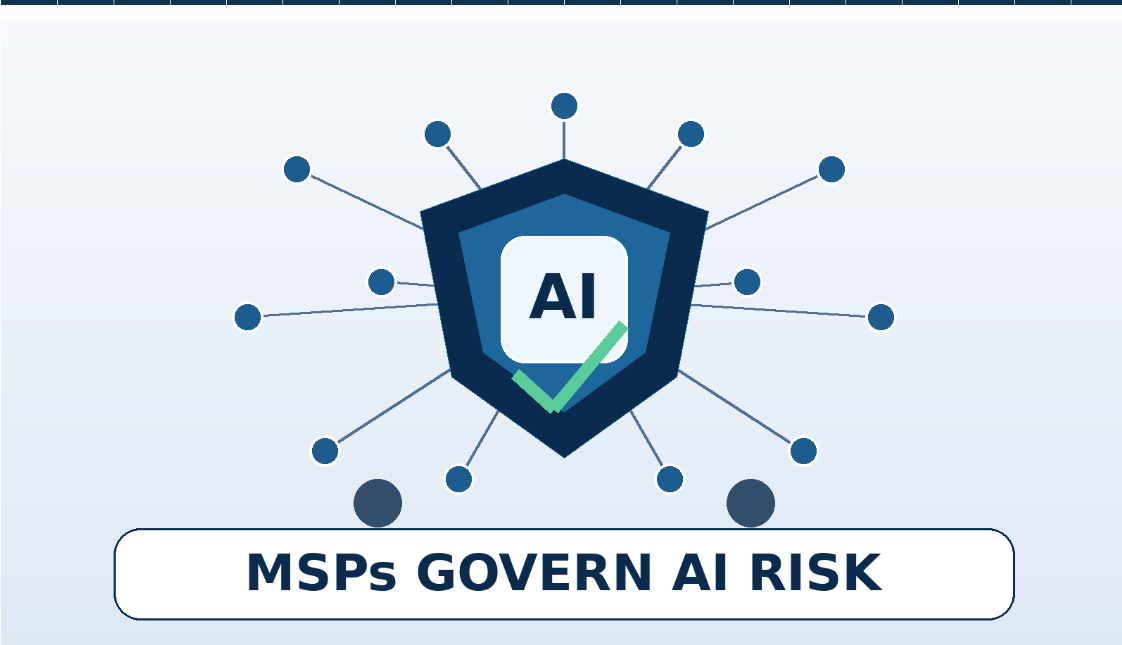
- Businesses increasingly need managed service providers to govern AI use, not simply deploy tools.
- AI governance is converging with identity, networking, cybersecurity, data protection and disaster recovery.
- MSPs may need to provide documented controls, measurable evidence and clear accountability to remain credible partners.
The managed service provider model is entering another stage of development. For years, the MSP’s role expanded from device support into cloud management, cybersecurity, compliance and business continuity. Artificial intelligence is now pushing that role further.
Many small and midsize organizations want to use generative AI, automation and intelligent agents, but they lack the internal staff to evaluate models, protect data, document decisions and continuously monitor risk. This creates an opportunity for MSPs. It also creates responsibility.
An MSP that introduces AI into a customer environment may influence which models are used, what information those models can access, where data is processed and which actions can be automated. Those decisions can affect privacy, security, compliance and business operations.
AI services therefore require a more structured operating model than simply activating a new feature inside an existing software platform.
The MSP Role Is Moving From Deployment to Governance
Recent calls for stronger MSP accountability reflect a growing concern that businesses may adopt AI faster than they establish policies around it.
Customers increasingly want to know which models are being used, what data is submitted, where that data travels, how long it is retained and whether automated outputs are reviewed.
The NIST AI Risk Management Framework offers one way to organize those responsibilities. Its core functions are Govern, Map, Measure and Manage. The framework is voluntary, but it gives organizations a common structure for identifying AI risks, assigning responsibility and monitoring systems across their lifecycle.
For an MSP, this could translate into practical services such as maintaining an inventory of approved AI systems, classifying use cases by risk, documenting data flows, testing model behavior, controlling access, recording exceptions and reviewing vendors.
The goal is not to eliminate experimentation. It is to make experimentation visible and manageable.
The ISO/IEC 42001 AI management system standard provides another reference point. It describes requirements for establishing, maintaining and continually improving an organizational AI management system. It is designed to address policies, objectives, processes, risk treatment and continuous improvement rather than focusing on one specific model or application.
MSPs do not necessarily need to turn every customer engagement into a certification project. They may, however, benefit from borrowing the discipline behind these frameworks. A repeatable governance process can be easier to sell, support and audit than a collection of informal recommendations.
Demand Is Growing for Integrated AI Services
The renewed attention around AI-enabled managed services for the midmarket suggests that customers are looking for bundled capabilities across cloud, applications, data and security.
Midmarket businesses often have complex environments but smaller internal teams than large enterprises. As a result, they may prefer a provider that can coordinate several parts of an AI modernization program.
This creates a meaningful distinction between selling an AI tool and operating an AI environment.
Selling a tool may involve licensing, configuration and training. Operating an environment requires identity controls, data classification, integration monitoring, incident response, cost management, vendor review and ongoing policy enforcement. It may also require human oversight when an AI system recommends or executes an action.
That difference is likely to shape managed service packages.
A provider might offer an AI readiness assessment, approved-tool catalog, data-access design, employee-use policy, model monitoring, prompt and output logging, security testing, cost reporting and quarterly governance reviews. Each element can be tied to evidence that a customer can inspect.
Networking, Identity and AI Are Converging
The combination of AI-assisted network management and SASE capabilities illustrates how infrastructure tools are becoming more automated.
MSPs can use AI to identify anomalies, recommend configurations, summarize events and reduce manual administration across multiple customer environments.
Yet automation does not reduce the importance of access control. It increases it.
A tool that can observe a network is useful. A tool that can change policies, isolate devices or modify configurations carries greater operational risk.
The NIST Zero Trust Architecture guidance emphasizes that access should not be trusted solely because of network location or asset ownership. Authentication and authorization should be evaluated before access to a resource is established.
That principle becomes especially relevant when AI agents can act across cloud services, endpoints and business applications.
MSPs may need to treat every AI agent as a distinct operational identity. It should have defined permissions, approved data sources, logging, limits on autonomous action and a method for revocation.
Shared service accounts and broad administrative privileges become harder to justify when automated systems can operate continuously.
Legacy Operations Still Matter
AI governance cannot be separated from the operational problems customers already have.
The continued modernization of VDI and cloud desktop environments shows that patching, lifecycle management, audit logging and application control remain difficult even in mature technology categories.
Adding AI to an environment with weak operational hygiene can magnify existing gaps.
For example, an organization may approve an AI assistant but fail to patch the virtual desktop through which employees access it. It may secure the model while leaving browser extensions unmanaged. It may create a data policy but lack the logs needed to determine whether sensitive information was submitted.
The relevant lesson is that AI governance should be built on a functioning operational foundation.
Identity management, endpoint security, asset inventory, patching, configuration control and logging remain essential. AI controls supplement these capabilities. They do not replace them.
Recovery Must Be Designed for AI-Enabled Operations
Business continuity is another area where the MSP role is expanding.
The risks created by oversized image backups and storage sprawl show why recovery planning must address backup integrity, malware persistence and the ability to identify a clean restore point.
The CISA StopRansomware Guide recommends maintaining offline, encrypted backups and regularly testing their availability and integrity. CISA guidance also emphasizes that accessible backups are often targeted by ransomware actors.
AI introduces additional recovery questions.
Which model configurations must be preserved? Can an organization reconstruct an agent’s permissions and approved tools? Are prompts, system instructions, retrieval sources and audit records included in continuity planning? Could a restored system reintroduce a compromised integration or malicious automation rule?
An MSP offering AI operations may need to back up more than files and virtual machines. It may need to preserve the configuration and governance state of the AI environment while ensuring that compromised components are not automatically restored.
Scale Does Not Remove Accountability
The growth of white-labeled NOC, SOC and helpdesk services reflects the pressure on MSPs to expand capacity without carrying every operational function internally.
Outsourced delivery can help providers offer around-the-clock coverage, specialized skills and broader services.
The model can be useful, but it introduces another layer of third-party risk. A customer may believe it is working with one MSP while parts of monitoring, response or support are delivered by another organization.
AI services could add model vendors, data processors, automation platforms and cloud providers to that chain.
The joint CISA advisory for MSPs and their customers recommends a shared commitment to security, clear responsibilities and baseline protections.
Those principles can also guide AI service delivery. Customers should understand which party performs each function and who is responsible when an alert, model failure or data incident occurs.
Outsourcing execution does not outsource accountability.
MSPs may need contractual clarity, vendor due diligence, access separation, incident-notification requirements and evidence that downstream providers follow the promised controls.
What Customers May Begin Asking
The MSP selection process is likely to include more detailed questions about AI.
Which AI systems are approved for use?
What customer information can each system access?
Is customer data used to train a model?
Where is the information processed and retained?
Which actions can an AI agent perform without human approval?
How are model changes, prompts and permissions documented?
What evidence is available for audits or investigations?
How will the environment be restored after an incident?
Which subcontractors or platforms participate in delivering the service?
These questions turn AI governance into a practical managed service rather than an abstract consulting topic.
The Opportunity Is Trust Through Evidence
MSPs have long succeeded by reducing complexity for customers. AI gives them another opportunity to do that, but the service must extend beyond tool selection.
The provider that can show an accurate AI inventory, controlled permissions, documented data flows, tested recovery procedures and clear accountability may become more valuable to customers than a provider offering a longer list of AI features.
This shift does not require MSPs to predict every future regulation or model capability. It requires them to establish a disciplined process that can adapt as technology changes.
AI is redefining the managed services relationship. Customers will still need support, security and infrastructure management.
Increasingly, they may also need a partner that can explain how AI is being used, prove that controls are operating and respond when the technology behaves in an unexpected way.
That is a larger responsibility than deploying software. It may also become one of the more important ways an MSP demonstrates continuing value.

If you liked this post, you’ll love one of the the leading global business communications and technology events since 1999, the ITEXPO #TECHSUPERSHOW, Feb 9-11, 2027 Fort Lauderdale, Florida.
Don’t forget the collocated MSP Expo – just for managed service providers!
Aside from his role as CEO of TMC and chairman of ITEXPO #TECHSUPERSHOW Feb 9-11, 2027, Rich Tehrani is CEO of RT Advisors and a Registered Representative (investment banker) with and offering securities through Four Points Capital Partners LLC (Four Points) (Member FINRA/SIPC). He handles capital/debt raises as well as M&A. RT Advisors is not owned by Four Points.
The above is not an endorsement or recommendation to buy/sell any security or sector mentioned. No companies mentioned above are current or past clients of RT Advisors.
The views and opinions expressed above are those of the participants. While believed to be reliable, the information has not been independently verified for accuracy. Any broad, general statements made herein are provided for context only and should not be construed as exhaustive or universally applicable.
Portions of this article may have been developed with the assistance of artificial intelligence, which may have contributed to ideation, content generation, factual review, or editing