Takeaways
- For most of commercial history, producing something and distributing it were closely connected.
- Industrialization separated manufacturing from sales and gave larger companies an advantage in transportation, inventory and market access.
- Catalogs, highways, barcodes, computers and the internet progressively reduced the cost of reaching customers.
- Digital platforms now allow smaller businesses to rent capabilities that large companies once had to build themselves.
- The pressure facing major pizza chains shows what happens when a long-standing distribution advantage becomes broadly available.
- As distribution becomes easier, companies must compete more directly on product quality, reputation, customer experience and differentiation.
A neighborhood pizza restaurant may make an excellent product. For much of the past several decades, however, that was not enough to compete with a national chain.
The large chain had television advertising, a recognizable brand, centralized purchasing, standardized operations, a memorable phone number, online ordering and thousands of delivery drivers. The local restaurant might have had better pizza, but the chain made ordering easier.
That advantage is beginning to weaken.
A recent Financial Times article examines how delivery platforms such as DoorDash and Uber Eats have reduced some of the technological and logistical advantages once enjoyed by Domino’s, Pizza Hut, Papa Johns and other large chains. Delivery sales at US quick-service pizza chains reportedly fell from $19.8 billion in 2021 to $17.3 billion in 2022 and then to $16.5 billion in 2023. The FT also noted pressure on several major pizza businesses, including planned restaurant closures and declining investor confidence in parts of the sector.
The story is about more than pizza. It represents the latest stage in a much longer transformation of distribution.
For thousands of years, one of the central challenges of commerce has been getting a product from the person who makes it to the person who wants it. Each major advance in transportation, communications and technology has changed who can reach the customer, how far goods can travel and which companies hold the advantage.
When products were made and sold by the same person
In the earliest local economies, production and distribution were often part of the same activity.
A farmer brought crops to a nearby market. A blacksmith sold tools from a workshop. A baker served customers who lived close enough to walk to the bakery. Craftspeople made products by hand and sold them directly or through merchants who traveled between communities.
The distance a product could travel was limited by transportation time, cost and the risk of damage or spoilage. This was particularly important for food. Without refrigeration, reliable roads or rapid transportation, most prepared food had to be consumed close to where it was made.
A successful business therefore needed more than the ability to produce something customers wanted. It needed physical access to those customers.
In many cases, geography protected local businesses from distant competitors. A customer could not easily compare every merchant in a region, much less order from one hundreds of miles away. Competition was shaped by who was nearby.
Merchants separated production from selling
As trade networks expanded, merchants became distribution specialists.
They bought products from farmers, craftspeople and manufacturers, transported those goods and resold them in other communities. Wholesalers and retailers allowed producers to reach customers they would never meet directly.
This division of labor created an important shift. The company that controlled access to customers could become as influential as the company making the product.
Warehouses, ports, trade routes, market stalls and retail locations became commercial assets. A manufacturer might produce a desirable item, but without relationships with merchants or access to transportation, its addressable market remained limited.
The basic structure of the modern supply chain began to emerge. Producers made goods. Intermediaries aggregated and transported them. Retailers presented them to customers.
Industrialization created the need for mass distribution
The Industrial Revolution dramatically increased productive capacity.
Machines could make goods more quickly and consistently than individual craftspeople. Factories could produce quantities far beyond the needs of their surrounding communities.
Mass production, however, created a corresponding requirement for mass distribution.
Factories needed raw materials delivered at predictable intervals. Finished goods needed to be stored, transported and sold across much larger territories. Railroads and steamships allowed products to travel farther and at lower cost, while wholesalers helped manufacturers place goods in regional and local stores.
Branding also became more important. A customer buying from a distant manufacturer could no longer rely entirely on a personal relationship with the producer. Packaging, advertising and a recognizable company name helped establish familiarity and trust.
Large companies gained an advantage because they could afford factories, warehouses, transportation contracts, sales teams and advertising. Scale did not merely reduce the cost of production. It increased access to distribution.
The catalog brought the store into the home
Mail-order catalogs represented another major change.
Instead of traveling to a store, customers could browse products at home, submit an order and receive goods through the postal and transportation networks.
Montgomery Ward distributed a one-page catalog in 1872, and Sears followed with its mail-order business in the 1890s. Improvements in rail transportation, Rural Free Delivery and the introduction of Parcel Post helped mail-order companies reach customers across the United States. The National Postal Museum reports that Sears processed five times as many orders in 1913 as it had the previous year after Parcel Post became available.
The catalog was, in many respects, an early version of e-commerce.
It displayed products remotely. It allowed customers to compare options without entering a store. It connected a purchasing interface to warehouses, payment processing and a fulfillment network.
For rural customers, catalogs greatly expanded the selection of goods available. For merchants such as Sears, they opened a national market without requiring a conventional store in every town.
Yet the model still required considerable scale. Printing and mailing catalogs, maintaining warehouses, managing inventory and fulfilling orders demanded capital and operational expertise.
Distribution was becoming more accessible to customers, but it remained difficult for smaller sellers to build.
Highways and trucking connected national markets
The expansion of roads and trucking added another layer to the distribution system.
The Federal-Aid Highway Act of 1956 launched the Interstate Highway System, which had significant implications for freight movement. Trucking could connect factories, warehouses, distribution centers and stores through a flexible national transportation network. Before the Interstate era, ton-mileage carried by truck combinations had already grown from 13.7 billion in 1936 to 115.6 billion in 1955.
Retail and restaurant chains could use these networks to support locations across multiple states.
Centralized purchasing allowed chains to negotiate with suppliers. Regional distribution centers could replenish stores. Standardized ingredients, packaging and equipment helped companies deliver a consistent experience in different markets.
The ability to coordinate a national supply chain became a competitive advantage that was difficult for a local company to reproduce.
Barcodes and computers made the supply chain visible
Physical transportation was only part of the challenge. Businesses also needed information.
They needed to know what had been produced, what was in a warehouse, what had been shipped, what had been sold and what needed to be reordered.
The adoption of the Universal Product Code helped automate that process. The first commercial barcode scan occurred on June 26, 1974, when a package of Wrigley’s gum was scanned at a supermarket in Ohio. Barcodes subsequently became a widely used method for identifying products throughout retail and supply-chain operations.
Computers, electronic data interchange and enterprise software expanded those capabilities.
Retailers could track sales more accurately. Manufacturers could plan production around demand. Warehouses could automate portions of receiving, storage and fulfillment. Supply chains became increasingly coordinated through data rather than phone calls, paper forms and manual inventory counts.
These systems initially favored large organizations that could afford the software, equipment and technical personnel required to operate them.
Once again, technology strengthened the distribution advantage of scale before eventually becoming more widely accessible.
The internet separated selling from physical stores
The commercial internet changed the relationship between location and customer access.
A company no longer needed a store in every city to display its products. A website could function as a catalog, storefront and order-processing system available from almost anywhere.
Search engines helped customers discover unfamiliar sellers. Online payment systems simplified transactions. Ratings and reviews provided information that had previously come from a salesperson, retailer or personal recommendation.
This allowed a small company to present its products alongside those of a much larger competitor.
However, the internet did not eliminate the physical requirements of distribution. Businesses still needed inventory, packaging, warehousing, transportation, returns and customer service.
E-commerce made the storefront less expensive. The supply chain behind it remained complex.
Platforms turned infrastructure into a service
Online marketplaces pushed the transformation further.
Businesses could sell through platforms that already had customers, payment systems, reviews, advertising tools and, in some cases, fulfillment networks.
Instead of constructing an entire distribution system, a seller could rent access to one.
The same principle expanded into other industries. Software developers gained access to customers through app stores. Independent merchants could sell through e-commerce marketplaces. Drivers could find passengers through ride-sharing platforms. Property owners could reach travelers through booking platforms.
Restaurants eventually gained a comparable distribution system through food-delivery apps.
A restaurant no longer had to develop its own ordering software, recruit a delivery workforce, process digital payments, build a customer-tracking system and advertise to every potential customer independently.
The platform could provide much of that infrastructure.
Why pizza chains had a powerful advantage
Pizza was unusually well suited to the traditional delivery model.
The product travels reasonably well, can be prepared in standardized kitchens and is commonly ordered for groups. National chains built their operations around these characteristics.
Their advantage was not limited to the recipe.
They invested in national advertising so customers knew their names. They established dense networks of franchise locations. They created systems for accepting orders, preparing food quickly and dispatching drivers. Later, they invested heavily in websites, mobile apps, loyalty programs and order tracking.
For a customer seeking convenience, the decision often began with a practical question: Which restaurant delivers?
Large pizza companies had an immediate answer.
The local restaurant might offer a more distinctive product, but customers had to know it existed, locate a menu, place an order and determine whether delivery was available.
The chain’s distribution system was part of the product experience.
In addition – many used automation from leading restaurant communications and logistics vendors such as Unified Office to tie their backoffice operations and communications into a seamless platform.
Delivery apps changed the question
Third-party delivery platforms have changed the customer’s starting point.
Instead of deciding which pizza company to call, the customer opens an app and sees many restaurants at once. National chains, regional operators and independent pizzerias can appear in the same interface.
The customer can compare prices, menus, photographs, ratings, estimated delivery times and promotions. The restaurant does not necessarily need its own fleet of drivers. The platform coordinates the transaction and the final trip to the customer.
As the Financial Times observed, this weakens a technological and logistical advantage that large pizza companies spent decades developing. The apps have also made pizza compete more directly with burgers, tacos, sushi, wings, salads and virtually every other deliverable food category.
The large chains have not lost all their advantages. They still benefit from brand recognition, purchasing scale, established franchise systems, customer data and substantial advertising budgets.
But distribution is less exclusive.
A local restaurant can now provide an ordering and delivery experience that, from the customer’s perspective, may appear similar to that of a national operator.
The question is no longer simply, “Who can deliver?”
It is increasingly, “What do I want, and which restaurant appears most appealing right now?”
Distribution has not disappeared
This does not mean that distribution no longer matters.
It means that control over distribution has moved.
The neighborhood pizzeria may gain access to thousands of customers, but it becomes more dependent on the delivery platform. The app can influence visibility, commissions, promotions, customer relationships and the order in which restaurants appear.
A national chain may gain incremental orders through the same platform while losing some control over the customer experience and customer data.
The historical pattern repeats itself. A new intermediary reduces one barrier while creating another.
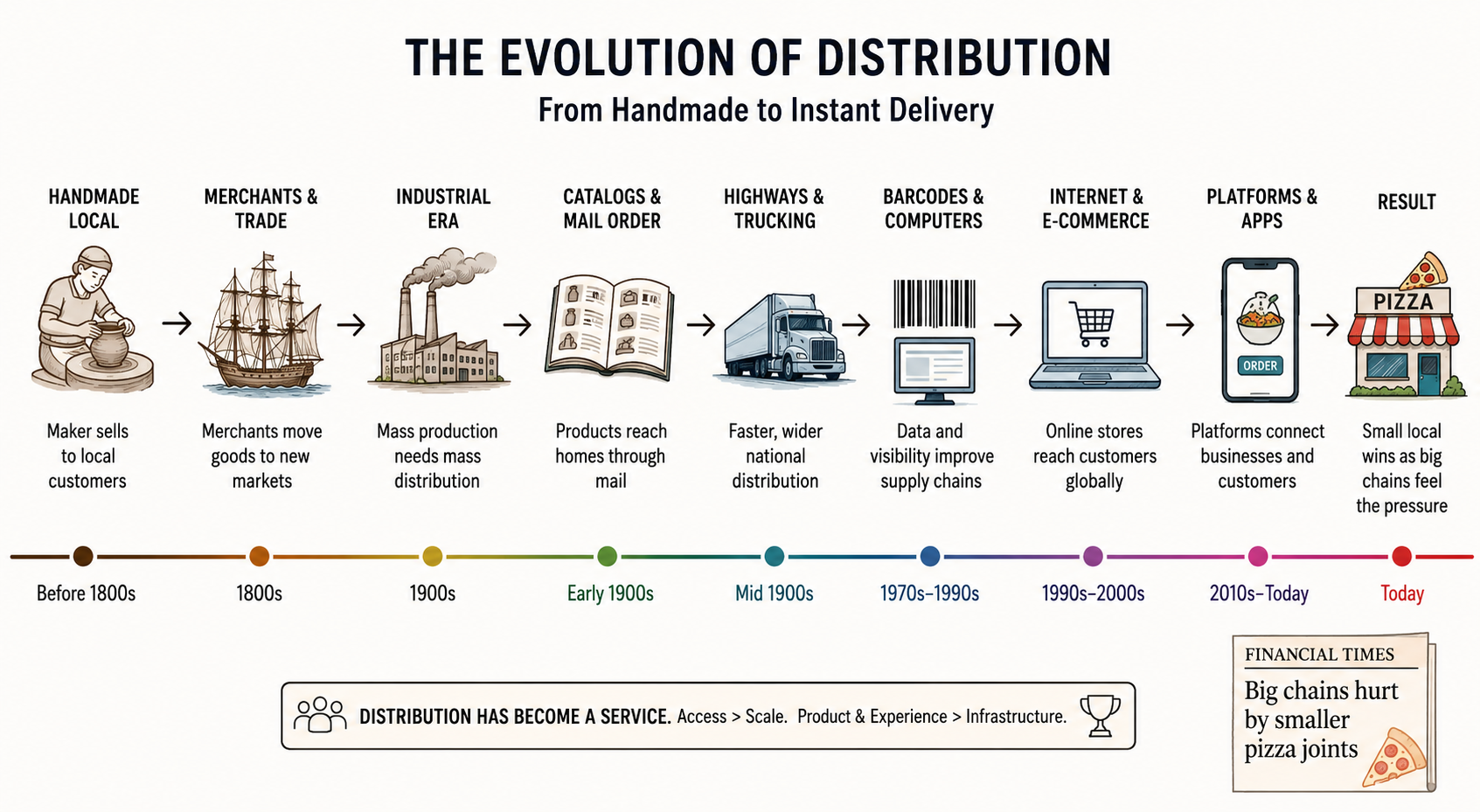
Merchants connected craftspeople to distant markets. Catalog companies connected warehouses to rural consumers. Retail chains connected manufacturers to national audiences. Online marketplaces connected sellers to internet shoppers. Delivery apps now connect local restaurants to customers who expect immediate convenience.
Each system expands access, but each also creates a new gatekeeper.
What businesses compete on when distribution becomes easier
When distribution is difficult, the company that can reach the customer has a major advantage.
When many companies can reach the customer, other factors become more visible.
Product quality matters. Reputation matters. Customer reviews matter. Pricing, presentation, responsiveness and reliability matter. A distinct story or experience can matter more because the customer has more choices in front of them.
This may favor smaller companies in certain situations. They can move quickly, offer specialized products and build strong local reputations. They no longer need to reproduce every piece of infrastructure owned by a national competitor.
But easier access does not guarantee profitable growth.
Platform fees can reduce margins. Competitors are visible beside one another. Customers can switch with a few taps. The business may have limited access to customer data and may need to pay for advertising within the platform to maintain visibility.
Distribution has become easier to obtain, but attention and loyalty remain scarce.
The next distribution layer may be AI
The evolution may not end with delivery apps.
For centuries, distribution primarily meant moving a physical product. Later, it included distributing information about the product through catalogs, advertising, websites, search engines and marketplaces.
AI systems may increasingly influence the distribution of recommendations.
A customer can ask an AI assistant to identify a restaurant, software platform, financial service, cybersecurity provider or business consultant that meets a specific set of requirements. Instead of reviewing every available option, the customer may begin with the companies the AI system chooses to mention.
That would create another form of distribution: access to consideration.
Just as a product could once be absent from a store shelf, a company can be absent from a digital recommendation. And just as delivery apps changed which restaurants could conveniently reach a customer, AI may change which companies enter the customer’s decision process.
The tools will be different, but the underlying commercial challenge remains familiar.
Making a good product is essential. Getting that product into the market is equally important.
The history of distribution is the history of reducing the distance between those two activities. It began with goods made and sold by hand, expanded through merchants and supply chains, accelerated through highways and computers, and moved online through websites and platforms.
Now a local pizza restaurant can use essentially the same digital delivery network as a multinational chain.
That is a meaningful opportunity for smaller businesses and a warning for established companies. An advantage based primarily on infrastructure may weaken once that infrastructure becomes available as a service.
When that happens, companies must give customers another reason to choose them.

If you liked this post, you’ll love one of the the leading global business communications and technology events since 1999, the ITEXPO #TECHSUPERSHOW, Feb 9-11, 2027 Fort Lauderdale, Florida.
Don’t forget the collocated MSP Expo – just for managed service providers!
Aside from his role as CEO of TMC and chairman of ITEXPO #TECHSUPERSHOW Feb 9-11, 2027, Rich Tehrani is CEO of RT Advisors and a Registered Representative (investment banker) with and offering securities through Four Points Capital Partners LLC (Four Points) (Member FINRA/SIPC). He handles capital/debt raises as well as M&A. RT Advisors is not owned by Four Points.
The above is not an endorsement or recommendation to buy/sell any security or sector mentioned. No companies mentioned above are current or past clients of RT Advisors.
The views and opinions expressed above are those of the participants. While believed to be reliable, the information has not been independently verified for accuracy. Any broad, general statements made herein are provided for context only and should not be construed as exhaustive or universally applicable.
Portions of this article may have been developed with the assistance of artificial intelligence, which may have contributed to ideation, content generation, factual review, or editing