Key Takeaways:
- Agentic AI is shifting beyond simple chat responses into autonomous, multi-step workflows.
- These systems handle planning, researching, and refining tasks with less human input.
- Nick Rokke of The Bleeding Edge describes AI agents as a turning point in how people interact with technology.
- The distinction between conventional LLMs and agentic AI highlights a broader transformation in productivity.
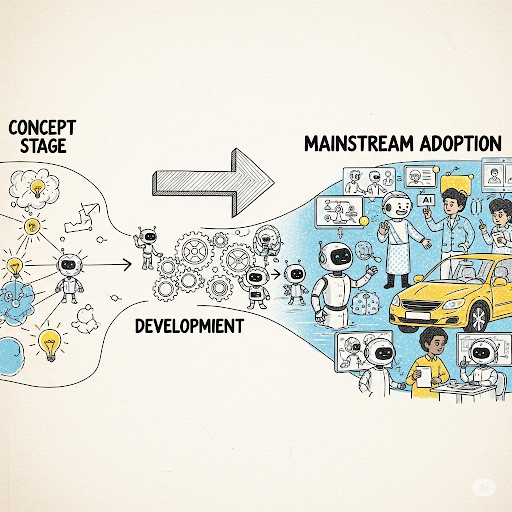
- The move into mainstream adoption could reshape both individual work habits and enterprise operations.
Artificial intelligence has already become a fixture in daily work, but according to Nick Rokke of The Bleeding Edge, we are entering a new stage where AI agents are no longer a concept or experiment but a mainstream reality. In his recent piece AI Agents for Everyone, Rokke explains that the latest generation of “agentic AI” is not simply responding to user prompts. Instead, it is capable of executing tasks in a way that resembles a human workflow—iterative, self-directed, and adaptive.
This shift represents a meaningful departure from how most people have experienced AI so far. Traditional large language models such as ChatGPT or Gemini respond to user input with a one-time answer. If the answer needs adjusting, the responsibility has been on the user to prompt again with more context or corrections. Agentic AI turns that structure on its head. It not only generates output but also evaluates its own work, makes revisions, and progresses through subtasks with far less supervision.
Rokke illustrates this change by contrasting a conventional AI exchange with the way agentic AI handles complexity. With standard models, a user might ask for a market research summary, receive a response, and then need to clarify that more details or a specific format are required. The AI provides another attempt, and the cycle continues. An AI agent, on the other hand, would break down the task into components, research independently, generate multiple drafts, critique its own results, and refine the answer until it reaches a polished conclusion. The responsibility shifts from the human providing multiple inputs to the AI managing the workflow itself.
“Instead of stopping at one attempt, agentic AI keeps going,” Rokke wrote. “It learns from its own mistakes, it iterates, and it works toward a result that is more useful.” This kind of capability brings the technology closer to the way a skilled assistant might handle assignments, not simply responding but also anticipating needs and adapting.
The implications are far-reaching. For individuals, the promise is reduced friction in everyday work. Tasks like drafting presentations, running analyses, or preparing reports may require fewer cycles of back-and-forth prompting. For businesses, the introduction of autonomous AI agents could streamline workflows that today depend heavily on employee oversight of tools. Rokke notes that the mainstream arrival of agentic AI marks “a seismic shift in how we interact with AI,” moving beyond novelty into systems that can handle substantial, real-world tasks.
A central difference is the nature of the output. Conventional language models generate what Rokke calls “zero-shot” responses: you ask, they answer, and the exchange ends unless you intervene. Agentic AI transforms this into a continuous process. The agent does not stop at a single answer; it drives the process forward, using a feedback loop to refine quality without needing additional human instruction. This shift from single-draft answers to multi-step refinement highlights why many see agentic AI as a new phase in the field rather than just an incremental update.
Some of this evolution is already visible in how companies are deploying AI today. Tools are emerging that string together multiple LLM calls with planning modules, memory, and error correction layers. The difference, Rokke emphasizes, is that these capabilities are no longer confined to labs or specialized developers. They are becoming widely available in commercial products and accessible platforms. This broad availability is what justifies the claim that AI agents are “for everyone.”
Still, Rokke tempers excitement with realism. While the promise of agentic AI is clear, its success will depend on reliability, efficiency, and the ability to integrate with human workflows. “This is not about replacing people,” he wrote. “It’s about enabling them to focus on higher-value decisions while the AI handles the lower-level iteration.” That framing reflects a broader trend in the conversation around AI adoption, where augmentation rather than replacement is emphasized as the most practical near-term outcome.
The comparison between conventional AI and agentic AI underscores the scale of change. Large language models are reactive, limited by the user’s ability to refine prompts and guide the tool. AI agents are proactive, capable of decomposing a problem and taking initiative in solving it. In practice, this might mean everything from running an in-depth analysis of financial data to automatically generating and revising software code until it meets the desired standard.
For many users, this change could feel subtle at first—more polished answers, fewer clarifications needed—but the cumulative effect may be transformative. Enterprises adopting agentic AI may see workflows compressed from days to hours. Individual professionals may find that time once spent nudging a model into usefulness can instead be devoted to strategy, analysis, or decision-making.
The question now is not whether AI agents will become widespread but how quickly their use will scale and what safeguards will accompany them. Rokke points to the current moment as an inflection point. “The technology has crossed the line from theory to practice,” he observed. “Now it is about integration and adoption.”
In this framing, AI agents represent both a natural extension of LLM progress and a distinct new phase. The underlying models remain crucial, but the ability to orchestrate them into autonomous systems changes their role from reactive tools to active participants in work. That change could mark the beginning of a long period of adaptation for individuals, businesses, and society as a whole.
As Rokke’s essay makes clear, the shift is not about making AI smarter in a single step but about teaching AI how to work more like people do—through trial, revision, and persistence. And with agentic AI now reaching the mainstream, the expectation is that more people will soon experience AI not as something they direct step by step, but as a partner capable of driving work forward on its own.
Learn how AI Agents can supercharge your company’s profits and productivity at TMC’s AI Agent Event Sept 29-30, 2025 in DC.
Rich Tehrani serves as CEO of TMC and chairman of ITEXPO #TECHSUPERSHOW Feb 10-12, 2026 and is CEO of RT Advisors and is a Registered Representative (investment banker) with and offering securities through Four Points Capital Partners LLC (Four Points) (Member FINRA/SIPC). He handles capital/debt raises as well as M&A. RT Advisors is not owned by Four Points.
The above is not an endorsement or recommendation to buy/sell any security or sector mentioned. No companies mentioned above are current or past clients of RT Advisors.
The views and opinions expressed above are those of the participants. While believed to be reliable, the information has not been independently verified for accuracy. Any broad, general statements made herein are provided for context only and should not be construed as exhaustive or universally applicable.
Portions of this article may have been developed with the assistance of artificial intelligence, which may have contributed to ideation, content generation, factual review, or editing.