Key Takeaways:
- AI is now the leading driver of IT investment for the second year in a row, with 58% of IT buyers ranking it as their top priority.
- Mid-market companies are adopting AI faster than large enterprises, with 92% expecting budget increases in 2026 compared to 46% of enterprises.
- Cybersecurity, CX, and cloud remain foundational, but AI is increasingly infused into all three, creating a dual-front opportunity for advisors.
- Less than half of advisors feel confident selling AI solutions, revealing a major readiness gap.
- Advisors who use AI internally report higher confidence, stronger revenue growth, and better client outcomes.
Introduction: A Market at an Inflection Point
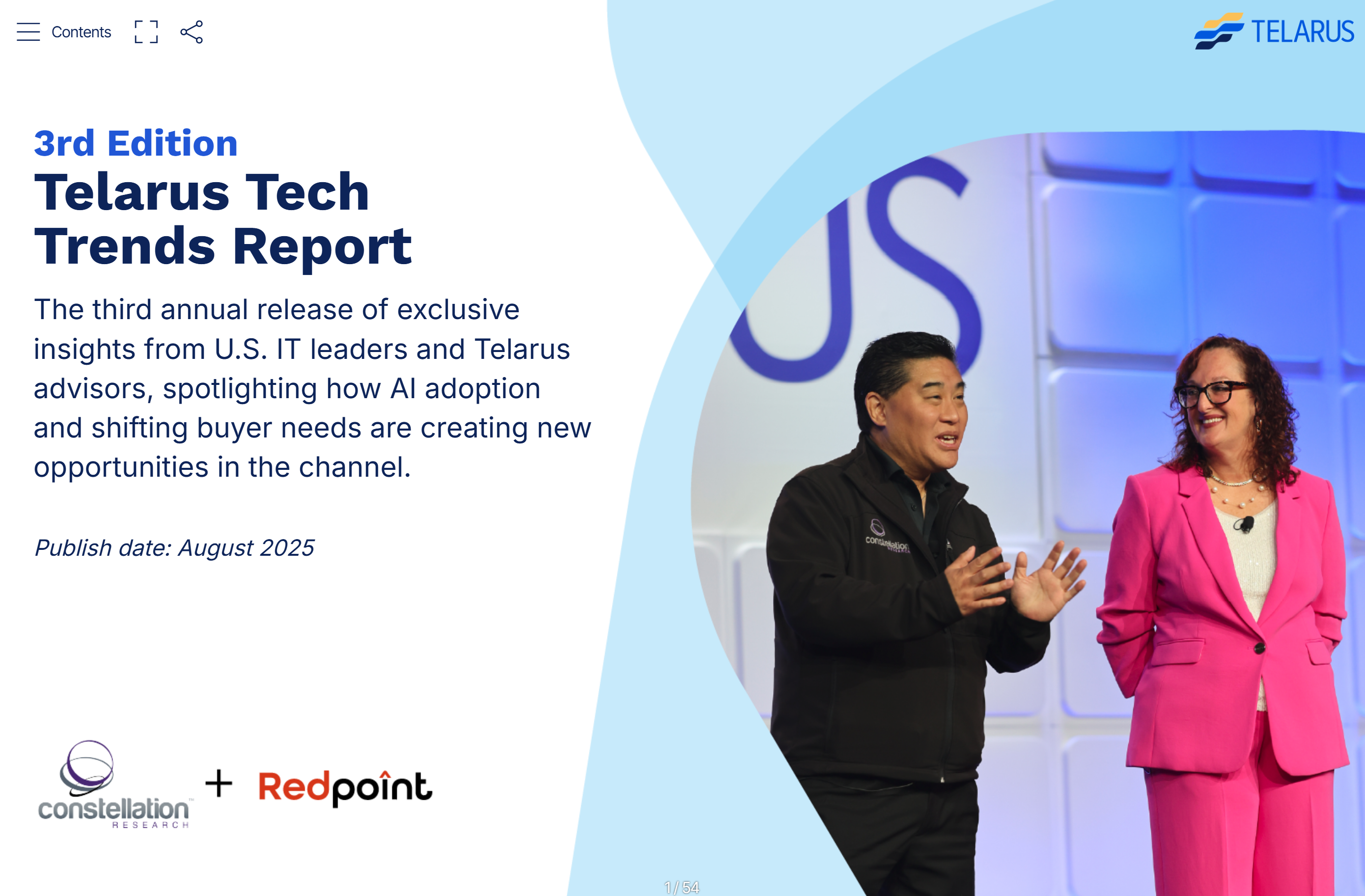
Technology advisors are navigating one of the most dynamic moments in the channel’s history. According to the newly released Telarus Tech Trends Report (3rd edition), based on surveys of nearly 400 IT buyers and over 450 technology advisors, AI has moved from experimental pilots to mainstream deployments across CX, cybersecurity, and cloud.
We were briefed about the content of the report at Telarus Partner Summit, recently in California and the final edition did not dissapoint.
Adam Edwards, CEO of Telarus, described the shift in his opening letter: “Most IT leaders report stable or growing budgets, but spending is shifting—away from headcount and toward tools that enable efficiency, automation, AI adoption, and digital customer experience”.

This realignment is creating both opportunities and risks for advisors. Buyers want more than access to products—they want guidance on implementation, governance, and measurable outcomes. As Edwards emphasized, advisors who evolve beyond resale into trusted transformation partners will be best positioned to lead.
AI Takes Center Stage
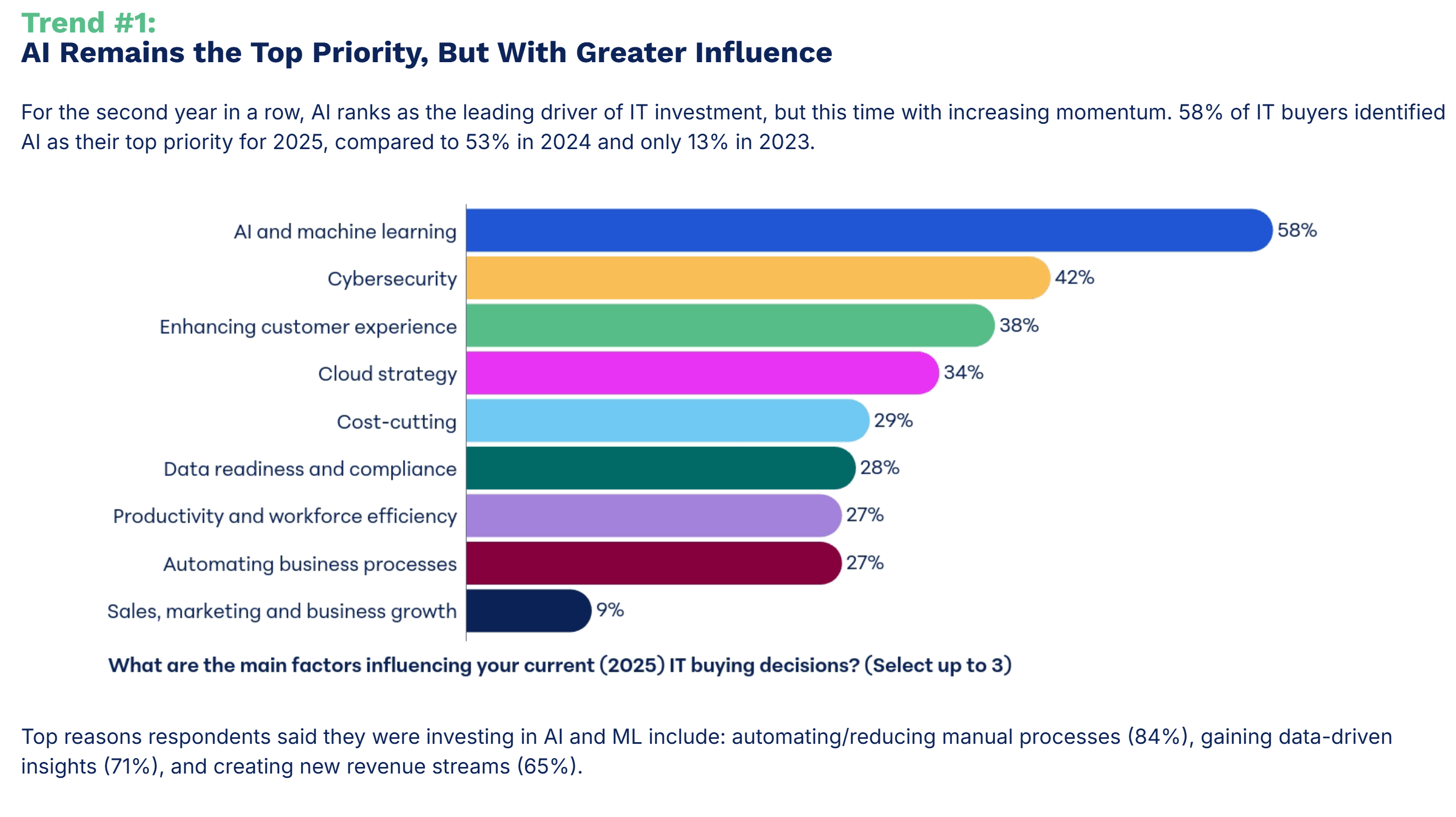
The report shows AI topping IT investment priorities for the second consecutive year, with 58% of buyers naming it their leading focus for 2025—up from 53% in 2024 and only 13% in 2023. The top use cases cited were automation of manual processes (84%), gaining data-driven insights (71%), and creating new revenue streams (65%).
At a Telarus panel discussion, Constellation Research CEO Ray Wang explained how quickly the AI landscape has evolved. “Three years ago, cyber was everything. Then generative AI appeared—creative, but not yet core to the enterprise. Then agentic AI hit, and everything changed. Two plus two equals four—but now the question is, what outcome do you want with that?”
Ray is one of the most spot-on tech analysts out there – so when he speaks, it is worth paying solid attention!
Dan Foster, Telarus CRO, underscored the pressure advisors are feeling: “There’s a massive opportunity in how much AI is driving buying decisions, but less than 40% of our advisors feel comfortable and confident selling it”.
This readiness gap is reflected in the report itself: only 13% of advisors say they feel “very prepared” to sell AI solutions, and one in three are not discussing AI with clients at all.
The Mid-Market Advantage
One of the clearest findings is the divergence between mid-market and enterprise strategies. Mid-market companies—defined as those with 51–500 employees—are proving far more agile.
- 92% of mid-market buyers expect IT budget increases in 2026, compared to just 46% of enterprises.
- 89% of mid-market firms plan to grow software spend, versus only 41% increasing headcount.
- Mid-market organizations are three times more likely to engage external advisors than large enterprises.
As Ray Wang put it, “The mid-market is using AI and automation as a lever to catch up. They can even leapfrog if they choose the right products”.
For advisors, this means the near-term growth engine lies squarely in mid-sized organizations. These buyers are open to experimentation, eager for guidance, and less constrained by bureaucratic procurement cycles.

Cybersecurity, Cloud, and CX: AI’s Adjacent Growth
While AI garners headlines, cybersecurity, CX, and cloud remain the backbone of advisor revenue. The Tech Trends Report highlights that UCaaS, networking, and cybersecurity are the top revenue generators, with cybersecurity and advanced networking expanding fastest.
Cybersecurity
- 60% of buyers are already using AI in cybersecurity, across real-time threat detection, automated incident response, and data loss prevention.
- Enterprise buyers lean toward code reviews and penetration testing, while mid-market buyers prioritize automated prevention—often compensating for leaner security teams.
Jason Stein, VP of Cybersecurity at Telarus, stressed that layering AI into defense strategies is now essential: “Suppliers we’ve added to the portfolio are going deep, from intrusion detection to remediation. This is far beyond antivirus or phishing tools”.
Cloud
Cloud modernization is particularly strong in the mid-market, where 63% of firms say they need external help migrating and scaling infrastructure. Advisors who specialize in cloud readiness and FinOps can capture significant demand as firms look to balance efficiency with AI integration.
Customer Experience
CX continues to be one of the most direct entry points for AI adoption. As Foster noted, behavioral analytics and sentiment analysis often serve as the “gateway drug” for organizations experimenting with AI.
The survey confirms this: UCaaS leads advisor revenue activity, with mid-market and enterprise buyers alike investing in virtual agents, real-time assistance, and hyper-personalized engagement.
Advisors Under Pressure
Despite the demand, many advisors remain behind the curve. Nearly half say they don’t feel prepared to sell AI, and 44% admit they rarely or never discuss data readiness with clients.
This is a missed opportunity, as buyers increasingly identify data readiness as a critical precursor to AI success. As one IT director at a mid-market manufacturing company put it: “We are looking to move all of our information systems into the cloud and use AI to help keep it secure and ready and functioning”.
Foster acknowledged the stakes: “If advisors aren’t asking security or AI questions, they’re leaving the side door open for others to get in. We have to back them up with certifications, engineering, and training”.
Telarus has invested in programs like AI Essentials learning tracks and advanced engineering certifications to help close the gap. Advisors who adopt AI internally—using it for operations, marketing, or solution pilots—report significantly higher selling confidence and stronger revenue growth.
Complexity Creates Opportunity
Even with AI’s acceleration, traditional challenges remain. Implementation is still difficult, especially when enterprises stack new software on legacy systems rather than replacing them.
As Adam Edwards explained, “Complexity is why this channel will always thrive. Marketplaces don’t solve integration. If it were as simple as point-and-click, Amazon would have done it. Advisors are needed when buyers face integration, compliance, and coordination challenges”.
Advisors can differentiate by offering:
- Expertise in high-demand areas like AI, cloud, and cybersecurity.
- Revenue assurance through platforms like Telarus Hub, which proactively identifies commission discrepancies and gives partners clearer visibility into their pipeline.
- Specialization in verticalized AI solutions, such as legal or healthcare-specific language models, which are beginning to emerge in CX and voice agent use cases.
The Road Ahead: Exponentials and Trust
Ray Wang has described this era as one of “AI exponentials,” where small teams can drive massive returns. “We’re seeing 10x, 100x, even 1,000x productivity gains. That’s the level of scale possible when AI and automation converge”.
Yet the report cautions that not all advisors are ready to operate at this pace. One in three aren’t even discussing AI, and those who hesitate risk losing ground to more proactive competitors.
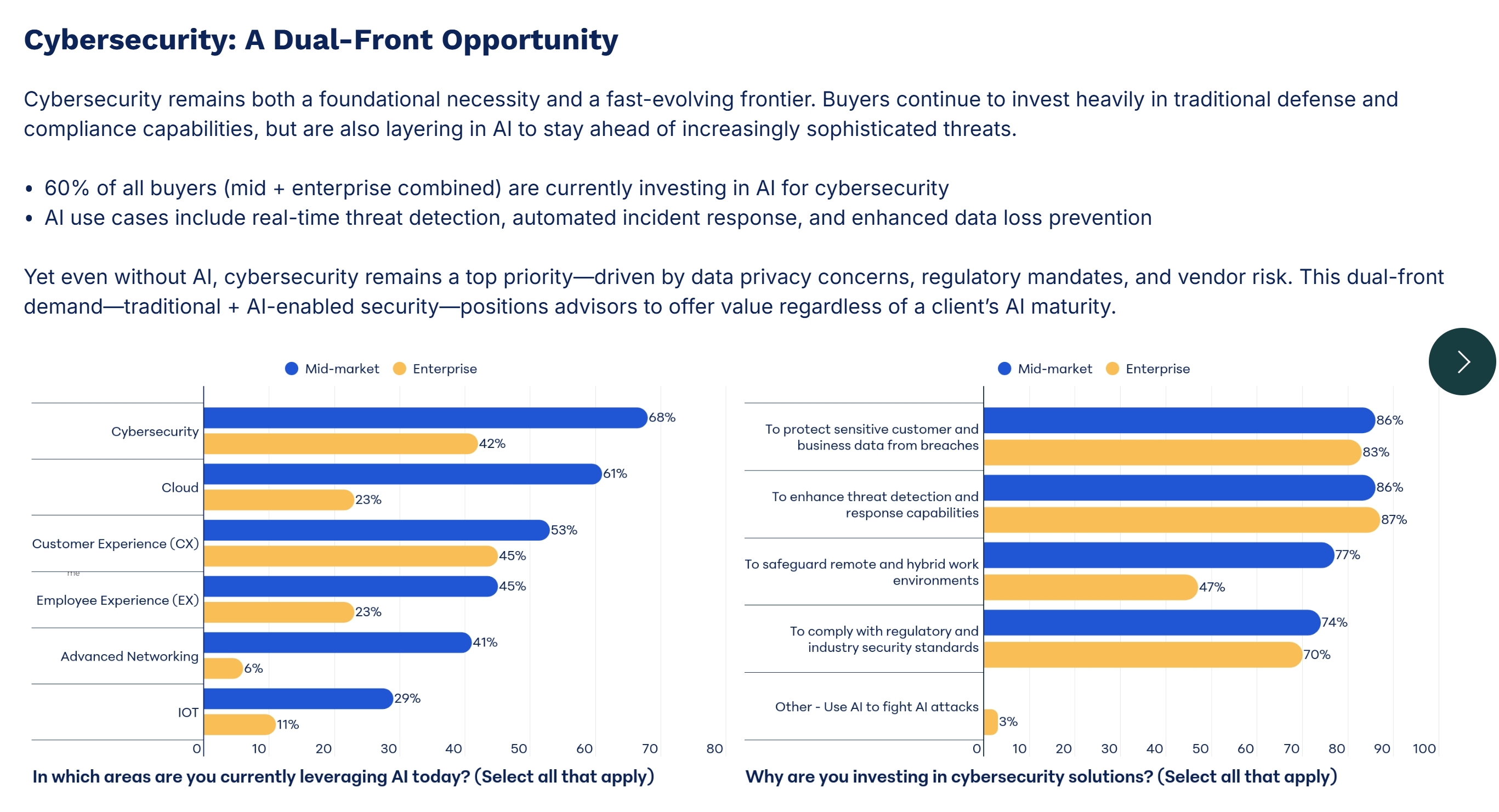
The bottom line is clear: opportunity is everywhere, but the window to act is now. Mid-market buyers are accelerating, enterprises are scrutinizing costs, and all segments are demanding trusted advisors who can connect emerging technologies to business outcomes.
As Edwards summed up, “Advisors who can evolve beyond solution selling to become trusted transformation partners will be best positioned to lead”.
Conclusion
The 2025 Telarus Tech Trends data paints a picture of a market in transition. AI is no longer experimental—it is strategic. Mid-market firms are pulling ahead, while enterprises wrestle with cost pressures. Cybersecurity, CX, and cloud remain foundational, but AI is being layered into all three.
For advisors, the message is both cautionary and optimistic. The demand for guidance has never been greater, but so too is the risk of falling behind. Success will depend on closing the AI readiness gap, embracing data-driven conversations, and positioning as strategic partners in transformation rather than mere resellers.
The channel thrives when complexity rises, and in 2025, complexity is everywhere. For advisors willing to specialize, adopt AI internally, and guide buyers through uncertainty, the path forward promises both growth and influence.
Learn how AI Agents can supercharge your company’s profits and productivity at TMC’s AI Agent Event, Sept 29-30, 2025 in DC.

If you liked this post, you’ll love one of the the leading global business communications and technology events since 1999, the ITEXPO #TECHSUPERSHOW, Feb 10-12, 2026 Fort Lauderdale, Florida.
Don’t forget the collocated MSP Expo – just for managed service providers!
Aside from his role as CEO of TMC and chairman of ITEXPO #TECHSUPERSHOW Feb 10-12, 2026, Rich Tehrani is CEO of RT Advisors and a Registered Representative (investment banker) with and offering securities through Four Points Capital Partners LLC (Four Points) (Member FINRA/SIPC). He handles capital/debt raises as well as M&A. RT Advisors is not owned by Four Points.
The above is not an endorsement or recommendation to buy/sell any security or sector mentioned. No companies mentioned above are current or past clients of RT Advisors.
The views and opinions expressed above are those of the participants. While believed to be reliable, the information has not been independently verified for accuracy. Any broad, general statements made herein are provided for context only and should not be construed as exhaustive or universally applicable.
Portions of this article may have been developed with the assistance of artificial intelligence, which may have contributed to ideation, content generation, factual review, or editing