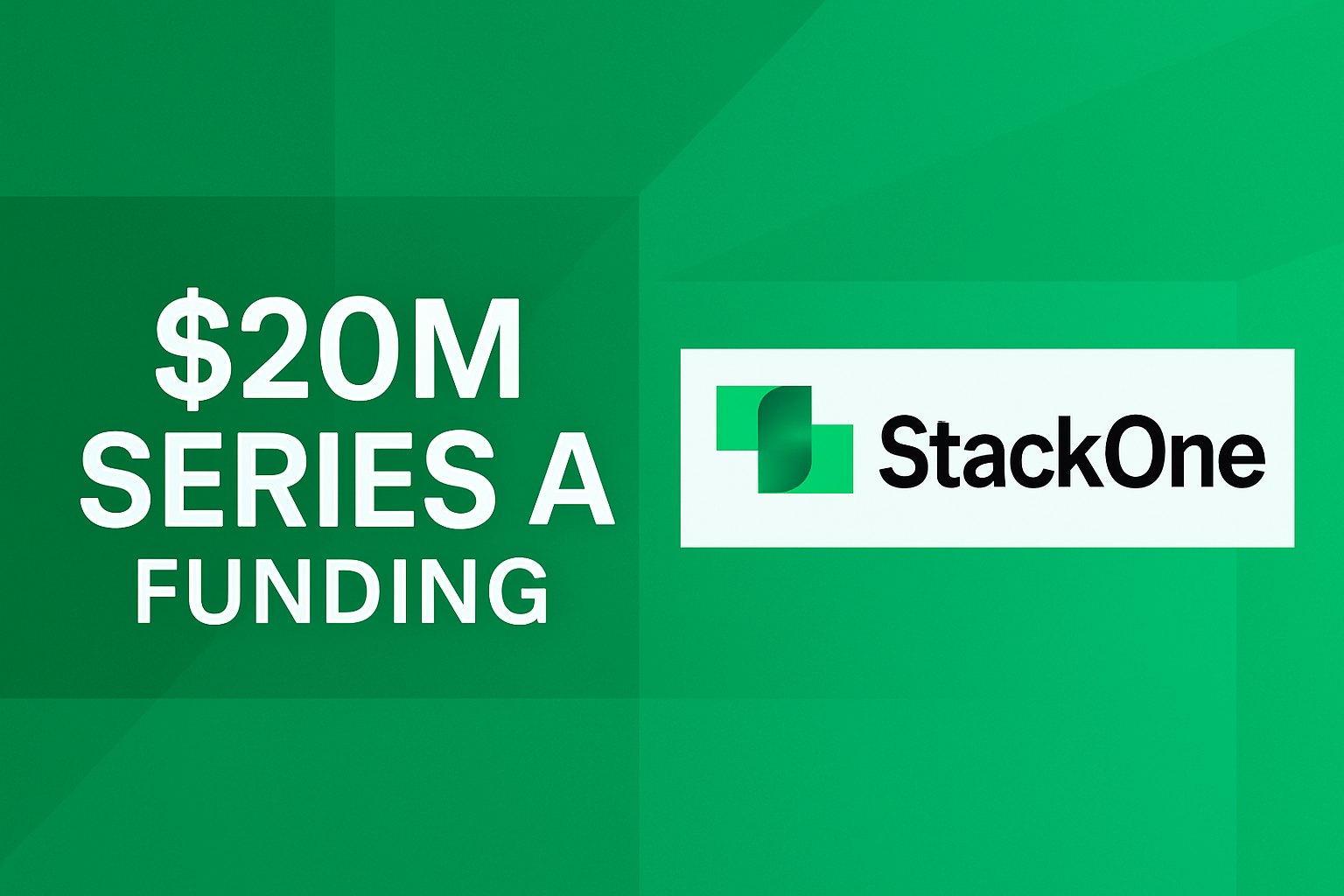
StackOne, an AI-powered integration platform for SaaS vendors and AI agents, has raised $20 million in a Series A funding round led by GV (formerly Google Ventures). The round also included participation from Workday Ventures, XTX Ventures, Episode 1, Playfair, and a group of strategic angels from companies including OpenAI, DeepMind, Microsoft, and MuleSoft. The latest investment brings StackOne’s total funding to $24 million.

The company plans to use the capital to enhance its proprietary tool-calling large language model (LLM), deepen platform integrations, and expand research and development initiatives. At the core of StackOne’s value proposition is a shift in how enterprise software tools are integrated—particularly in the age of increasingly autonomous AI agents.
If the name sounds familiar – it’s because yesterday we covered Stack AI, who raised $16M to create AI agents for every job.
The Challenge of Integration in SaaS and AI
As the number of business applications proliferates, software integration has become one of the most significant pain points for product and engineering teams. In B2B SaaS, integrations are no longer optional—they are a key differentiator. According to industry research cited by StackOne, 83% of B2B buyers consider integrations a top priority in purchasing decisions. Yet despite this urgency, 71% of SaaS firms still take three or more weeks to launch a single integration.
StackOne’s founders, CEO Romain Sestier and CTO Guillaume Lebedel, experienced this bottleneck firsthand while building products at companies like Google, Oracle, and Yieldify. In their view, the rise of AI agents has only compounded the issue, creating new demands for fast, secure, and scalable integrations that can support both human users and autonomous software systems.
“Guillaume and I have felt the acute pain of integrations for over a decade,” said Sestier. “We’d see teams burn months rebuilding or rejecting integration requests. Nothing on the market eased this pain, so we built it ourselves. StackOne is the platform we always wanted—built for the AI future of SaaS.”
“They’re creating infrastructure that modern software and the entire AI agent ecosystem can rely on.”
Luna Schmid, Partner at GV

Rethinking the Integration Architecture
StackOne’s approach combines a proprietary AI agent with a real-time integration engine designed for enterprise environments. The AI agent is tasked with parsing APIs, understanding business logic, and enabling integrations at a level of speed and precision that would be difficult to match with traditional development.
Instead of relying solely on conventional APIs or pre-built connectors, StackOne dynamically builds integrations with support for more than 200 platforms and 3,000+ actions. These include systems for HR, CRM, ticketing, identity and access management (IAM), and messaging—enabling coverage across much of the modern enterprise stack.
According to Lebedel, this unified layer is what differentiates StackOne from the growing number of Model Context Protocol (MCP) and agent-to-agent interoperability frameworks. “Standards like MCP show promise but fall short for enterprise use cases,” he said. “They lack the depth, security, and multi-tenant support necessary at scale. StackOne addresses those challenges directly.”
Real-World Results and Use Cases
StackOne’s impact has already been demonstrated by customers like Drata, Attensi, Localyze, and Mindtools, who are using the platform to build integrations faster and more securely than traditional methods allow. Drata, a compliance automation provider, recently launched 100 integrations using the platform. Mindtools, a provider of management development solutions, was able to deploy a Workday integration in record time, securing a new customer contract in the process.

These examples highlight the growing importance of integration infrastructure in both customer acquisition and retention. In sectors like HR, compliance, and operations—where data must move seamlessly across multiple systems—being able to deliver reliable, real-time integrations has become a competitive imperative.
Support from Strategic Investors
Investors backing StackOne cite the company’s architectural approach and long-term potential as reasons for their involvement.
“What impressed us most about StackOne is its ambition and clarity,” said Luna Schmid, Partner at GV. “They’re creating infrastructure that modern software and the entire AI agent ecosystem can rely on. The depth of secure integrations, the pace of delivery, and the team’s foresight into AI’s future uniquely position StackOne to redefine this category.”
Barbry McGann, Managing Director and SVP at Workday Ventures, noted the platform’s enterprise-readiness: “We’ve been impressed by how quickly and deeply StackOne integrates with complex enterprise systems. Their focus on agent-to-agent interoperability is unlocking powerful use cases for customers.”

Building an Ecosystem for AI Agent Builders
Beyond its technical platform, StackOne is fostering an ecosystem around enterprise AI integrations. The company has launched its own open-source initiatives and AI Demo Days, creating a community for AI developers, infrastructure teams, and researchers to collaborate and share best practices.
This community approach reflects StackOne’s larger ambition: not only to streamline the process of building and scaling integrations, but to become a central hub for the AI-powered future of software.
A Platform for the Long-Term
StackOne’s trajectory illustrates a larger trend in enterprise software—the shift from static, pre-defined integrations to dynamic, AI-augmented connections between systems. As AI agents become more common in enterprise workflows, the need for adaptable, secure integration platforms is expected to grow significantly.
While it remains early days in terms of widespread adoption, StackOne’s position in the integration market—estimated at $17.5 billion—suggests room for meaningful impact. With a platform designed for flexibility, scalability, and real-world security requirements, the company aims to serve not only the AI-first companies of today but also the broader software ecosystem of tomorrow.
Learn how AI Agents can supercharge your company’s profits and productivity at TMC’s AI Agent Event in Sept 29-30, 2025 in DC.
If you liked this post, you’ll love one of the the leading global business communications and technology events since 1999, the ITEXPO #TECHSUPERSHOW, Feb 10-12, 2026 Fort Lauderdale, Florida.
Don’t forget the collocated MSP Expo – just for managed service providers!

Aside from his role as CEO of TMC and chairman of ITEXPO #TECHSUPERSHOW Feb 10-12, 2026, Rich Tehrani is CEO of RT Advisors and a Registered Representative (investment banker) with and offering securities through Four Points Capital Partners LLC (Four Points) (Member FINRA/SIPC). He handles capital/debt raises as well as M&A. RT Advisors is not owned by Four Points.
The above is not an endorsement or recommendation to buy/sell any security or sector mentioned. No companies mentioned above are current or past clients of RT Advisors.
The views and opinions expressed above are those of the participants. While believed to be reliable, the information has not been independently verified for accuracy. Any broad, general statements made herein are provided for context only and should not be construed as exhaustive or universally applicable.