
Key Takeaways:
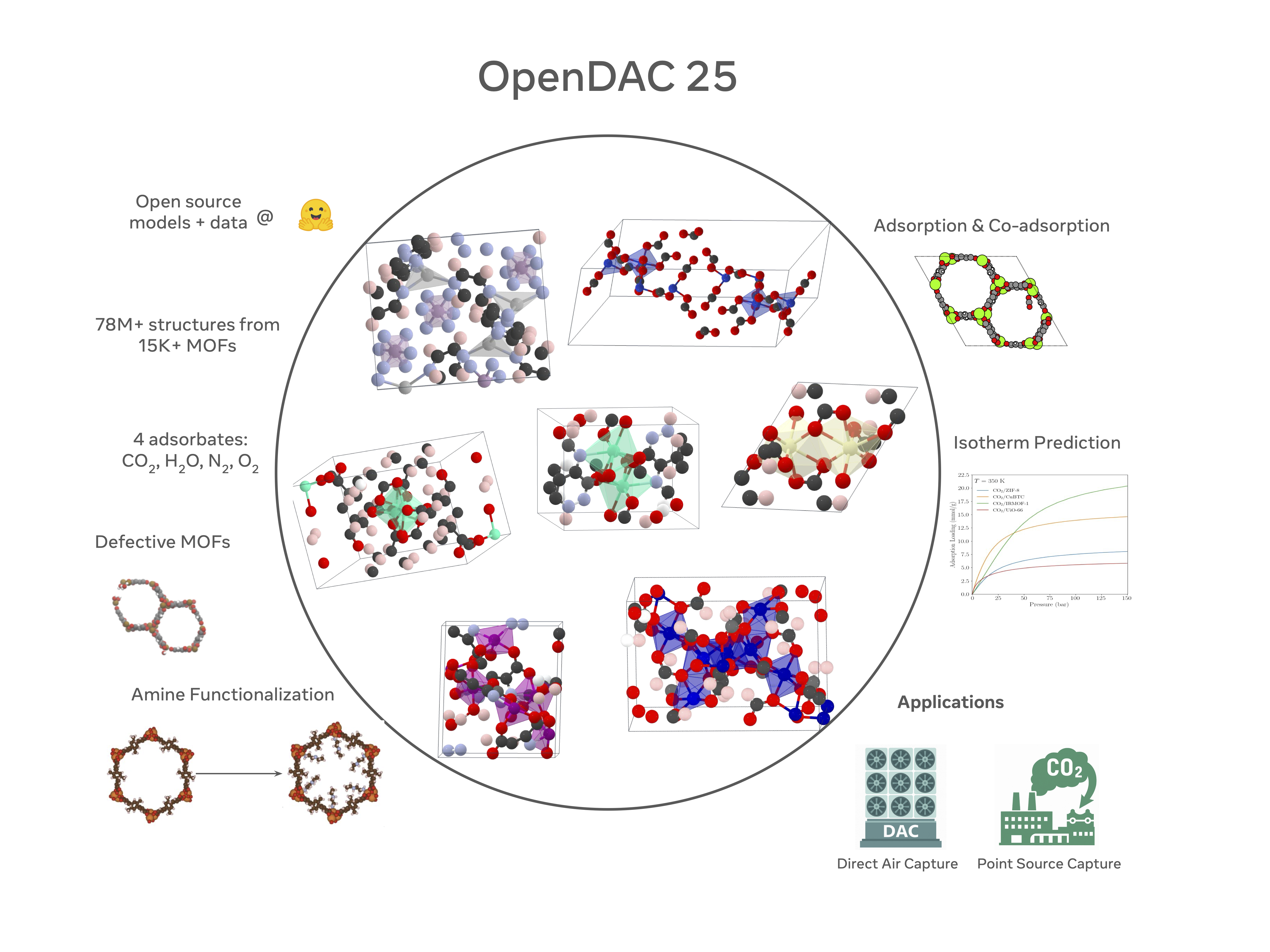
- Meta’s FAIR research group has launched the Open Direct Air Capture 2025 (ODAC25) dataset with nearly 70 million high-quality adsorption calculations.
- The dataset spans 15,000 functionalized and synthetically generated metal-organic frameworks (MOFs), covering CO₂, H₂O, N₂, and O₂.
- Alongside ODAC25, Meta released trained machine-learned interatomic potential models under the FAIR Chemistry License.
- Data access requires agreement to terms and accurate disclosure of personal and organizational information.
- The release underscores Meta’s push into open science, supporting AI-driven discovery for climate-related applications.
Meta’s Fundamental AI Research (FAIR) team has released a major new resource for climate and materials researchers: the Open Direct Air Capture 2025 dataset (ODAC25). Available through Hugging Face, ODAC25 provides nearly 70 million density functional theory (DFT) adsorption calculations designed to accelerate research into sorbent materials for direct air capture of carbon dioxide.
The dataset represents a significant expansion of earlier work, particularly the ODAC23 collection. Where ODAC23 focused on a narrower set of molecular interactions, ODAC25 introduces broader chemical and configurational diversity. It covers CO₂, H₂O, N₂, and O₂ adsorption energies across 15,000 metal-organic frameworks (MOFs) that are either functionalized or synthetically generated. These frameworks are considered promising candidates for carbon capture due to their porous structures and tunable chemical properties.
According to Meta’s supporting documentation on Hugging Face, the dataset was built using large-scale DFT simulations. These calculations capture how gas molecules interact with MOFs at the atomic level, providing researchers with a rich training ground for machine learning models that can predict adsorption behavior more efficiently. The scale of ODAC25—tens of millions of data points—marks one of the most comprehensive open resources available for direct air capture research.
Alongside the dataset, Meta has published state-of-the-art machine-learned interatomic potential models trained on ODAC25. These models are designed to accelerate adsorption energy prediction and Henry’s law coefficient estimation, which are critical to evaluating the performance of sorbents in real-world applications. While DFT simulations remain the gold standard for accuracy, they are computationally expensive. Machine-learned potentials trained on ODAC25 can deliver comparable results at a fraction of the cost and time, opening the door to broader exploration of candidate materials.
The dataset is distributed under a Creative Commons CC BY 4.0 license, ensuring broad reuse with appropriate attribution. The accompanying models, however, are covered under the FAIR Chemistry License (v1, updated in May 2025). This license includes an Acceptable Use Policy that prohibits uses related to military applications, critical infrastructure exploitation, disinformation campaigns, and other harmful activities. The explicit inclusion of these restrictions reflects a growing trend in AI-related research to balance openness with safeguards against misuse.
Accessing ODAC25 requires users to provide accurate personal information, including legal name, date of birth, and organizational details without acronyms or shorthand. These requirements aim to ensure responsible access and maintain accountability. Once granted, users can download the dataset, model checkpoints, and supporting materials. The FAIR team has also provided links to the fairchem GitHub repository, where developers can find tutorials, model usage guides, and an ASE-calculator integration for running adsorption simulations more easily.
The release builds on FAIR’s long-standing commitment to open-source contributions in AI. While Meta is better known for consumer-facing products and social platforms, the company has steadily expanded its investments in scientific research, particularly in areas where AI can play a transformative role. With ODAC25, Meta is positioning itself as a contributor to climate-focused AI research, aligning with broader global interest in developing scalable technologies for carbon removal.
Researchers studying direct air capture note that sorbent discovery is a major bottleneck. Identifying new MOFs with the right balance of stability, adsorption strength, and regeneration capability has traditionally been a slow, trial-and-error process. By providing both a large dataset and machine learning models, ODAC25 lowers barriers for scientists seeking to screen and optimize materials. As noted in an accompanying preprint on arXiv, the dataset’s scale and diversity should enable the development of models that generalize better across chemical systems and capture structural flexibility more effectively than earlier datasets.
The open nature of the release also means academic and industry labs without large compute budgets can access resources previously available only to a handful of institutions. By democratizing access to high-quality adsorption data and models, FAIR aims to accelerate discovery cycles and foster collaboration across the climate research ecosystem.
The implications extend beyond carbon capture. While ODAC25 is tailored to direct air capture, the methods and models could be adapted for other challenges in materials science, including gas separation, catalysis, and energy storage. The ability to predict molecular interactions at scale could significantly shorten the timeline for designing materials with properties optimized for specific applications.
Still, challenges remain. Large datasets and models are not a substitute for experimental validation, and translating computational predictions into deployable sorbents involves additional hurdles. Moreover, while the FAIR Chemistry License limits certain uses, enforcing acceptable use policies remains a complex issue in open-source communities. Balancing accessibility with safeguards will continue to be an area of debate as more AI-driven scientific tools are released.
In the broader context, ODAC25 illustrates how AI and machine learning are moving into domains traditionally dominated by physics and chemistry. By integrating large-scale simulations with AI methods, researchers are creating hybrid workflows that promise both accuracy and efficiency. Meta’s contribution through ODAC25 highlights the role of private-sector AI research teams in advancing not just consumer technology, but scientific progress on global challenges.
In conclusion, Meta’s release of the ODAC25 dataset and models provides researchers with an unprecedented resource for advancing direct air capture. By combining nearly 70 million adsorption calculations with trained interatomic potential models, FAIR is enabling a new wave of AI-driven materials discovery. The release underscores the potential for AI to accelerate solutions to climate change while raising important questions about access, licensing, and responsible use.
Learn how AI Agents can supercharge your company’s profits and productivity at TMC’s AI Agent Event in Sept 29-30, 2025 in DC.

Rich Tehrani serves as CEO of TMC and chairman of ITEXPO #TECHSUPERSHOW Feb 10-12, 2026 and is CEO of RT Advisors and is a Registered Representative (investment banker) with and offering securities through Four Points Capital Partners LLC (Four Points) (Member FINRA/SIPC). He handles capital/debt raises as well as M&A. RT Advisors is not owned by Four Points.
The above is not an endorsement or recommendation to buy/sell any security or sector mentioned. No companies mentioned above are current or past clients of RT Advisors.
The views and opinions expressed above are those of the participants. While believed to be reliable, the information has not been independently verified for accuracy. Any broad, general statements made herein are provided for context only and should not be construed as exhaustive or universally applicable.
Portions of this article may have been developed with the assistance of artificial intelligence, which may have contributed to ideation, content generation, factual review, or editing.