
Key Takeaways:
- Google has made external interoperability between Google Chat and Microsoft Teams available through NextPlane OpenHub.
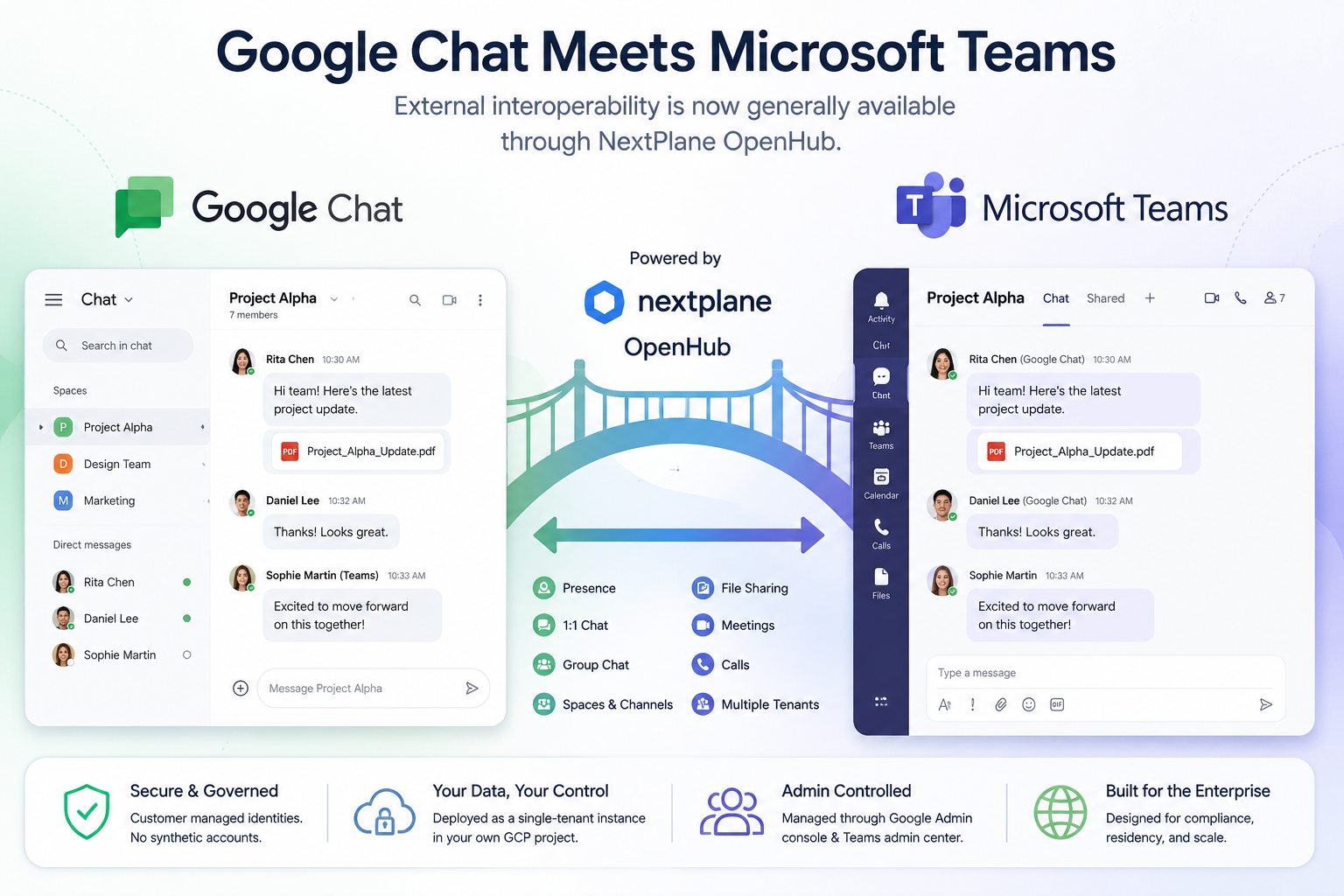
- The release supports presence, direct chat, group chat, Channels and Spaces, file sharing, and meeting and call initiation.
- The announcement matters for companies that need to collaborate across customers, suppliers, partners, resellers, and acquisition targets without forcing one side to change platforms.
- OpenHub is positioned around enterprise governance, including customer managed identities, customer controlled data, and deployment as a dedicated single tenant service.
- The move reflects a broader shift in enterprise UC, where coexistence among major collaboration platforms is becoming more important than forced consolidation.
For years, enterprise collaboration has had a fairly obvious problem: many companies standardize internally on one platform, but their customers, suppliers, channel partners, acquisition targets, and outside project teams often use another.
That gap has been especially visible between Google Workspace and Microsoft Teams. A company may run Google Chat internally while a key customer lives in Teams. A reseller may use Microsoft 365 while its vendor operates in Google Workspace. A newly acquired business may not be ready for a migration. In each case, the practical workaround has often been a messy combination of guest accounts, email threads, duplicate meetings, missed notifications, and users toggling between applications.
Google is now taking a more formal step toward reducing that friction. In a recent Google Workspace Updates post, the company announced that Google Chat external interoperability with Microsoft Teams through NextPlane OpenHub is now available. Google said the release enables Google Chat users to communicate with people on external Microsoft Teams tenants, allowing cross platform collaboration across organizational boundaries.
The feature set is broader than a basic chat bridge. Google said the release supports presence, one to one chat, group chat, Channels and Spaces, file sharing, and meeting and call initiation. A single Google Workspace environment can also connect to multiple external Microsoft Teams tenants through OpenHub, giving organizations a way to collaborate across several outside Teams environments through one interoperability layer.
That matters because many enterprises are no longer dealing with a single collaboration stack. They are dealing with a network of stakeholders, each with its own IT policies, security reviews, identity controls, and platform preferences. The traditional answer was often to push everyone toward one standard. In practice, that can be difficult, slow, and expensive. It can also be unrealistic when the outside party is a customer, a large partner, a telecom operator, a government agency, or a supplier with its own internal requirements.
The more practical question is becoming: how can teams collaborate without forcing every party to abandon the system they already use?
That is where NextPlane OpenHub is being positioned. Google said OpenHub was built to bridge the Google Chat and Microsoft Teams divide and provide a familiar cross platform collaboration experience without requiring all parties to use the same collaboration platform. The company also highlighted governance features, noting that OpenHub is deployed as a dedicated single tenant service, can run in a customer owned GCP project, and keeps customer data under customer control.
The identity model is another important part of the story. According to Google, OpenHub uses customer managed identities and does not require fake user accounts, NextPlane controlled user accounts, cross tenant impersonation, or a proxy Teams tenant. For regulated industries, large enterprises, and organizations with strict vendor risk management processes, those details are not minor. They can affect whether a deployment clears security, legal, compliance, and architecture reviews.
Google also said configuration and ongoing management are handled through the Google Admin console and Microsoft Teams admin center, without requiring a separate OpenHub administration console. Administrators on both sides must provide consent and register NextPlane OpenHub as an enterprise application before the feature can be used. Separate NextPlane licensing is required.
Coverage from ChromeUnboxed framed the announcement as part of a larger move away from platform walls in workplace communications. The publication noted that companies using Google Workspace often still need to work with clients, vendors, and suppliers that use Teams, and that this has historically led to guest accounts, fragmented email threads, and missed notifications.
The timing is interesting for the UC market. Collaboration platforms became central to enterprise work during the remote and hybrid work surge. But as the market matured, platform fragmentation became more visible. A company might standardize on Microsoft Teams for internal work, use Slack with engineering partners, rely on Google Workspace for document collaboration, and still need Webex or Zoom for customer meetings. That creates a daily operational burden for users and a governance challenge for IT.
Interoperability does not remove the need for good platform strategy. It does, however, give enterprises another option between full migration and unmanaged fragmentation.
For Google Workspace customers, the practical use cases are easy to understand. A company can collaborate with a Teams based customer without asking that customer to join Google Chat. A channel partner can keep its internal Teams workflows while working with a Google Workspace vendor. A company involved in M&A can support cross company communication before a full platform decision is made. A regulated organization can evaluate cross platform messaging while keeping identity, data control, and administrative consent in focus.
The announcement may also create opportunities for service providers and resellers. CEO Farzin Shahidi told us NextPlane has received a great deal of inbound inquiries since the announcement – ranging from global telecom carriers to resellers.
Still, the direction is consistent with where enterprise collaboration appears to be heading. Telecom operators, MSPs, systems integrators, and cloud resellers are increasingly being asked to help customers manage not just one UC platform, but a mixed environment of collaboration, calling, messaging, identity, compliance, and AI enabled productivity tools. A product that connects Google Chat and Microsoft Teams can become part of a broader managed collaboration strategy.
There is also a data residency angle. The NextPlane note emphasized that OpenHub can deploy as a single tenant instance on the customer’s own GCP environment. Google’s announcement similarly stated that OpenHub can run in a customer owned GCP project and keeps customer data under customer control. For organizations in financial services, healthcare, government, telecom, and other regulated sectors, that architecture may be an important part of the evaluation process.
The larger takeaway is that interoperability is becoming less of a convenience feature and more of an enterprise requirement. Companies are not collaborating inside neat platform boundaries anymore. They work across partner ecosystems, outsourced teams, regional subsidiaries, acquisition targets, regulated workflows, and global customer relationships. In that environment, the ability to communicate across Google Chat and Microsoft Teams without forcing a rip and replace project could help reduce operational friction.
This does not mean every enterprise will adopt OpenHub or that interoperability will solve every collaboration challenge. Admin consent is still required on both sides. Licensing must be evaluated. Security teams will need to review permissions, identity handling, retention, logging, and data flow. Legal and compliance teams may also want to understand how records, files, and meeting initiation are handled across each environment.
But the general availability announcement is still notable. Google is formally pointing Workspace customers toward a path for external interoperability with Microsoft Teams through NextPlane OpenHub. For the UC industry, that signals a continued shift away from closed collaboration islands and toward managed coexistence.
The wall between Google Chat and Microsoft Teams may not disappear overnight. But for enterprises that need to work across organizational and platform boundaries, it now appears to have a more formal doorway.

If you liked this post, you’ll love one of the the leading global business communications and technology events since 1999, the ITEXPO #TECHSUPERSHOW, Feb 9-11, 2027 Fort Lauderdale, Florida.
Don’t forget the collocated MSP Expo – just for managed service providers!
Aside from his role as CEO of TMC and chairman of ITEXPO #TECHSUPERSHOW Feb 9-11, 2027, Rich Tehrani is CEO of RT Advisors and a Registered Representative (investment banker) with and offering securities through Four Points Capital Partners LLC (Four Points) (Member FINRA/SIPC). He handles capital/debt raises as well as M&A. RT Advisors is not owned by Four Points.
The above is not an endorsement or recommendation to buy/sell any security or sector mentioned. No companies mentioned above besides NextPlane are current or past clients of RT Advisors.
The views and opinions expressed above are those of the participants. While believed to be reliable, the information has not been independently verified for accuracy. Any broad, general statements made herein are provided for context only and should not be construed as exhaustive or universally applicable.
Portions of this article may have been developed with the assistance of artificial intelligence, which may have contributed to ideation, content generation, factual review, or editing