
Key Takeaways:
- Enterprises continue to layer cloud services onto existing infrastructure, increasing operational complexity
- Fragmented visibility across cloud and on-prem environments can slow teams and elevate risk
- IP Fabric has expanded native Azure and GCP visibility while streamlining day-to-day workflows
- Unified, real-world network insight may help teams validate changes, improve compliance, and reduce troubleshooting time
Hybrid networking has quietly become the default operating model for many enterprises. Not because organizations planned it that way from the start, but because application architectures, regulatory pressures, and cost considerations pushed them there over time. One workload moved to the cloud. Then another. Soon enough, teams were managing a patchwork of on-premises infrastructure, private connectivity, and multiple cloud environments.
Here’s the thing. While infrastructure evolved, visibility often did not.
That gap is what IP Fabric is aiming to close with its latest platform updates, announced today. The company introduced new capabilities designed to unify network assurance across cloud, on-premises, and hybrid environments, with deeper native visibility into Microsoft Azure and Google Cloud Platform, expanded IPv6 support, and workflow improvements intended to make daily operations less painful for network, cloud, and security teams.

The challenge IP Fabric is addressing is not abstract. Enterprises today rely heavily on cloud networking constructs like private endpoints, interconnects, and cloud firewalls. These are powerful tools, but they are frequently managed in isolation from traditional network platforms. Over time, that separation creates blind spots. Engineers struggle to validate changes. Security teams lack confidence in compliance posture. Troubleshooting stretches longer than it should.
And when environments get large or regulated, those blind spots carry real consequences.
According to IP Fabric, organizations are not abandoning on-prem infrastructure so much as layering cloud services on top of it. That layered reality increases operational risk when teams cannot see how traffic actually flows end to end. The more distributed the architecture becomes, the harder it is to maintain a reliable source of truth.
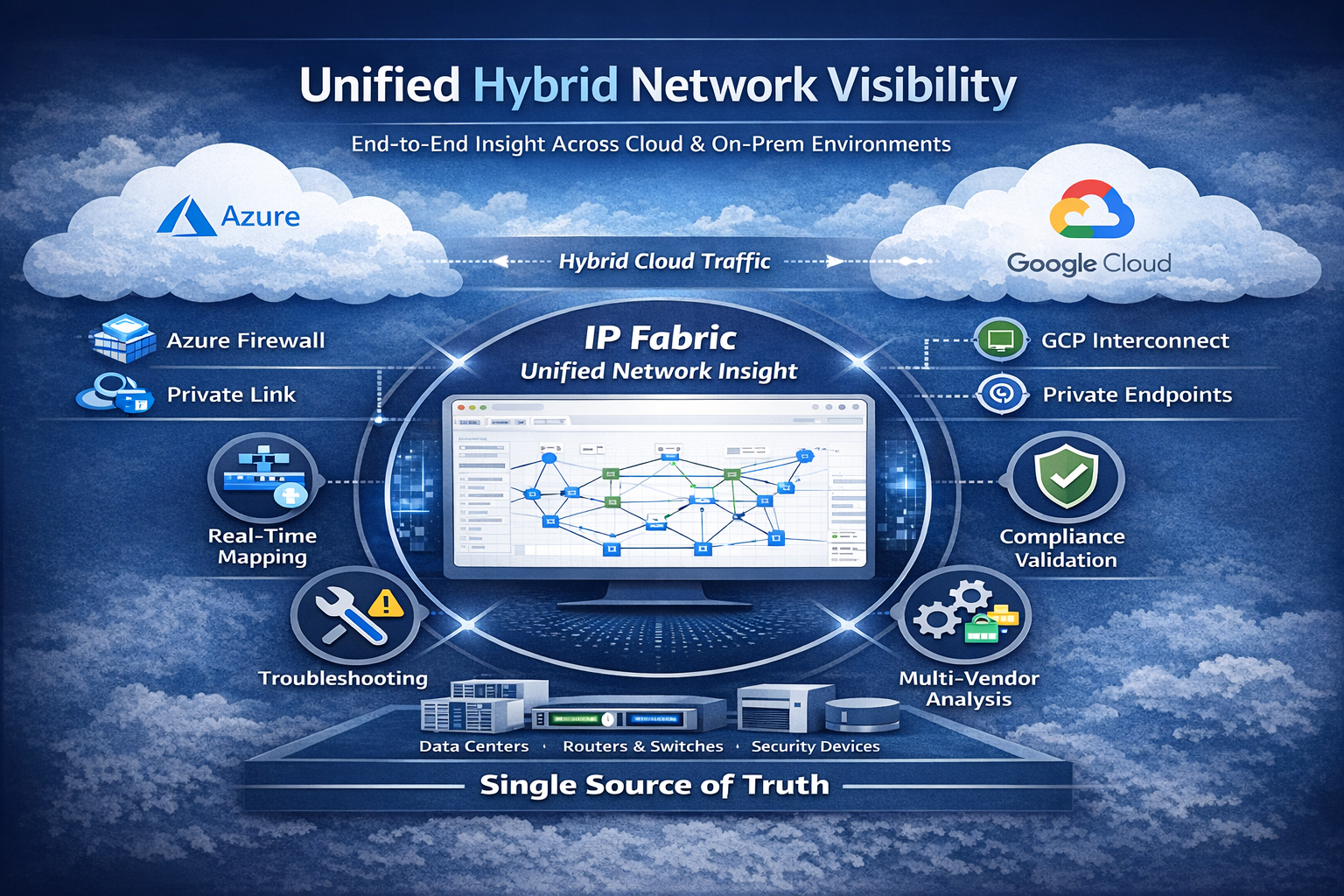
IP Fabric’s approach centers on providing an on-demand, continuously validated view of how networks truly operate, rather than how they are supposed to operate on paper. The new release enhances that model by pulling richer Azure and GCP context directly into its end-to-end network view. That includes expanded insight into Azure Firewall, Private Link, Private Endpoints, and multi-project discovery in GCP, as well as improved hybrid pathing through support for GCP Interconnect.
That distinction matters. Theoretical modeling can look clean but often breaks down when real-world configurations drift. Lightweight scanning tools might collect data, but they frequently lack the context required to explain what that data actually means in practice. IP Fabric positions itself differently, emphasizing immediate, actionable insight that reflects the current state of the environment.
“As compliance and operational risks escalate, enterprises cannot afford blind spots,” said Pavel Bykov, CEO and Co-Founder of IP Fabric. “To solve this, we’ve expanded cloud visibility while simplifying day-to-day operations for cloud, network and security teams.”
The simplification piece is easy to overlook, but it may be just as important as expanded visibility. Network tools have a reputation for being powerful yet cumbersome. Over time, complexity accumulates in the tooling itself. IP Fabric’s update includes workflow enhancements like CSV-based attribute import and export, simplified filter management, and clearer diagrams with improved path interpretation. None of those features are flashy on their own, but together they can reduce friction for teams trying to move quickly without breaking things.
And speed matters. Hybrid network projects are rarely static. Mergers and acquisitions, SD-WAN deployments, automation initiatives, and cloud migrations all depend on accurate understanding of dependencies and paths. When teams lack confidence in what is actually connected to what, projects slow down or stall entirely.
One of the more interesting aspects of IP Fabric’s positioning is its focus on being a single source of truth across vendors and environments. Modern networks rarely belong to one ecosystem. Multi-vendor reality is the norm, not the exception. Normalizing that data and presenting it in a consistent way can help teams spend less time reconciling tools and more time solving problems.
There’s also a compliance angle that keeps coming up in conversations with large enterprises. Regulatory expectations continue to rise, particularly in industries where network misconfigurations can translate directly into risk exposure. Visibility is not just an operational concern anymore. It is a governance requirement.
IP Fabric argues that by continuously validating configurations and interdependencies, teams can surface risks earlier and make decisions grounded in actual network behavior. That may help organizations reduce outages, improve security posture, and better manage spend, especially as cloud environments scale.
None of this eliminates the inherent complexity of hybrid networks. But it does suggest a shift in how that complexity is managed. Rather than treating cloud and on-prem environments as separate worlds, IP Fabric is betting that unifying them under a single operational model is the more sustainable path forward.
As hybrid architectures continue to mature, tools that can keep pace with real-world change without adding friction are likely to stand out. Whether this latest expansion gives IP Fabric an edge will depend on how effectively teams can translate improved visibility into better outcomes. But the direction is clear. Fragmented insight is no longer sufficient.
And for many enterprises, it hasn’t been for a while.

If you liked this post, you’ll love one of the the leading global business communications and technology events since 1999, the ITEXPO #TECHSUPERSHOW, Feb 10-12, 2026 Fort Lauderdale, Florida.
Don’t forget the collocated MSP Expo – just for managed service providers!
Aside from his role as CEO of TMC and chairman of ITEXPO #TECHSUPERSHOW Feb 10-12, 2026, Rich Tehrani is CEO of RT Advisors and a Registered Representative (investment banker) with and offering securities through Four Points Capital Partners LLC (Four Points) (Member FINRA/SIPC). He handles capital/debt raises as well as M&A. RT Advisors is not owned by Four Points.
The above is not an endorsement or recommendation to buy/sell any security or sector mentioned. No companies mentioned above are current or past clients of RT Advisors.
The views and opinions expressed above are those of the participants. While believed to be reliable, the information has not been independently verified for accuracy. Any broad, general statements made herein are provided for context only and should not be construed as exhaustive or universally applicable.
Portions of this article may have been developed with the assistance of artificial intelligence, which may have contributed to ideation, content generation, factual review, or editing