Key Takeaways
- AI is moving from a software story to a physical infrastructure story involving power, chips, memory, cooling, land, water, cloud capacity and financing.
- Recent developments suggest that AI demand is scaling faster than some underlying systems can support without higher costs, local resistance or capacity constraints.
- Cloud buyers may need to rethink the assumption that AI compute will be cheap, elastic and always available.
- Data center growth is becoming a local policy issue as communities weigh jobs and tax revenue against water use, power demand, grid costs and land use.
- Enterprises should treat AI adoption as an infrastructure strategy, not only a software or productivity initiative.
The artificial intelligence boom has mostly been described through software. The public sees chatbots, copilots, coding agents, search summaries, synthetic media, automated workflows and customer service tools. Executives see productivity potential. Vendors see new revenue. Investors see a platform shift.
But the next phase of AI is becoming much more physical.
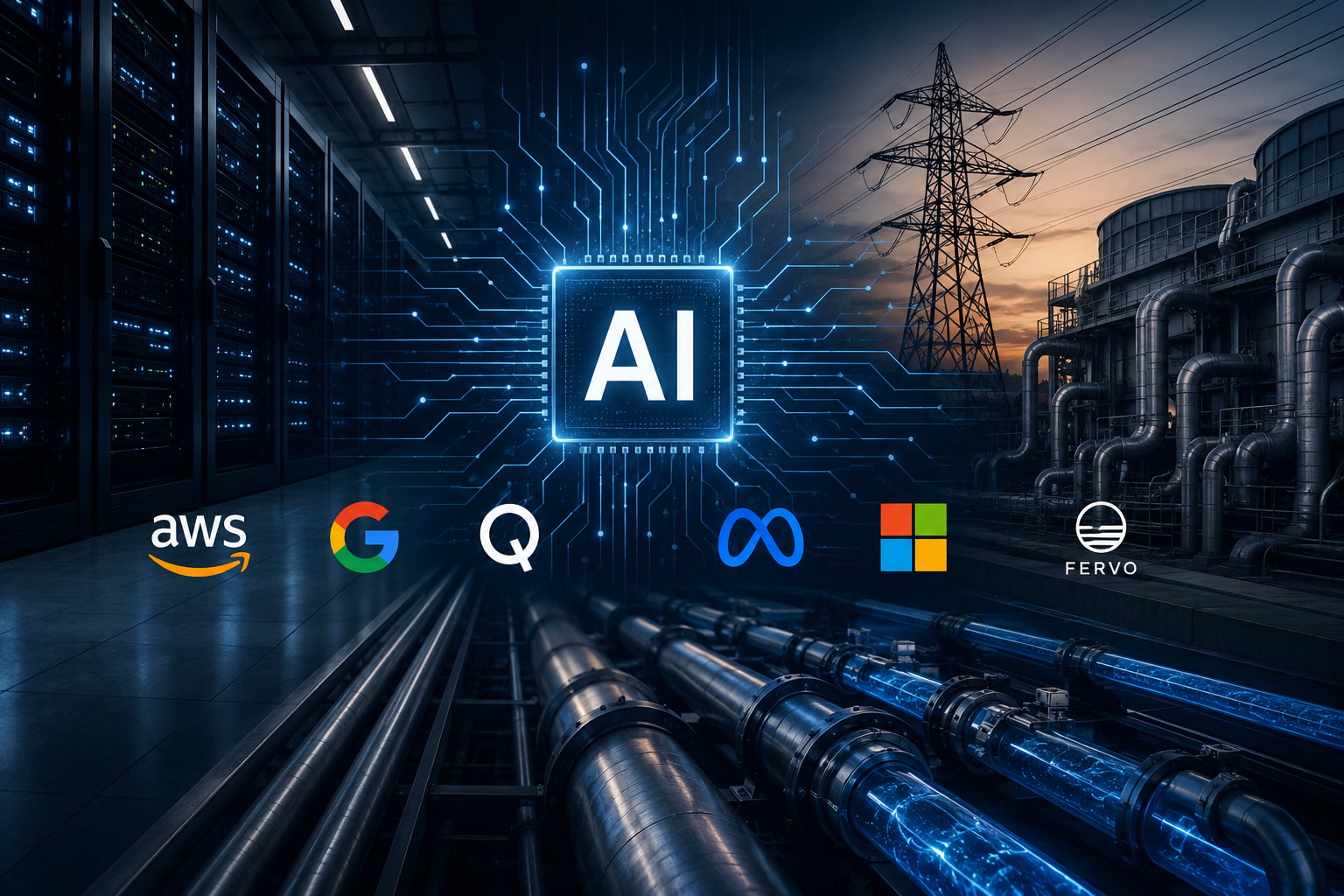
Behind every prompt is a data center. Behind every model is a chain of chips, memory, cooling systems, electrical substations, cloud contracts, fiber routes, financing structures and local permits. As AI workloads move from experiments into production, these hidden layers are becoming harder to ignore.
The market is now facing a basic question: can the real-world infrastructure behind AI scale fast enough to support the expectations being placed on it?
A recent Qualcomm data center update captured the scale of the shift. Qualcomm is expanding its AI data center strategy as large financial institutions raise forecasts for AI-related capital spending. Goldman Sachs has projected roughly $7.6 trillion in cumulative AI-related expenditures from 2026 to 2031, including data centers, power and compute infrastructure. Hyperscalers are already spending heavily to secure the capacity needed to run AI services at scale.
That spending tells a larger story. AI adoption is no longer limited by curiosity. Enterprises want more AI. Software providers want to embed AI into more applications. Cloud platforms want to support more model training and inference. The limiting factor is increasingly the infrastructure required to make those ambitions work.
This marks a change from earlier cloud cycles. For years, enterprise technology buyers grew accustomed to capacity that felt almost unlimited. Cloud computing made it possible to add servers, storage and applications without owning the underlying hardware. Costs did not always fall in a straight line, but the overall expectation was that cloud capacity would become broader, more efficient and easier to consume.
AI complicates that assumption.
The most demanding AI workloads depend on specialized GPUs, accelerators, high-bandwidth memory, advanced networking and dense server environments. These resources cannot be created instantly. They depend on long manufacturing cycles, complex supply chains and data center facilities that require major power and cooling upgrades. As a result, AI capacity is beginning to behave less like a simple utility and more like a scarce strategic asset.
Cloud pricing is one of the early indicators. In one AI cloud pricing development, Amazon Web Services raised pricing for AI-related GPU capacity, reflecting the premium being placed on scarce infrastructure. Another AWS capacity block update pointed to continued pressure around EC2 Capacity Blocks for machine learning.
The message for enterprise buyers is straightforward. AI cost planning cannot assume that compute will always be inexpensive, elastic and easy to reserve. A pilot project may tolerate variable costs. A production AI system tied to customer service, software development, fraud detection, compliance review or sales operations needs a more disciplined model.
That discipline starts with understanding actual usage. Training, fine tuning, inference, retrieval, storage, monitoring and governance all carry different cost profiles. Some organizations may be able to use smaller models, retrieval-augmented generation, caching or workload optimization to reduce exposure. Others may need committed cloud capacity or hybrid infrastructure. In either case, the economics should be modeled before AI becomes operationally embedded.
The compute access issue is not limited to smaller companies. A report involving Google and Meta described Google capping Meta’s Gemini usage after Meta reportedly sought more capacity than Google could provide. The point is not simply that one large technology company had a constraint with another. It is that even the largest AI participants can encounter limits when demand rises faster than available infrastructure.
That should make enterprise buyers more careful. AI vendor evaluation should not stop at model quality, user interface or integration features. Buyers should also ask about capacity commitments, usage limits, latency, regional availability, service continuity, model dependency and pricing exposure. A vendor may have a compelling AI feature, but the business value depends on whether that feature remains available, affordable and reliable when usage expands.
The pressure is also moving into the component supply chain. A memory market report described how rising DRAM costs are affecting device pricing and putting pressure on smaller electronics firms. AI infrastructure is a major driver because advanced data center systems require large amounts of DRAM, LPDDR and high-bandwidth memory.
This is where AI becomes a broader technology procurement issue. Memory used in AI servers is part of a larger supply ecosystem that also affects devices, embedded systems, communications equipment, routers, industrial hardware and other electronics. When large data center buyers absorb more supply, smaller manufacturers may face higher costs or weaker allocation priority.
For enterprise customers, the impact may appear indirectly. A company may not be buying GPUs, but it may still pay more for hardware refreshes, edge systems, workstations, appliances or specialized devices. AI demand can lift costs in categories that are not labeled as AI. Procurement teams should consider whether longer lead times, higher component prices or supplier concentration could affect broader IT planning.
Cooling is another part of the equation. AI data centers are not just larger versions of traditional facilities. They are often denser, hotter and more complex. High-performance AI racks can generate thermal loads that require liquid cooling or other advanced systems. That makes cooling reliability a direct factor in AI uptime.
A recent Omen AI funding announcement illustrates the shift. The company raised $31 million to expand coolant monitoring for data centers. On the surface, coolant monitoring may sound like a narrow engineering function. In practice, it points to a larger operational reality. As AI facilities become more thermally intense, coolant quality, contamination, bacterial growth and system performance can affect reliability.
That adds another layer to enterprise risk. AI may feel digital to the user, but the infrastructure is physical. Hardware can overheat. Cooling loops can degrade. Power systems can fail. Supply chains can tighten. Facilities can be delayed. When AI workloads become business-critical, these physical dependencies become business continuity issues.
Power may be the largest constraint of all.
A Fervo Energy market development showed how AI demand is reshaping interest in energy infrastructure. Geothermal, nuclear, natural gas, renewables, storage and grid modernization are all being pulled into the AI conversation because data centers require reliable electricity at massive scale.
That does not mean every AI project will reshape an energy market. But at the hyperscale level, power availability can influence where data centers are built, how quickly they can open and what kinds of energy contracts developers pursue. For some regions, AI infrastructure may become an economic development opportunity. For others, it may become a source of tension over grid capacity, water use and ratepayer costs.
Local communities are starting to respond accordingly. In Ohio, an early-stage Belmont County data center concept raised questions around a potential 2 to 3 gigawatt project. The company involved described the activity as exploratory, but the scale alone was enough to prompt discussion about power, water, land use, feasibility and transparency.
That reaction is not surprising. A project measured in gigawatts is not a routine commercial real estate proposal. It can affect utility planning, transmission needs, land development, road use, construction labor and long-term regional strategy. Counties that once reviewed warehouses, offices and industrial sites are now being asked to evaluate infrastructure projects with far larger energy profiles.
Florida shows a similar pattern. A DeSoto County data center moratorium report described a move toward a one-year pause on new data center applications after residents raised concerns about water use, power demand, gas turbines and transparency around a proposed hyperscale campus.
The issue is not that every data center project is harmful. Many communities want investment, tax revenue and job creation. A well-planned data center can be part of a broader economic development strategy. But communities are increasingly asking for specifics. How much water will be used? Will the project require new utility infrastructure? Who pays for that infrastructure? How will backup power be handled? What are the noise, heat and environmental impacts? Will residents face higher costs?
Those questions are also reaching regulators. An Arizona utility regulation update highlighted concerns around data center growth, extreme heat, water stress and electric bills. The central issue is cost allocation. If utilities build new infrastructure to serve large data center loads, regulators may need to determine whether those costs are paid by the data center customers, broader ratepayers or some combination of both.
That debate could become more common as AI infrastructure expands. Data centers can be attractive utility customers because they consume large volumes of power on predictable schedules. But if serving them requires new substations, transmission lines or generation resources, the public policy questions become more complex. Local residents may support economic development while still opposing arrangements that shift costs or resource burdens onto households and small businesses.
Tax incentives add another layer. A Google data center incentive report described long-term property tax abatements tied to planned data center projects in Arkansas. These agreements can help states compete for large infrastructure investments, but they also require careful analysis of public costs and benefits.
The challenge is that data center economics are often difficult for communities to evaluate early. A project may promise investment and future tax revenue, but incentives can reduce near-term public collections. Utility needs may evolve over time. Expansion phases may change the original assumptions. Water, power and land use impacts may become clearer only after planning advances.
This is why transparency is becoming central to the AI infrastructure conversation. Developers need predictable approval processes. Communities need credible information. Utilities need planning visibility. Regulators need to understand who benefits and who pays. Without that clarity, more projects may face delays, moratoriums or political opposition.
The financing side also deserves attention. A Bank for International Settlements warning raised concerns that some AI financing structures could amplify a market downturn if expectations shift. The concern centers on non-bank financing, private credit, hedge funds and related structures that can move quickly when sentiment changes.
This does not mean AI infrastructure investment is inherently unstable. Large capital projects often rely on complex financing, and AI demand may support significant long-term investment. Still, the scale of the buildout raises the importance of execution. If AI revenue grows more slowly than expected, if cloud margins narrow, if power costs rise or if data center projects face delays, investors may reassess risk. That could affect financing availability, project timing and pricing for end customers.
For enterprises, the practical lesson is not to avoid AI. It is to adopt AI with a better understanding of the infrastructure behind it.
- First, companies should separate AI experimentation from AI production. Experiments are valuable, but they can hide cost and capacity issues. Production deployments require clearer assumptions around usage, performance, security, uptime, data governance and vendor dependency.
- Second, enterprises should map which AI workloads are mission-critical. A marketing content assistant and an AI-powered fraud detection system do not carry the same risk. A customer support agent that handles live interactions has different requirements than an internal research tool. Each workload should be evaluated for availability, cost volatility, data sensitivity and fallback options.
- Third, buyers should press vendors on infrastructure resilience. Which cloud providers support the service? Are there usage caps? What happens during capacity shortages? Can workloads be moved between models? Is pricing fixed, usage-based or subject to change? Are there regional restrictions? How is customer data protected if model providers or infrastructure partners change?
- Fourth, finance teams should be involved earlier. AI adoption often starts in technology or innovation groups, but production AI can become a material operating expense. Token usage, GPU reservations, storage, monitoring and vendor commitments can add up quickly. CFOs do not need to slow innovation, but they should help build a cost framework before usage scales.
- Fifth, boards should ask infrastructure questions. AI strategy should include more than model selection and employee adoption. Directors may need to understand exposure to cloud pricing, vendor concentration, data center regions, regulatory constraints, energy availability and continuity planning. These issues are now part of AI governance.
The broader takeaway is simple. AI is not just an application layer. It is a stack that reaches into the physical economy.
Models depend on compute. Compute depends on chips and memory. Chips and memory depend on supply chains. Data centers depend on land, water, cooling and power. Power depends on utilities, generation, transmission and regulation. Financing depends on confidence that AI demand will justify the enormous capital being deployed.
That chain is now visible.
The next phase of AI will likely be shaped as much by infrastructure execution as by model innovation. Companies with reliable access to compute, disciplined cost controls and resilient vendor strategies may be better positioned to turn AI into measurable business value. Companies that treat AI as a simple software add-on may run into surprises as pricing, capacity and operational dependencies become clearer.
The AI buildout has hit the real world. The question now is whether enterprises, cloud providers, utilities, regulators, investors and communities can align fast enough to support it.

If you liked this post, you’ll love one of the the leading global business communications and technology events since 1999, the ITEXPO #TECHSUPERSHOW, Feb 9-11, 2027 Fort Lauderdale, Florida.
Don’t forget the collocated MSP Expo – just for managed service providers!
Aside from his role as CEO of TMC and chairman of ITEXPO #TECHSUPERSHOW Feb 9-11, 2027, Rich Tehrani is CEO of RT Advisors and a Registered Representative (investment banker) with and offering securities through Four Points Capital Partners LLC (Four Points) (Member FINRA/SIPC). He handles capital/debt raises as well as M&A. RT Advisors is not owned by Four Points.
The above is not an endorsement or recommendation to buy/sell any security or sector mentioned. No companies mentioned above are current or past clients of RT Advisors.
The views and opinions expressed above are those of the participants. While believed to be reliable, the information has not been independently verified for accuracy. Any broad, general statements made herein are provided for context only and should not be construed as exhaustive or universally applicable.
Portions of this article may have been developed with the assistance of artificial intelligence, which may have contributed to ideation, content generation, factual review, or editing