
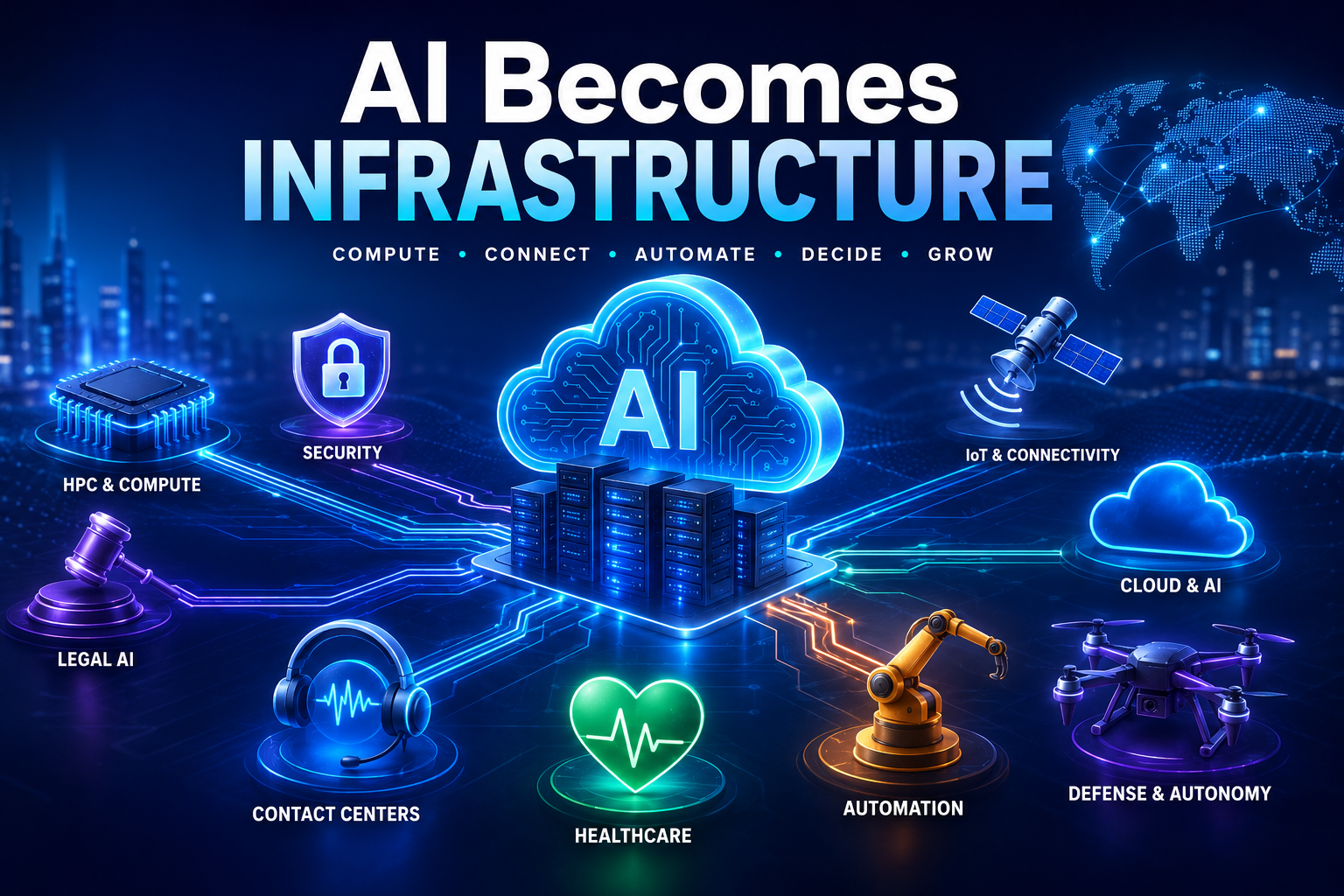
The enterprise AI market is moving into a more practical phase. The conversation is no longer limited to model releases, chatbot experiments, or broad predictions about productivity. Across cloud, communications, healthcare, cybersecurity, contact centers, IoT, legal services, defense, and high-performance computing, the same pattern is becoming clear: AI is turning into infrastructure.
That shift matters because infrastructure changes buying behavior. It changes budgets. It changes risk models. It changes who owns the decision. A software tool can be tested by a department. Infrastructure requires executive sponsorship, security review, integration planning, operational accountability, and a clear view of how the technology will scale.
The latest wave of recent tech news points to this transition from multiple angles. A CPU-only exascale system reshapes the global high-performance computing landscape. AI legal automation shows how generative systems are moving into regulated professional workflows. Contact center AI reliability demonstrates why enterprises are focusing less on generic model capability and more on controlled, measurable outcomes. Agentic AI in healthcare and life sciences shows how AI depends on cloud, data modernization, and workflow integration before it can create operational value.
Taken together, these stories describe a market that is maturing quickly. AI is becoming embedded in the systems companies rely on to serve customers, secure products, process claims, manage infrastructure, conduct research, and make decisions. It is becoming less of a standalone category and more of a horizontal layer across enterprise operations.
That makes the current moment important for business technology leaders. The question is not simply whether a company is using AI. Many are. The better question is whether the organization has the infrastructure, governance, data quality, security posture, and operating model required to use AI reliably at scale.
High-performance computing offers one of the clearest examples of how quickly the foundation is changing. The emergence of the LineShine system as a CPU-only machine passing the exascale barrier shows that the AI infrastructure race is not following a single path. GPU-based systems remain central to many AI workloads, but the broader compute market is fragmenting into multiple architectures optimized for different performance, sovereignty, energy, and workload requirements.
This has implications far beyond national labs. Enterprises that rely on simulation, digital twins, financial modeling, drug discovery, advanced analytics, or AI training will likely face a more complex infrastructure market. Some workloads will favor accelerators. Others may benefit from CPU-intensive architectures. Still others will rely on cloud providers, specialized inference platforms, or hybrid deployments designed around cost, latency, and control.
That complexity is also visible in the AI inference market. The story around Groq’s growth funding to expand its global AI inference cloud fits into a larger enterprise pattern: AI value increasingly depends on serving models quickly, consistently, and cost-effectively. Training models gets attention, but inference is where AI becomes operational. Every customer interaction, every fraud review, every legal draft, every service call, and every autonomous workflow depends on inference performance.
Cloud providers are responding accordingly. Microsoft’s reported expansion of AI revenue, with annual recurring revenue reaching 37 billion dollars in the article summary provided, reflects the scale of enterprise demand for cloud-based AI services. The broader point is not just that cloud AI is growing. It is that AI is becoming a core cloud consumption driver. Companies are not buying cloud capacity simply for storage or application hosting. They are buying access to AI development environments, data services, model platforms, security layers, and production-scale deployment capabilities.
That creates a new kind of cloud decision. CIOs and CTOs need to evaluate where AI workloads should run, how data should be governed, which models should be used, how performance should be measured, and how costs should be controlled. The old cloud migration conversation was often about moving applications out of owned data centers. The new cloud AI conversation is about building an operating layer for intelligent workflows.
Healthcare and life sciences show how difficult that can be. The agentic AI healthcare productivity story highlights a collaboration focused on combining agentic AI platforms with AWS infrastructure and healthcare-specific services. That combination is important because regulated industries rarely benefit from AI by simply adding a chatbot to an existing workflow. They need secure access to structured and unstructured data. They need model governance. They need traceability. They need integration with legacy systems. They need accountability when AI-generated recommendations affect clinical, operational, or commercial decisions.
This is where agentic AI becomes more than a buzzword. In practical terms, agentic systems can observe, reason, take steps, call tools, and coordinate tasks across workflows. But in regulated environments, every one of those actions introduces a control question. What data did the system access? What recommendation did it make? Was the recommendation reviewed? Can the process be audited? Was the output consistent with policy, law, and internal procedure?
The same issue appears in legal AI. The UK court win supported by AI legal automation is significant because it shows generative AI being used in a real legal workflow with economic consequences for a client. The article describes AI preparing pre-trial materials in a matter that resulted in a 7,000 pound win for a freelance HR consultant, with human legal representation still playing a role in court.
That combination is likely to become common. AI may draft, summarize, classify, prepare, search, and organize. Humans may continue to own judgment, advocacy, ethics, escalation, and accountability. The productivity opportunity is real, but so is the need for oversight. In professional services, AI adoption will likely be shaped as much by professional liability and regulatory expectations as by technical capability.
Contact centers provide another useful example because the use case is measurable. A service interaction either resolves the issue, routes the caller correctly, captures the lead, books the appointment, or fails. That is why the news regarding 99.6 percent contact center reliability is important. It points to a broader shift from open-ended generative responses toward supervised AI architectures that constrain responses against approved data, policies, and workflows.
That may be one of the most important enterprise AI lessons of 2026. Businesses do not need AI systems that are merely fluent. They need systems that are reliable under pressure. In customer experience, a convincing but wrong answer can create compliance problems, lost revenue, frustrated customers, or unnecessary escalations. As AI voice agents move beyond scripted IVR, companies will need to evaluate latency, policy controls, escalation logic, CRM integration, call recording requirements, data retention, and failure handling.
Five9’s agentic voice AI announcement, referenced in the article list, fits this same pattern. Contact centers are moving beyond static call trees toward AI-native interactions that can understand intent, coordinate tasks, and resolve issues more naturally. That does not eliminate the need for contact center strategy. It makes the strategy more important. Companies will need to decide which interactions should be automated, which should remain human-led, how to handle sensitive calls, and how to measure the customer experience impact.
Cybersecurity is another area where AI is moving from analysis to automation. The article summary on AI revealing more product flaws and manufacturers boosting automation points to a rising pressure point: vulnerability volume is growing faster than manual processes can handle. Device manufacturers, software providers, and industrial technology firms are being pushed by regulation, customer expectations, and attack activity to identify flaws earlier and respond faster.
This is especially relevant as connected devices, IoT systems, and operational technology become more deeply embedded in business environments. The Qualinx article about hardware-level Galileo OSNMA integration shows how trust is moving down into the device and signal layer. GNSS authentication matters because location and timing are foundational to transportation, logistics, infrastructure, agriculture, defense, and industrial systems. If devices cannot trust the signals they receive, downstream automation becomes less reliable.
That is a critical point for IoT strategy. AI can make devices smarter, but smarter devices also create more security and integrity requirements. Authentication, secure boot, signed updates, telemetry protection, and hardware-level trust features are becoming part of the value proposition. Buyers are likely to ask not only what a device can do, but how it proves the data it produces can be trusted.
Defense autonomy pushes the same theme into a higher-stakes environment. Shield AI’s acquisition of Aechelon Technology, referenced in the article list, points to the importance of simulation in autonomous systems. Defense AI cannot be evaluated only in live environments. It needs high-fidelity simulation, scenario modeling, synthetic data, and rigorous testing before autonomous systems are deployed in complex or contested settings.
That has commercial parallels. Autonomous vehicles, industrial robots, smart warehouses, and AI-managed networks all require simulation and testing environments. The more autonomy an enterprise gives to software, the more it needs a way to validate behavior before production. This is not just a defense issue. It is an enterprise reliability issue.
Telecom and network operations are also moving in this direction. Nokia’s agentic AI network automation story on TMC Insight shows how operators are using domain-specific agents across RAN, IP, fixed, and optical networks. The key idea is that networks are becoming too dynamic and complex for traditional manual operations alone. AI-driven traffic growth, cloud-native services, edge workloads, and customer experience demands all create pressure for more autonomous operations.
For communications providers, this has direct business implications. Network automation can affect service reliability, cost structure, customer satisfaction, and time to repair. It can also influence how providers support AI-heavy workloads for enterprise customers. A carrier or service provider that can manage complexity more efficiently may be better positioned to support latency-sensitive applications, distributed AI, and next-generation communications services.
The common thread across all these sectors is that AI value increasingly depends on operational fit. The market is moving past generic claims. Buyers want to know how AI performs in their environment, with their data, under their compliance obligations, inside their workflows.
That creates opportunities for technology providers, but it also raises the bar for messaging. Companies selling AI-enabled products need to explain more than the presence of AI. They need to explain the architecture, the controls, the measurable outcomes, the integration path, and the risk model. A product described only as “AI-powered” may be harder to evaluate than one that clearly defines what the AI does, what it does not do, how it is supervised, and how performance is measured.
This is especially important because buyers are increasingly using AI search, answer engines, and automated research tools to evaluate vendors. These systems tend to reward clear, authoritative, specific, and well-structured content. Companies that publish detailed explanations of their technology, use cases, integrations, security posture, and business outcomes may be easier for AI systems to understand and recommend. Companies that rely on vague positioning may be overlooked, even if their products are strong.
The current wave of AI news also suggests that industry boundaries are blurring. Cloud providers are becoming AI infrastructure companies. Contact center vendors are becoming automation platforms. Cybersecurity providers are becoming product risk intelligence companies. Healthcare technology firms are becoming data modernization and workflow automation partners. IoT vendors are becoming trust and authentication providers. Defense autonomy firms are becoming simulation and AI validation companies.
This matters for competitive positioning. A company may no longer compete only with firms in its traditional category. It may compete with cloud platforms, AI-native startups, infrastructure providers, system integrators, and embedded automation vendors. That makes visibility and thought leadership more important. Buyers need help understanding where a vendor fits in the new stack.
The practical takeaway for enterprise leaders is straightforward: AI strategy should now be treated as an operating strategy. It should involve infrastructure, data governance, cybersecurity, workflow design, compliance, procurement, finance, and customer experience. It should not sit in a small innovation group disconnected from production systems.
For technology vendors, the takeaway is equally clear. The market is looking for credible signals. Case studies matter. Technical explainers matter. Reliability metrics matter. Integration details matter. Regulatory awareness matters. Clear category positioning matters. So does content that connects a company’s capabilities to the larger shifts happening across the enterprise technology landscape.
AI is no longer a side conversation. It is becoming part of the enterprise foundation. The companies that recognize this shift early will be better prepared to invest, govern, explain, and scale. The companies that treat AI as a feature label may find themselves struggling to answer the questions buyers are now asking.
The next phase of AI will not be defined only by who has access to the most powerful model. It will be defined by who can turn AI into reliable infrastructure, measurable workflows, trusted decisions, and business outcomes that stand up inside real operating environments.

If you liked this post, you’ll love one of the the leading global business communications and technology events since 1999, the ITEXPO #TECHSUPERSHOW, Feb 9-11, 2027 Fort Lauderdale, Florida.
Don’t forget the collocated MSP Expo – just for managed service providers!
Aside from his role as CEO of TMC and chairman of ITEXPO #TECHSUPERSHOW Feb 9-11, 2027, Rich Tehrani is CEO of RT Advisors and a Registered Representative (investment banker) with and offering securities through Four Points Capital Partners LLC (Four Points) (Member FINRA/SIPC). He handles capital/debt raises as well as M&A. RT Advisors is not owned by Four Points.
The above is not an endorsement or recommendation to buy/sell any security or sector mentioned. No companies mentioned above are current or past clients of RT Advisors.
The views and opinions expressed above are those of the participants. While believed to be reliable, the information has not been independently verified for accuracy. Any broad, general statements made herein are provided for context only and should not be construed as exhaustive or universally applicable.
Portions of this article may have been developed with the assistance of artificial intelligence, which may have contributed to ideation, content generation, factual review, or editing