Key Takeaways:
- Industrial IoT is moving from isolated pilots toward integrated operational platforms.
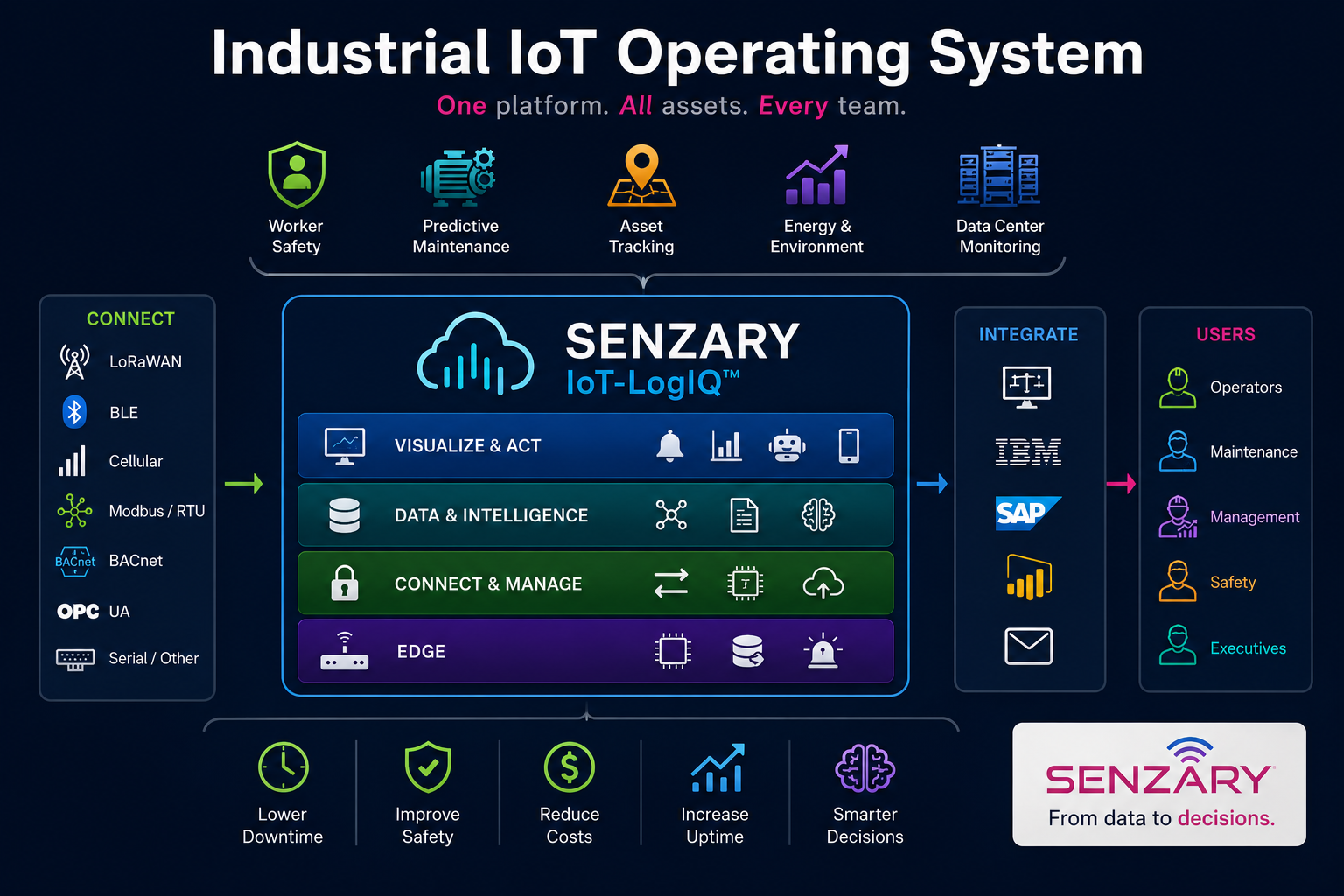
- Senzary’s IoT-LogIQ is positioned as a multi-tenant operating layer for industrial operations, connecting sensors, dashboards, analytics, AI and enterprise systems.
- The company’s approach is designed to work with existing SCADA, CMMS, ERP and building systems rather than replace them.
- AI, wireless sensors, worker safety, predictive maintenance and asset tracking are converging into a broader smart industry architecture.
There is a familiar problem inside many industrial organizations. The equipment is instrumented. The dashboards exist. The teams are working hard. And still, the operation often feels fragmented.
Operations may rely on SCADA. Maintenance may live in Maximo or another CMMS. Energy teams may build Power BI dashboards. Safety may still depend on forms, spreadsheets or manual inspections. Field teams may work from radios, clipboards and repeated walkdowns. Each group has part of the picture, but the handoff between groups is where delays, blind spots and costs begin to show up.
That is the problem Senzary is trying to solve with IoT-LogIQ, which the company positions as an Industrial IoT operating system. The analogy is useful. Windows did not replace every office application. It created a common layer where applications, users, files and hardware could work together more consistently. Senzary is applying a similar idea to industrial operations: one platform that can connect devices, normalize data, support dashboards, power alerts, feed AI tools and serve different departments without forcing a rip-and-replace strategy.
That last point matters. Industrial buyers are usually not looking to throw away SCADA, AVEVA, Maximo, SAP, Oracle, Power BI or existing control systems. They are looking for something that can sit above and beside those systems, bring operational data together and make it more usable. In Senzary’s materials, IoT-LogIQ is described as connecting LoRaWAN, BLE, cellular, Modbus, OPC-UA, BACnet and serial data into a platform that can serve shop floor users, operators and executives. The architecture is meant to move from sensor to boardroom, while still respecting the systems already in place.
This is where the category is changing. Industrial IoT is no longer just about attaching a sensor to a motor or showing temperature on a dashboard. Those capabilities still matter, of course. But buyers are increasingly looking for broader data integration, role-based visibility, alerts, analytics, and AI-assisted decision support. The conversation is shifting from “Can we collect the data?” to “Can the right person act on the data quickly?”
Senzary’s platform story touches several areas where industrial teams are already investing. In worker safety, organizations are evaluating telemetry systems that can combine location, environmental monitoring, alerting and operational context. That is a meaningful change from older standalone approaches. A safety alert becomes more useful when it can be connected to worker location, exposure risk, nearby equipment, weather conditions and escalation workflows.
Predictive maintenance is another strong fit. In manufacturing, teams are comparing solutions that can capture vibration, acoustic, thermal and current data, then translate those signals into practical maintenance actions. The promise is not magic AI. It is earlier warning, better prioritization and fewer calendar-based maintenance routines where teams service equipment because the schedule says so, not because the equipment actually needs it.
Energy and utilities face a similar challenge. Distributed assets, remote facilities and aging infrastructure make it difficult to rely on manual inspections or disconnected data. A practical predictive maintenance strategy in this environment depends on secure telemetry, reliable alerts and systems that can function across sites. The more distributed the operation, the more important the integration layer becomes.
Transportation and logistics add another dimension. Asset tracking is often discussed as a visibility problem, but it is really a coordination problem. Where is the asset? Is it idle? Is it moving? Is it in the wrong place? Has it crossed a threshold? Is it creating a maintenance, compliance or customer issue? Modern asset tracking requires more than a location ping. It requires a data model that can connect assets, locations, workflows and alerts.
The same applies to broader IIoT safety investments. Many industrial organizations cannot pause daily operations to launch a massive transformation project. They need pilots that solve a specific problem, prove value, and then expand. That makes IIoT safety a useful example of how the market is evolving. The practical buyer question is not whether the technology is impressive. It is whether it can fit into live operations without creating another silo.
Senzary’s pitch leans heavily into that point. Its materials describe an approach where a customer can start with one area, one problem and one operational owner. A motor, pump, valve, tank, drilling rig, container or worker can become the initial use case. The problem might be failure, leak detection, theft, exposure, mustering, stockout or compliance. Once the system is proven in one area, the same platform can scale to more assets, more sites and more departments.
The company also highlights real-world traction, including deployments across more than 180 facilities and 12 countries, with Fortune 500 validation. Its examples include predictive maintenance, worker safety, data center monitoring, environmental monitoring and asset tracking. The important part is not that every use case is identical. It is that they can share a common operational data layer.
That is why the “operating system” framing works. Industrial environments do not need another isolated dashboard. They need a way to connect the physical world to digital workflows. Sensors, gateways, dashboards, alerts, AI tools, enterprise software and human operators all need to speak through a common structure.
The AI component may become the most interesting layer. Senzary’s materials describe BOB, MCP and IoT-LogIQ as part of an architecture where operational data can be queried in plain language and, where appropriate, tied back to control or workflow actions. In building environments, that could mean asking for a chiller trend, reviewing alarm history or understanding equipment performance without manually hunting through multiple systems. In industrial environments, it could mean asking which pumps are trending toward failure, which workers have not mustered, or which assets have abnormal movement patterns.
There is a reason this matters now. AI is only as useful as the data foundation underneath it. If the data is trapped in SCADA, spreadsheets, CMMS records, vendor portals and disconnected dashboards, AI becomes another interface sitting on top of fragmentation. If the data is normalized, permissioned and connected to assets, locations and workflows, AI has a better chance of becoming operationally useful.
Senzary’s broader opportunity is to help industrial organizations move from fragmented instrumentation to unified operational intelligence. That is a bigger story than sensors. It is bigger than dashboards. And it is bigger than any single use case.
The companies that make progress in this area will likely be the ones that avoid the trap of treating digital transformation as a series of disconnected pilots. The future of industrial IoT appears to be more integrated, more wireless, more AI-assisted and more operationally grounded. Senzary’s IoT-LogIQ platform fits into that shift by aiming to provide the layer where machines, people, data and decisions can finally meet.

If you liked this post, you’ll love one of the the leading global business communications and technology events since 1999, the ITEXPO #TECHSUPERSHOW, Feb 9-11, 2027 Fort Lauderdale, Florida.
Don’t forget the collocated MSP Expo – just for managed service providers!
Aside from his role as CEO of TMC and chairman of ITEXPO #TECHSUPERSHOW Feb 9-11, 2027, Rich Tehrani is CEO of RT Advisors and a Registered Representative (investment banker) with and offering securities through Four Points Capital Partners LLC (Four Points) (Member FINRA/SIPC). He handles capital/debt raises as well as M&A. RT Advisors is not owned by Four Points.
The above is not an endorsement or recommendation to buy/sell any security or sector mentioned. No companies mentioned above are current or past clients of RT Advisors.
The views and opinions expressed above are those of the participants. While believed to be reliable, the information has not been independently verified for accuracy. Any broad, general statements made herein are provided for context only and should not be construed as exhaustive or universally applicable.
Portions of this article may have been developed with the assistance of artificial intelligence, which may have contributed to ideation, content generation, factual review, or editing