Key Takeaways:
- Tencent Cloud has introduced AIoT 2.0, integrating advanced voice, vision, and cloud capabilities into connected devices.
- The platform includes tools such as TWeTalk and TWeSee, enabling conversational AI, visual recognition, and real-time multimedia processing.
- Real-world applications already include AI-powered toys, headphones, and smart locks.
- AIoT momentum is being driven by broader industry adoption, market growth, and the shift toward edge AI for faster, more secure operations.
- Analysts expect the AIoT market to grow rapidly, with industries such as healthcare, manufacturing, and smart cities leading adoption.
Tencent Cloud has announced the launch of AIoT 2.0, a suite of solutions designed to make artificial intelligence and the Internet of Things work more seamlessly together. This evolution marks a shift from devices that are simply connected and lightly assisted by AI toward those that are genuinely AI-driven. The new platform offers multimodal capabilities, advanced hardware-software integration, and cloud-based services that streamline communication and management for a wide range of devices.
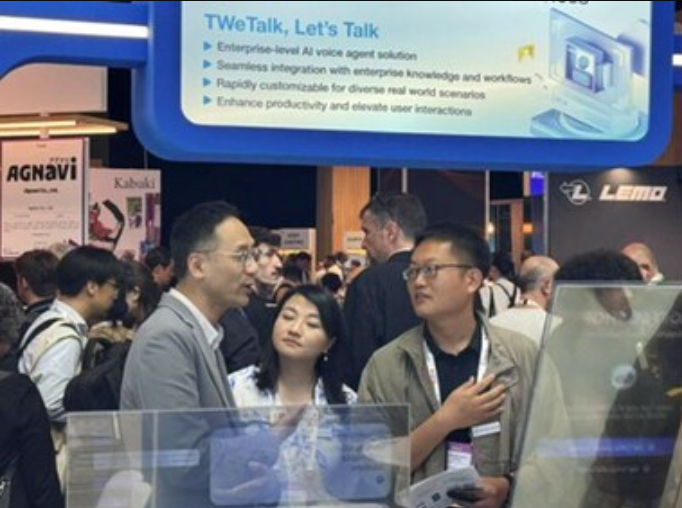
Central to AIoT 2.0 are two new offerings: TWeTalk, a conversational voice agent, and TWeSee, a visual intelligence system. TWeTalk enables more natural interactions through speech-to-text processing, emotion recognition, and natural-language search. TWeSee provides object recognition, scene understanding, and real-time video summarization. These tools are backed by Tencent’s cloud infrastructure, which facilitates device messaging, management, and audio/video communication in a unified environment.
The technology is already finding its way into consumer and commercial products. In the consumer segment, Alpha Group’s Weslie 3.0 smart toy incorporates TWeTalk to allow children to make calls via WeChat, listen to music, and recall past interactions. This blend of entertainment and communication represents how AIoT can bring intellectual property and interactive AI features together in a single product.
In another example, Philips has integrated AIoT 2.0 features into its headphones, enabling them to act as portable meeting assistants. These devices can translate speech in real time, summarize meeting discussions, and help users bridge language barriers without separate apps or additional hardware.
In the smart home sector, locks equipped with TWeSee can identify and respond to security events almost instantly. They generate short video clips summarizing activity, send alerts in under half a second, and improve battery life efficiency by as much as 30 percent. This blend of security, efficiency, and AI-powered analytics illustrates the platform’s ability to meet practical, high-value use cases.
Tencent’s updates come as the AIoT market continues to expand at a rapid pace. Analysts project that the sector could grow at a compound annual rate exceeding 27 percent through the decade, driven by both consumer demand and enterprise investment. One factor in this growth is the movement toward edge AI—processing data locally on devices rather than in remote data centers. This approach reduces latency, enhances privacy, and allows devices to function more independently, making AIoT solutions more appealing to industries that rely on speed and reliability.
Beyond consumer electronics, AIoT is seeing strong uptake in industrial and public sector settings. In manufacturing, AIoT solutions are used for predictive maintenance, reducing downtime and repair costs by identifying potential failures before they occur. In healthcare, wearable devices can continuously monitor vital signs, detect anomalies, and alert providers in real time, enabling more proactive patient care. Smart city projects are deploying AIoT systems to manage traffic flows, monitor air quality, and optimize energy consumption. In agriculture, AIoT is helping farmers track crop health, predict yields, and manage resources more efficiently.
A recent industry survey indicates that nearly half of enterprises now prioritize AI and machine learning capabilities when considering new IoT deployments. This shift suggests AIoT is moving from an experimental phase into a strategic priority for organizations seeking to improve efficiency, enhance customer experiences, and create new business models.
The increasing maturity of AIoT solutions is also lowering adoption barriers. Integration has historically been a challenge, as AI capabilities often had to be bolted onto existing IoT systems. Tencent’s AIoT 2.0 seeks to address this by providing a unified framework where AI is embedded from the ground up. This reduces development complexity, shortens time-to-market, and allows developers and manufacturers to focus on customizing features for their specific industries.
While the technology’s potential is significant, adoption still requires consideration of security, privacy, and compliance. As more devices collect sensitive data, robust security measures become essential to protect users and maintain trust. Federated learning and other privacy-preserving technologies could play a larger role in future AIoT deployments, enabling AI training without centralizing personal data.
Overall, Tencent’s AIoT 2.0 launch reflects both the technology’s current capabilities and the broader momentum driving the AIoT sector forward. By combining conversational and visual AI with robust cloud infrastructure, the platform opens the door to new use cases that are both practical and commercially viable. With strong growth projections, diverse industry applications, and a shift toward integrated solutions, AIoT is poised to become a major driver of innovation across multiple sectors in the coming years.

Learn about the latest in IoT at AIOT World Expo, Feb 10-12, 2026 Fort Lauderdale, Florida.
Rich Tehrani serves as CEO of TMC and chairman of ITEXPO #TECHSUPERSHOW Feb 10-12, 2026 and is CEO of RT Advisors and is a Registered Representative (investment banker) with and offering securities through Four Points Capital Partners LLC (Four Points) (Member FINRA/SIPC). He handles capital/debt raises as well as M&A. RT Advisors is not owned by Four Points.
The above is not an endorsement or recommendation to buy/sell any security or sector mentioned. No companies mentioned above are current or past clients of RT Advisors.
The views and opinions expressed above are those of the participants. While believed to be reliable, the information has not been independently verified for accuracy. Any broad, general statements made herein are provided for context only and should not be construed as exhaustive or universally applicable.
Portions of this article may have been developed with the assistance of artificial intelligence, which may have contributed to ideation, content generation, factual review, or editing.