
Key Takeaways:
- Agentic AI Development: The new R&D group will develop an agentic AI framework to empower warehouse robots with the ability to understand and act on natural language commands.
- Enhanced Robot Capabilities: Unlike current robots that perform single tasks, the agentic AI-powered robots will be capable of handling multiple functions, such as unloading trailers and retrieving parts for repairs.
- Integration with Delivery Systems: Amazon is also exploring the use of humanoid robots for package delivery, potentially integrating them with its fleet of Rivian electric vans.
- Sustainability Goals: The deployment of advanced AI and robotics is expected to improve efficiency, reduce emissions, and minimize waste in Amazon’s logistics operations.
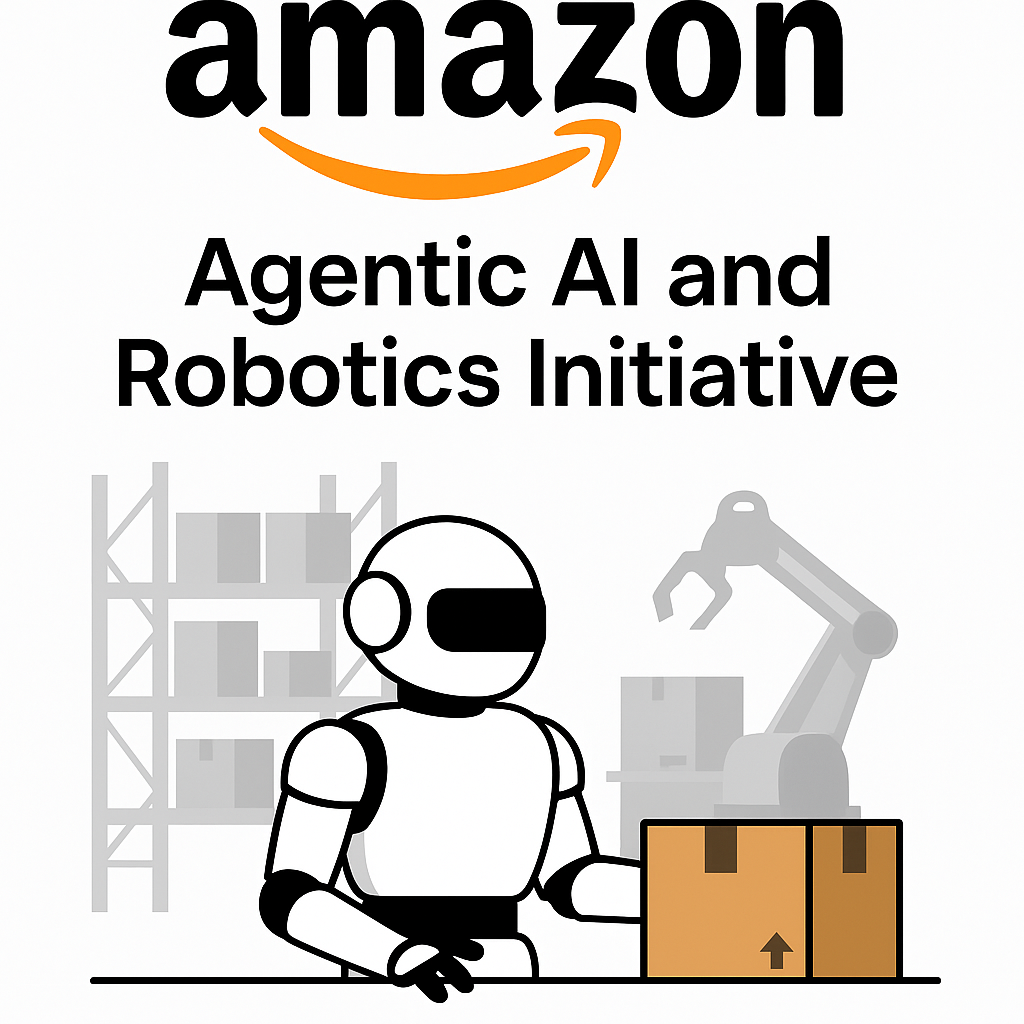
Amazon has launched a new research and development group within its Lab126 division focused on the development of agentic artificial intelligence (AI) and robotics. The announcement highlights Amazon’s efforts to enhance warehouse and logistics automation by enabling robots to operate more independently and adaptively in real-world environments.
While AI has long been part of Amazon’s operational backbone—from recommendation engines to logistics planning—the shift toward agentic AI represents a move to create systems capable of making decisions, planning tasks, and interacting more fluidly with dynamic surroundings. The new group will specifically work on AI systems that support more autonomous robotic agents across Amazon’s fulfillment and delivery infrastructure.
Why Agentic AI Now?
Agentic AI refers to systems that go beyond traditional machine learning outputs. Rather than just predicting the next word or selecting from a fixed set of actions, agentic systems are designed to interpret goals, break them into steps, and carry them out with a degree of autonomy. These systems are often capable of interacting with the world through sensors, actuators, or software interfaces, continuously updating their plans based on new information.
In the context of Amazon’s operations, agentic AI could enable warehouse robots not only to carry out discrete actions like picking items or moving boxes, but also to make decisions such as rerouting themselves during congestion, handling unexpected issues like damaged inventory, or even coordinating with other machines or human workers to complete more complex tasks.
According to industry analysts, this form of AI has the potential to reduce downtime, improve throughput, and minimize the need for human oversight in certain repetitive or physically demanding logistics processes. While exact timelines for deployment are not public, Amazon’s decision to create a dedicated team signals both strategic importance and a desire to maintain a leadership position in retail logistics automation.
A Deeper Role for Robotics
Amazon already uses a range of robots in its facilities, including mobile robots for transporting inventory pods and robotic arms for palletizing. However, most of these systems operate in constrained environments with relatively fixed tasks and are not yet capable of flexible, autonomous decision-making.
The new agentic AI initiative aims to change that. According to people familiar with the company’s plans, Amazon wants to develop robots that can execute compound tasks. For example, an agentic warehouse robot might be able to receive a command like “prepare this set of packages for repair” and then figure out the appropriate sequence of actions—locating the packages, retrieving necessary tools or parts, and staging items for human review.
In a broader sense, this level of autonomy could allow Amazon to reduce the number of discrete tools or interfaces required to coordinate robotic tasks, streamlining both programming and operations.
Integration With Logistics and Delivery
Amazon is also exploring ways to apply agentic AI in last-mile delivery. One area of experimentation involves humanoid robots. These robots could potentially work alongside the company’s Rivian electric delivery vans to assist in delivering packages in suburban or urban settings. While still early-stage, such robots could be useful in situations where navigating stairs, elevators, or gated areas is a challenge for traditional delivery methods.
The company’s interest in integrating advanced robotics into its delivery infrastructure aligns with its broader efforts to increase logistics efficiency while lowering environmental impact. Agentic AI could play a role in reducing fuel consumption, shortening delivery times, and improving the consistency of service—particularly in areas where labor shortages or geographic challenges create friction.
Security, Ethics, and Oversight
As with many AI systems operating in physical spaces, safety and reliability are critical. Amazon’s Lab126 division, based in Sunnyvale, California, is reportedly working with internal safety review boards and external advisors to ensure that the new agentic systems are compliant with industry standards. Human-in-the-loop oversight will likely remain a foundational part of any initial deployments, especially as the technology matures.
There are also broader conversations underway in the AI and robotics communities about the ethical design of autonomous systems—especially those deployed at scale. Transparency in decision-making, data privacy, and the potential for displacement of human roles are all active areas of debate. Amazon has not yet detailed how these considerations will be factored into the new group’s work but has historically emphasized the role of automation in augmenting, not replacing, human labor.
Strategic Implications
The creation of a standalone R&D group dedicated to agentic AI suggests that Amazon views this technology as central to its long-term operational strategy. The company has a history of integrating emerging technologies into its logistics network, from machine vision in package sorting to advanced forecasting models in its inventory systems.
With the growing complexity of global supply chains and increasing customer expectations around speed and reliability, Amazon’s move into more autonomous, decision-capable robotics may be as much about managing scale as it is about technological leadership.
Conclusion
Amazon’s formation of a new R&D group focused on agentic AI and robotics underscores its commitment to pushing the boundaries of warehouse and logistics automation. By developing AI systems that can plan, adapt, and act independently, Amazon is laying the groundwork for a more autonomous, efficient supply chain. While practical deployment may still be in development, the initiative reflects a broader shift in how enterprise logistics systems are being reimagined through the lens of next-generation AI.
Learn how AI Agents can supercharge your company’s profits and productivity at TMC’s AI Agent Event in Sept 29-30, 2025 in DC.

Rich Tehrani serves as CEO of TMC and chairman of ITEXPO #TECHSUPERSHOW Feb 10-12, 2026 and is CEO of RT Advisors and is a Registered Representative (investment banker) with and offering securities through Four Points Capital Partners LLC (Four Points) (Member FINRA/SIPC). He handles capital/debt raises as well as M&A. RT Advisors is not owned by Four Points.
The above is not an endorsement or recommendation to buy/sell any security or sector mentioned. No companies mentioned above are current or past clients of RT Advisors.
The views and opinions expressed above are those of the participants. While believed to be reliable, the information has not been independently verified for accuracy. Any broad, general statements made herein are provided for context only and should not be construed as exhaustive or universally applicable.
Portions of this article may have been developed with the assistance of artificial intelligence, which may have contributed to ideation, content generation, factual review, or editing.