

Key Takeaways:
- Amazon launched Kiro, a spec-first AI software development tool aimed at eliminating the disorder often caused by “vibe coding.”
- The platform uses intelligent agents to automatically generate design documents, specifications, and test plans from developer prompts.
- Kiro enters a competitive market already populated by GitHub Copilot and Google Gemini Code Assist, but differentiates by tightly integrating planning and execution.
- Pricing will include a free tier and two paid tiers: $19 and $39 per user/month depending on usage volume.
- The rollout reflects Amazon’s broader push to streamline development inside and outside AWS, with potential internal adoption alongside tools like Cursor.
In an effort to tame what some call the “chaos of vibe coding,” Amazon has introduced a new AI software development platform called Kiro. The tool is designed to bring more structure to the way developers build applications with AI-generated code, particularly as quick prototyping becomes the norm across industries.
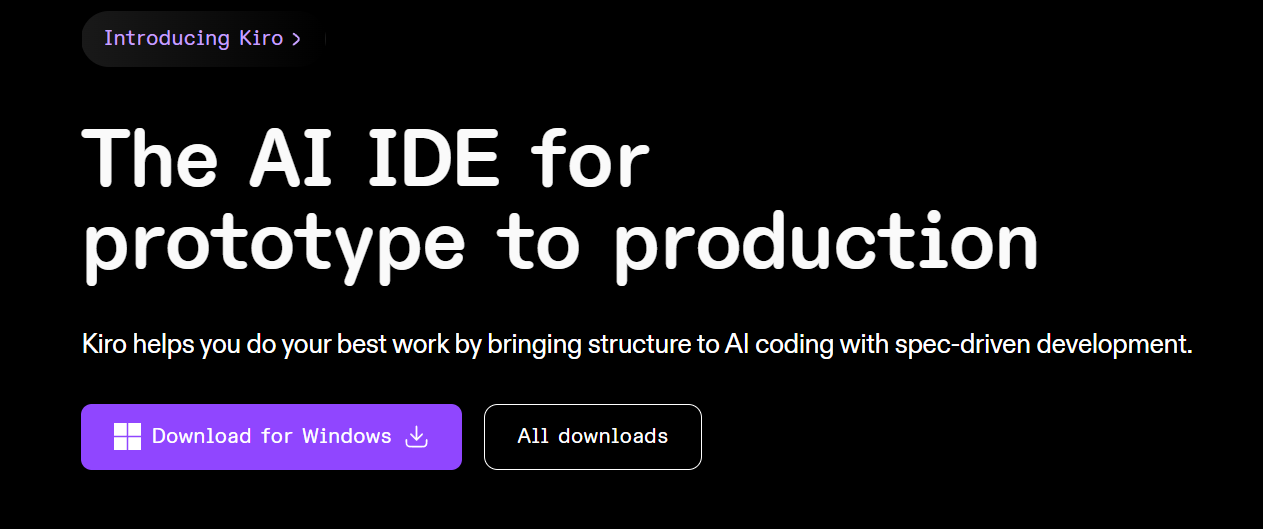
Kiro, launched under Amazon Web Services but hosted on a standalone site, blends the strengths of agentic AI and project planning. Rather than focusing solely on code completion, like GitHub Copilot or Google’s Gemini Code Assist, Kiro begins with the end in mind—automatically creating project specifications, breaking down task lists, and maintaining documentation throughout the development lifecycle.
Developers start by inputting a prompt or goal into Kiro. From there, the tool’s agents dissect the request into clear deliverables: specs, design docs, and implementation plans. As the developer writes or modifies code, Kiro continuously evaluates whether the documentation needs to be updated, or whether any plan adjustments are necessary. It also runs tests and flags inconsistencies in real time.
The approach reflects a shift from “autocomplete” tools to full lifecycle AI agents. And that’s intentional. Amazon said it hopes to move software development from “vibe coding”—a term used to describe the loose, fast-paced prototyping that’s common when using generative tools—to structured, spec-driven workflows that can scale in production.
In that regard, Kiro could appeal not just to developers, but to engineering leads and enterprise teams under pressure to maintain code quality while embracing AI-driven acceleration.
For now, Kiro is in preview and free to use. When the platform becomes generally available, Amazon plans to offer the following pricing tiers:
- Free: 50 agent interactions per user per month
- Pro ($19/user/month): 1,000 agent interactions
- Pro+ ($39/user/month): 3,000 agent interactions
This pricing structure is in line with other agent-focused platforms but emphasizes task-based usage instead of hours or seats. Kiro is also designed to integrate with other developer tools, including AWS and Git-based workflows.
While Kiro is new, it builds on lessons from Amazon’s earlier forays into AI-assisted development, including Amazon Q Developer. That tool, introduced at AWS re:Invent in 2023, focused on helping developers inside IDEs like Visual Studio Code. Kiro, however, appears more ambitious—serving as a full-fledged IDE and agent coordination layer.
Amazon’s timing is notable. Earlier this year, Business Insider reported that employees inside the company were pushing for broader use of AI development tools like Cursor, a fast-growing startup that gained traction with developer teams for its LLM-powered coding agents. Kiro could serve as Amazon’s in-house alternative, while also appealing to external AWS customers who want tighter integration and more control.
Microsoft and Google have already staked out strong positions in this space. GitHub’s Copilot Agents and Google’s Gemini Code Assist both promise developer productivity improvements, but tend to focus on midstream tasks like function generation and testing. Amazon’s bet with Kiro is to own the upstream planning—converting intent into organized execution from the outset.
There’s also a philosophical angle. “Vibe coding,” while creative and fast, can often leave teams with undocumented, unscalable, or insecure software. Kiro’s spec-first orientation suggests Amazon is betting that AI’s real promise isn’t just faster coding—but better-engineered systems.
Whether developers adopt this more structured approach remains to be seen. But as AI coding agents proliferate, the tools that prioritize reliability and planning may find traction with larger teams and mission-critical applications.
Kiro is still in its early days, but it adds to a growing trend: AI development isn’t just about writing code faster—it’s about organizing the process, too.
The AI Agent Event provides the knowledge and strategic frameworks companies need to adopt AI responsibly, efficiently, and at scale.
Learn how AI Agents can supercharge your company’s profits and productivity at TMC’s AI Agent Event in Sept 29-30, 2025 in DC.
Rich Tehrani serves as CEO of TMC and chairman of ITEXPO #TECHSUPERSHOW Feb 10-12, 2026 and is CEO of RT Advisors and is a Registered Representative (investment banker) with and offering securities through Four Points Capital Partners LLC (Four Points) (Member FINRA/SIPC). He handles capital/debt raises as well as M&A. RT Advisors is not owned by Four Points.
The above is not an endorsement or recommendation to buy/sell any security or sector mentioned. No companies mentioned above are current or past clients of RT Advisors.
The views and opinions expressed above are those of the participants. While believed to be reliable, the information has not been independently verified for accuracy. Any broad, general statements made herein are provided for context only and should not be construed as exhaustive or universally applicable.
Portions of this article may have been developed with the assistance of artificial intelligence, which may have contributed to ideation, content generation, factual review, or editing.