Key Takeaways:
- Scientists are exploring biological intelligence as a blueprint for creating next-generation autonomous systems that adapt and respond like living organisms.
- Innovations like organoid intelligence and biohybrid systems merge living cells with machines to enable real-time learning, sensing, and energy efficiency.
- Soft robotics and behavior-based approaches draw directly from nature to create machines that respond dynamically to environments.
- Biological systems integrate sensing, computing, and response across layers—offering a model for truly autonomous, self-regulating machines.
- Key challenges include ethical oversight, biological limitations, and maintaining performance and reproducibility at scale.
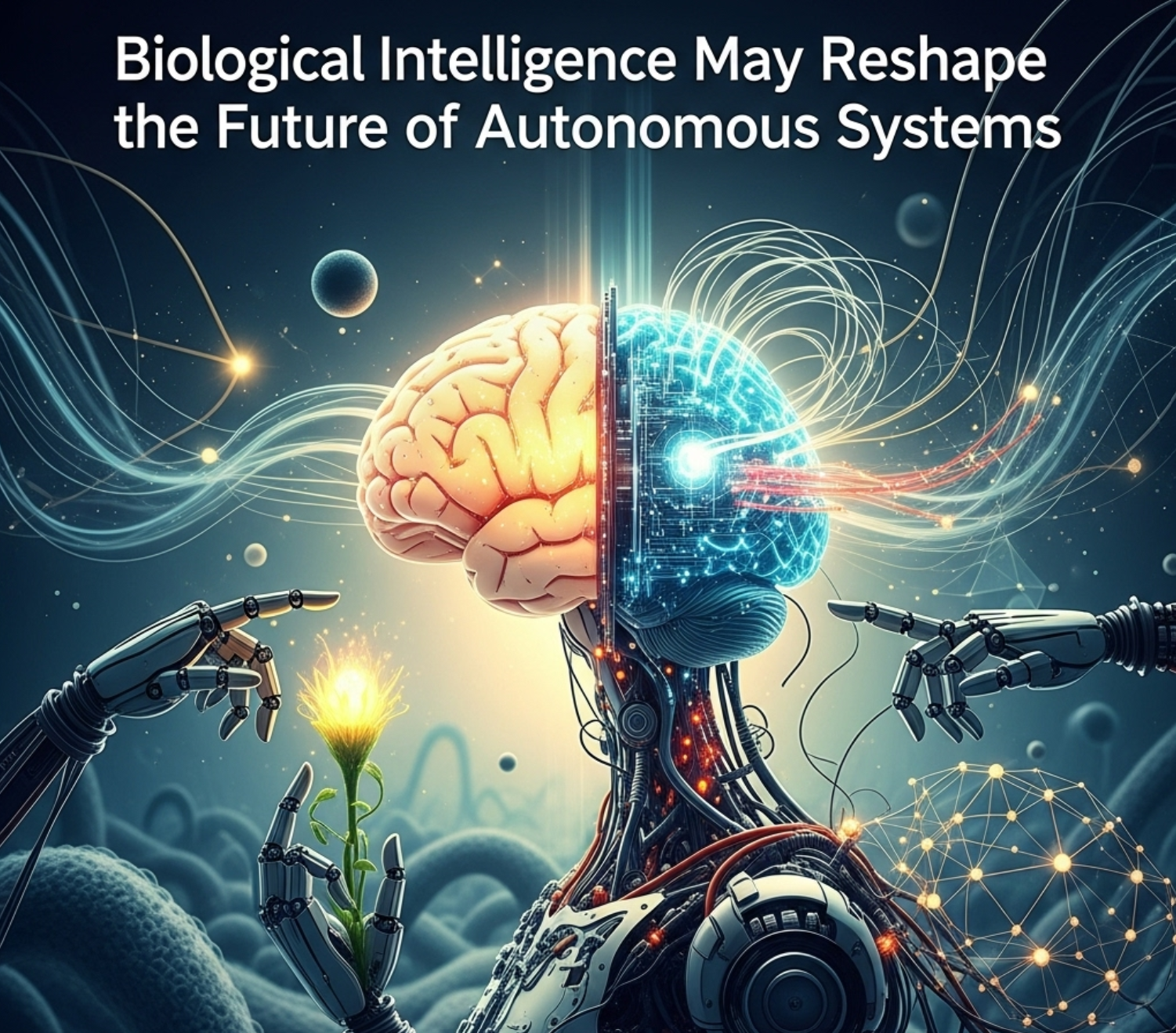
Artificial intelligence and robotics are rapidly advancing, but many researchers believe the future of autonomy lies not in building ever more powerful machines—but in mimicking the intelligence of life itself. The World Economic Forum recently outlined this vision, framing biological intelligence as a foundational principle for autonomous systems of the future.
Rather than relying solely on digital logic or deep neural networks, biological systems offer an integrated model where sensing, processing, and action are deeply interwoven. From simple organisms like bacteria to the human nervous system, biological intelligence shows how complex behavior can emerge from distributed, layered control—not centralized computation.
For engineers designing autonomous systems—whether for transportation, defense, medicine, or agriculture—this shift in thinking could redefine what it means for a machine to be “intelligent.”
From Machine Learning to Life-Inspired Learning
The conventional view of autonomy has centered on high-performance computation: better processors, deeper neural networks, and more data. But biological systems are inherently efficient. They respond to real-world complexity by evolving flexible, adaptive strategies over time.
This idea has given rise to new fields like organoid intelligence, where scientists grow human brain cells and interface them with electronic circuits. These living neural networks can perform simple tasks, like playing a video game, while using far less energy than traditional silicon-based systems. One prototype, the CL1 device created by Cortical Labs, integrates around 200,000 neurons with a silicon interface. Researchers observed that the cells were capable of learning in real-time—an early but important milestone in merging biology with computation.
There are also efforts underway to build “hybrots”—robotic systems directly controlled by live neurons. In these hybrids, biological cells process inputs and trigger outputs, giving machines the ability to react organically to new stimuli. Other biohybrid systems incorporate muscle tissue or soft, elastic structures that move like natural organisms. These aren’t speculative concepts—they’re already being tested in labs for applications ranging from targeted drug delivery to environmental sensing.
Physical Intelligence and Layered Adaptation
One key insight from biology is that intelligence is not just in the brain. Organisms rely on distributed intelligence—embedded in their bodies, muscles, sensory organs, and feedback loops. A jellyfish doesn’t have a central brain, yet it can navigate its environment effectively. This has inspired the development of soft robotics, which mimic the fluid, responsive movement of biological systems using flexible materials and embedded sensors.
Unlike traditional robots that rely on rigid joints and preprogrammed actions, soft robots change shape, stiffness, or surface texture in response to external cues. These properties allow for a form of “physical intelligence”—where the body itself becomes part of the decision-making system.
This approach aligns with behavior-based robotics, a design philosophy that forgoes complex planning in favor of tight perception-action loops. Robots designed with this model don’t need to map their environment in detail. Instead, they respond to simple cues using decentralized logic, much like insects or small mammals do. These systems are often more robust in unpredictable settings because they aren’t tied to rigid models of the world.
Convergence and the Path to True Autonomy
True autonomy, the kind that allows machines to operate for long periods in open-ended, dynamic environments, likely won’t come from a single breakthrough in AI. Instead, it will emerge from the convergence of multiple layers: sensing, communication, computation, and control.
This is where biology offers the most powerful blueprint. Living systems have evolved over billions of years to handle uncertainty, resource constraints, and multi-scale coordination. They do this through self-organization, learning, and redundancy—all features that technologists are now attempting to replicate.
Autonomous laboratory platforms are already beginning to reflect this model. At Argonne National Laboratory, robotic systems now conduct biology experiments end-to-end: forming hypotheses, running tests, and adjusting based on outcomes. These autonomous labs could accelerate discovery in areas like material science or pharmaceuticals.
Meanwhile, the World Economic Forum’s recent technology convergence report highlights the growing intersection of agentic AI, robotics, and spatial computing. As these technologies merge, they are expected to create systems that can move through the world, make decisions, and learn from consequences—just as living organisms do.
Challenges Ahead
Despite the enthusiasm, biological-autonomous systems come with serious technical and ethical hurdles. Maintaining living tissues over time is difficult. Neurons die, lose memory, and can be unpredictable. There’s also a lack of standardization: no two organoid systems behave exactly the same way, making reproducibility a challenge.
On the ethical front, the use of human-derived neural tissue raises important questions. Who is responsible for decisions made by systems using biological substrates? Should biohybrid systems be regulated like medical devices, or more like AI platforms? These issues will require collaboration across fields—from engineers and neuroscientists to legal scholars and ethicists.
There are also concerns about public perception. Systems that blur the line between biology and machines may trigger discomfort or opposition, especially in sensitive domains like healthcare or national defense. Clear communication and regulatory transparency will be key to public trust.
A Paradigm Shift in Motion
If these barriers can be addressed, biological intelligence could help redefine the architecture of autonomy. Rather than adding layers of complexity to current AI systems, engineers could instead simplify designs by making them more modular, adaptable, and context-aware—just like nature intended.
The implications are broad. Future smart cities, transportation systems, or climate monitoring networks could become less brittle and more self-correcting. Medical devices could become more personalized and energy-efficient. Even our understanding of intelligence itself may evolve—from something that happens in digital clouds to something deeply rooted in physical form and sensory experience.
What’s emerging isn’t just a new type of robot. It’s a new philosophy of machine design—one rooted in the deep intelligence of life.
Learn how AI Agents can supercharge your company’s profits and productivity at TMC’s AI Agent Event in Sept 29-30, 2025 in DC.

Rich Tehrani serves as CEO of TMC and chairman of ITEXPO #TECHSUPERSHOW Feb 10-12, 2026 and is CEO of RT Advisors and is a Registered Representative (investment banker) with and offering securities through Four Points Capital Partners LLC (Four Points) (Member FINRA/SIPC). He handles capital/debt raises as well as M&A. RT Advisors is not owned by Four Points.
The above is not an endorsement or recommendation to buy/sell any security or sector mentioned. No companies mentioned above are current or past clients of RT Advisors.
The views and opinions expressed above are those of the participants. While believed to be reliable, the information has not been independently verified for accuracy. Any broad, general statements made herein are provided for context only and should not be construed as exhaustive or universally applicable.
Portions of this article may have been developed with the assistance of artificial intelligence, which may have contributed to ideation, content generation, factual review, or editing.
For more on this topic, consider the following links:
https://www.ft.com/content/713eab47-a1f1-4477-a7de-f2b150e2faac
https://www.science.org/doi/10.1126/scirobotics.ads1292
https://en.wikipedia.org/wiki/Organoid_intelligence
https://en.wikipedia.org/wiki/Hybrots
https://en.wikipedia.org/wiki/Biohybrid_system
https://en.wikipedia.org/wiki/Behavior-based_robotics
https://en.wikipedia.org/wiki/Wetware_computer
https://www.nature.com/articles/s41598-025-89069-y
https://www.weforum.org/publications/technology-convergence-report-2025/digest