Key Takeaways:
• Elon Musk said Tesla’s Full Self-Driving (FSD) system is close to an “Unsupervised” stage that might permit texting while driving
• The company could soon move from SAE Level 2 automation toward Levels 3 or 4, though no roadmap was provided
• Only Mercedes-Benz and BMW currently have approval for Level 3 systems under limited conditions
• Musk suggested next-generation FSD could even allow drivers to sleep behind the wheel
• Regulatory and safety implications remain unclear as Tesla advances its autonomous technology
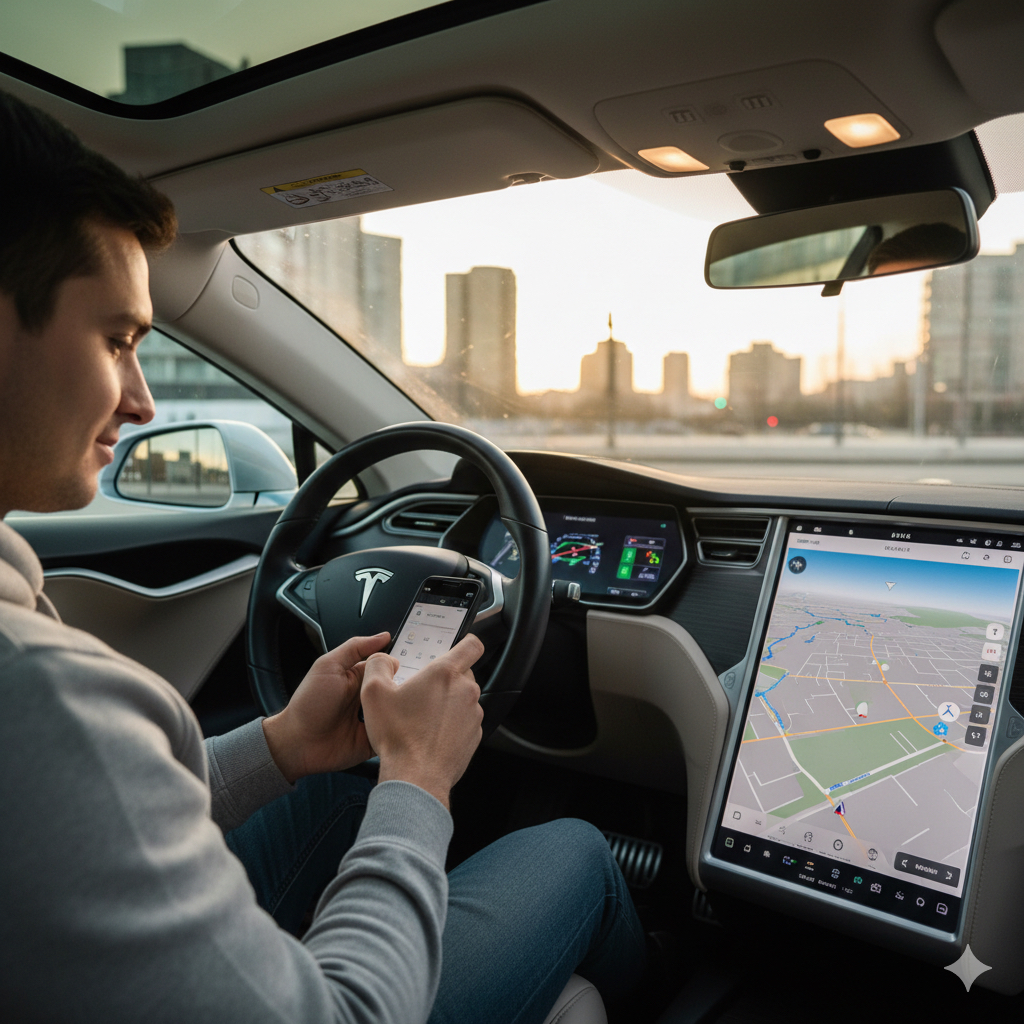
Elon Musk told investors that Tesla is “almost comfortable” allowing drivers to text while the vehicle operates in Full Self-Driving mode, suggesting the company may be nearing a pivotal shift in its autonomy strategy. Speaking during a recent shareholder meeting, Musk said Tesla’s system could soon be capable of handling all driving tasks without driver supervision, referring to this next phase as “Unsupervised Full Self-Driving.”
Musk’s statement hinted at a dramatic leap from the current system, which the Society of Automotive Engineers classifies as Level 2—where the car assists but still requires the driver’s constant attention and readiness to take control. “We’re almost comfortable with people texting and driving while Full Self-Driving is engaged,” Musk said. He added that the company expects to enable Unsupervised FSD “in a month or two,” but offered no technical or regulatory explanation for how Tesla plans to bridge the gap between supervised driver assistance and higher autonomy levels.
Moving Toward Higher Autonomy
SAE Level 3 automation allows drivers to remove their hands from the wheel and eyes from the road in specific scenarios, but the system may request driver intervention at any time. Mercedes-Benz and BMW have gained limited approvals for such systems in parts of Europe and the United States, primarily for controlled highway environments. Tesla, however, has continued to operate under Level 2 status while pushing over-the-air software updates to expand capabilities such as lane changes, traffic-light recognition, and automated navigation through city streets.
Industry analysts note that jumping to Level 3 or 4 autonomy—where the car can manage all driving tasks within defined conditions or even fully without human input—would require not only substantial software advances but also a new regulatory framework and safety validation process. Unlike other manufacturers that have undergone extensive certification testing, Tesla has largely relied on data from its customer fleet to train and refine its neural network.
The Challenge of “Unsupervised” Driving
Musk’s vision for “Unsupervised FSD” would represent a major shift in both liability and driver behavior. At present, Tesla’s system monitors driver attention through steering wheel torque and, in newer vehicles, interior cameras. Even small lapses in focus trigger warnings or disengagements. Allowing texting—or potentially even sleeping, as Musk has previously suggested—would mark a philosophical change from assistive automation to full autonomy.
Experts in automotive safety and regulatory policy have long cautioned that consumer expectations around automation can outpace reality. The U.S. National Highway Traffic Safety Administration has previously investigated Tesla’s driver-assistance crashes, including incidents where drivers appeared to over-rely on the system. Without a formal regulatory approval process for Level 3 or 4 autonomy, Tesla’s claim of being “almost ready” may reflect internal confidence rather than external validation.
Competitive Context
The comment arrives as competition in autonomous technology intensifies. Mercedes-Benz recently received approval for its Drive Pilot Level 3 system in select U.S. states, while BMW is preparing its own “hands-off” system for certain highway conditions. Waymo and Cruise have deployed fully driverless taxis in limited areas, though both companies operate under strict geographic and operational limits.
Tesla’s approach differs by leveraging its massive installed base of vehicles as a distributed test network. Each car running FSD Beta contributes real-world data back to Tesla’s central system, which the company uses to iterate and retrain its software models. This strategy has allowed Tesla to deploy features more quickly but has also drawn scrutiny from regulators for using public roads as a testing environment.
Investor and Public Reaction
Musk’s comments sparked another wave of debate among investors and safety advocates alike. Supporters view it as a signal that Tesla’s long-promised FSD revenue stream may soon materialize, potentially through subscription models or licensing. Critics, meanwhile, question whether the company can responsibly make such a leap without formal validation or third-party safety audits.
During the meeting, Musk doubled down on his long-term vision, saying that Tesla’s next-generation FSD could eventually enable drivers to sleep during trips. “At that point, it’s a game-changer for transportation economics,” he said. The statement reinforces Musk’s belief that autonomy will transform Tesla from a car manufacturer into a software and services company.
Still, for many observers, Tesla’s promise of Unsupervised Full Self-Driving within “a month or two” sounds ambitious given the technical, legal, and ethical hurdles. Even for a company known for pushing boundaries, the transition from driver-assist to hands-off autonomy remains one of the most complex challenges in modern mobility.
Until regulators formally recognize higher-level autonomy systems and Tesla demonstrates consistent safety performance across varied conditions, drivers will remain responsible for staying alert—even if their cars appear ready to do the driving for them.