Key Takeaways:
- The Linux Foundation is now the official steward of the Agent2Agent (A2A) protocol, a framework enabling communication between AI agents from different platforms.
- A2A was originally developed by Google and is backed by more than 100 companies including AWS, Cisco, Microsoft, Salesforce, SAP, and ServiceNow.
- The protocol addresses one of AI’s critical challenges: enabling secure, vendor-neutral coordination among autonomous systems.
- The move is intended to promote open governance, extensibility, and enterprise-grade security.
- A2A lays groundwork for scalable, multi-agent systems across industries, from cloud to customer service.
The Linux Foundation has officially taken over governance of the Agent2Agent (A2A) protocol, signaling a significant industry-wide step toward standardizing communication among AI agents. Originally developed by Google, A2A allows autonomous AI systems—also known as agents—to discover one another, exchange information securely, and collaborate, regardless of the platforms or vendors behind them.

The announcement was made during the Open Source Summit in Denver, where Linux Foundation Executive Director Jim Zemlin emphasized the importance of neutral oversight for such a critical piece of infrastructure. Under the Foundation’s stewardship, A2A will now follow a vendor-agnostic governance model that encourages transparency and broad community input.
The protocol arrives at a pivotal moment. As AI agents move from controlled demos to real-world applications—powering customer service bots, workflow assistants, analytics tools, and autonomous operations—the need for them to interoperate grows. Without a shared standard, agents from different vendors risk working in silos, limiting their usefulness and scalability. A2A aims to solve that by offering a common language and secure transport layer that can support everything from messaging to service handoffs.
Industry support for A2A is broad and growing. Founding backers include major players like AWS, Cisco’s Outshift, SAP, Salesforce, and ServiceNow. Microsoft, though not an initial contributor, has expressed support for the protocol’s goals and has indicated interest in collaborating to ensure responsible development of AI ecosystems.
Each of these companies brings different priorities. For some, it’s about enabling agent-based services within existing enterprise platforms. For others, it’s about laying a foundation for cross-cloud interoperability. Regardless of their individual motivations, the consensus is clear: AI agents must be able to work together across systems if the technology is to scale.
The Linux Foundation’s involvement provides the kind of neutral ground that can accelerate development. By shifting the protocol away from any single company’s control, the community hopes to avoid proprietary forks and ensure long-term viability. Open governance will help keep the protocol extensible—allowing it to evolve with emerging use cases while preserving compatibility with core standards like identity, security, and observability.
Among its technical capabilities, A2A supports agent discovery, secure messaging, identity verification, and permissions management. These are essential components for building multi-agent systems that need to coordinate tasks, share state, and execute workflows in real time. Whether applied to retail automation, customer service, or supply chain coordination, the protocol is designed to handle sensitive information transfer securely and at scale.
The timing aligns with broader shifts in AI architecture. Increasingly, focus is moving beyond large models to the orchestration of smaller, purpose-built agents that can operate semi-independently while interacting with other systems. Standards like A2A are foundational to that vision—creating a modular, interoperable ecosystem akin to what HTTP and TCP/IP did for the internet.
The protocol also pairs well with emerging initiatives such as the Model Context Protocol, which aims to make AI model interactions more transparent and trackable. Together, these efforts point toward an “Internet of Agents,” where software systems act autonomously yet coherently across companies, devices, and sectors.
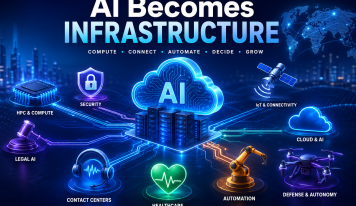
By adopting A2A, the Linux Foundation is not just solving a technical challenge—it’s enabling a new paradigm for how autonomous systems can be deployed and scaled. It reflects growing recognition that infrastructure, not just algorithms, will define the next era of AI adoption.
In the months ahead, working groups within the Foundation will expand the protocol’s capabilities, including support for real-time observability, advanced policy controls, and compatibility layers for enterprise use. Organizations are encouraged to contribute, test implementations, and help shape what could become a foundational layer of the AI economy.
Learn how AI Agents can supercharge your company’s profits and productivity at TMC’s AI Agent Event in Sept 29-30, 2025 in DC.
Rich Tehrani serves as CEO of TMC and chairman of ITEXPO #TECHSUPERSHOW Feb 10-12, 2026 and is CEO of RT Advisors and is a Registered Representative (investment banker) with and offering securities through Four Points Capital Partners LLC (Four Points) (Member FINRA/SIPC). He handles capital/debt raises as well as M&A. RT Advisors is not owned by Four Points.
The above is not an endorsement or recommendation to buy/sell any security or sector mentioned. No companies mentioned above are current or past clients of RT Advisors.
The views and opinions expressed above are those of the participants. While believed to be reliable, the information has not been independently verified for accuracy. Any broad, general statements made herein are provided for context only and should not be construed as exhaustive or universally applicable.
Portions of this article may have been developed with the assistance of artificial intelligence, which may have contributed to ideation, content generation, factual review, or editing.