Key Takeaways
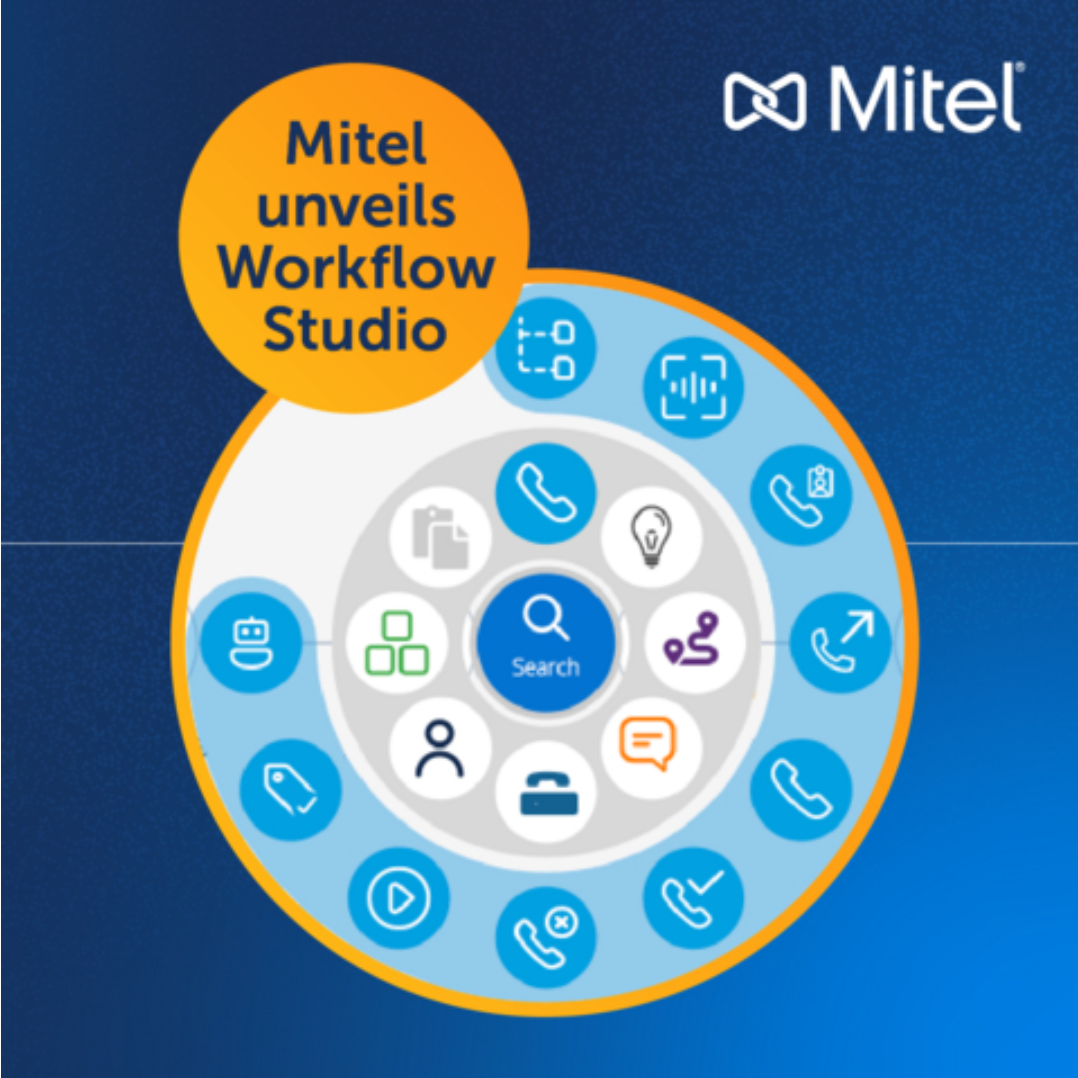
- Mitel introduces Workflow Studio, a low-code/no-code platform embedded with generative AI to streamline enterprise communications.
- The platform integrates with leading systems such as Microsoft 365, Zoom, Slack, Zendesk and Salesforce while leveraging models like ChatGPT, Gemini and Claude.
- A healthcare pilot at Heilig Hart Hospital demonstrates the potential: voicemail-to-text conversion produced faster response times and cost effectiveness.
- The new offering is positioned to support hybrid workplaces by simplifying AI-enabled workflows across communications and business processes.
- Mitel emphasizes agility, control and scaling as core benefits—allowing workflow creation without extensive development resources.
Enterprises shifting toward hybrid work environments are placing greater emphasis on intelligent automation that spans communications, collaboration and business-process systems. With its announcement of Workflow Studio, the communications-platform provider Mitel aims to address this demand by offering a generative-AI-powered workflow builder designed for business users and IT alike. The launch signals a strategic push by Mitel to bring AI-embedded automation into enterprise communications under more accessible, low-code/no-code paradigms.
The news comes on the heels of our coverage this past August of the company’s UC accelerator which among other things, focused on AI-powered agent tools.
At its core, Workflow Studio presents a drag-and-drop visual designer allowing organizations to automate tasks such as intelligent call routing, real-time language translation, notification triggers and visitor registration, all without requiring teams of developers. According to Mitel’s announcement, the platform is deeply integrated with Mitel’s unified communications (UC) offerings and can bridge external applications including Microsoft 365, Zoom, Slack, Zendesk and Salesforce. The generative-AI layer supports large language models (LLMs) such as ChatGPT, Google Gemini and Anthropic Claude.

In the announcement, Martin Bitzinger, Senior Vice-President of Product Management at Mitel, states:
“Workflow Studio removes major roadblocks, like a lack of access to advanced GenAI tools or a large development team, that often prevent organizations from fully utilizing tailored workflows embedded within critical business processes. In today’s workplace, communication is more important than ever as organizations look to increase consumer satisfaction, connect workforces, and improve employee productivity.”
One early customer example is Heilig Hart Hospital in Mol, Belgium. The facility, with 183 beds and around 850 staff, deployed Workflow Studio to convert voicemail messages into text and route them to support teams. According to Benjamin Peeters, IT Director at the hospital, “Mitel’s Workflow Studio has directly improved communication and responsiveness within our healthcare community. Its low-code approach allowed us to quickly implement custom workflows without needing extensive technical skills. The smooth integration with our existing systems … has proven to be cost-effective and has helped us provide faster, more accurate support to both staff and patients.”
This case illustrates how organizations in regulated, mission-critical environments can benefit from automation without lengthy development cycles. By converting voicemail into text and routing it appropriately, the hospital achieved measurable operational improvements, demonstrating a tangible use-case for the platform.
From a broader perspective, Mitel’s move reflects shifting priorities in enterprise technology. A cited report states that 53 percent of hybrid-communications deployments now include AI capabilities, underscoring rising demand for automation in communications workflows. By combining low-code visual tooling with generative-AI enhancements and native integration with UC systems, Mitel aims to capture a portion of this growing market.
Workflow Studio positions Mitel as not simply a communications vendor but a player in intelligent workflow automation. For organizations seeking to upgrade from legacy telephony or siloed UC systems, the offering provides a path to embed AI into customer-facing, employee-facing and operational workflows without requiring large development teams. The value proposition rests on speed, adaptability and scope: build once, iterate quickly and connect across applications.
That said, several considerations remain. First, the full market adoption of such platforms hinges on organizations’ ability to manage data privacy, model governance and workflow orchestration across multiple systems. While Mitel highlights control and scalability, enterprises will want clarity on model sourcing, training data, auditability and vendor lock-in. Second, low-code/no-code tools may shift workflow complexity into orchestration and design. Non-technical users may still require governance frameworks to ensure automation aligns with enterprise standards and risk policies. Third, competing solutions from hyperscale cloud providers and specialized workflow-automation vendors will pressure Mitel to demonstrate differentiated value—particularly in companies that already have existing workflow platforms or are deeply embedded in CRM/ITSM ecosystems.
Nonetheless, Workflow Studio could appeal to organizations at the intersection of communications, collaboration and business automation—especially those moving toward hybrid work models and seeking to bridge disparate tools without building custom integrations from scratch. By positioning itself around generative AI, Mitel aligns with a broader trend of bringing LLMs into enterprise workflows, rather than using them solely in standalone use cases.
In the context of Mitel’s recent corporate trajectory—emerging from financial restructuring as we covered this past June, reducing debt and refocusing on unified communications (UC) and customer-experience (CX) platforms—the launch of Workflow Studio may mark a continuance of its repositioned strategy. As enterprises increasingly expect their communications providers to deliver AI-embedded automation and seamless integration across application ecosystems, Mitel’s approach may resonate with buyers seeking unified solutions rather than point tools.
To adopt such a platform effectively, organizations should consider starting with high-impact but low-complexity workflows—such as voicemail translation, call-routing triggers or appointment scheduling—and iterate toward more ambitious automation scenarios. They should engage cross-functional teams including communications, IT, process owners and business units to define workflow objectives, success metrics and governance models. Additionally, they should clarify model-governance policies, data-privacy constraints, and how the new automation meshes with existing UC/CC-platform roadmaps.
In conclusion, Mitel Workflow Studio offers a potentially compelling path for enterprises to integrate generative-AI automation into their communications and business workflows with less technical overhead. The capability to plug into major collaborations tools, leverage top LLMs and design workflows visually brings a new dimension to the communications platform market. While adoption will depend on how organizations manage data, governance and vendor relationships, the launch reflects a meaningful shift in how communications providers are evolving to meet hybrid-work demands and intelligent-process ambitions.

If you liked this post, you’ll love one of the the leading global business communications and technology events since 1999, the ITEXPO #TECHSUPERSHOW, Feb 10-12, 2026 Fort Lauderdale, Florida.
Don’t forget the collocated MSP Expo – just for managed service providers!
Aside from his role as CEO of TMC and chairman of ITEXPO #TECHSUPERSHOW Feb 10-12, 2026, Rich Tehrani is CEO of RT Advisors and a Registered Representative (investment banker) with and offering securities through Four Points Capital Partners LLC (Four Points) (Member FINRA/SIPC). He handles capital/debt raises as well as M&A. RT Advisors is not owned by Four Points.
The above is not an endorsement or recommendation to buy/sell any security or sector mentioned. No companies mentioned above are current or past clients of RT Advisors.
The views and opinions expressed above are those of the participants. While believed to be reliable, the information has not been independently verified for accuracy. Any broad, general statements made herein are provided for context only and should not be construed as exhaustive or universally applicable.
Portions of this article may have been developed with the assistance of artificial intelligence, which may have contributed to ideation, content generation, factual review, or editing