

Key Takeaways:
- OpenAI is preparing to release GPT-5 in August 2025, featuring integration of its o3 reasoning engine and a redesigned tiered architecture.
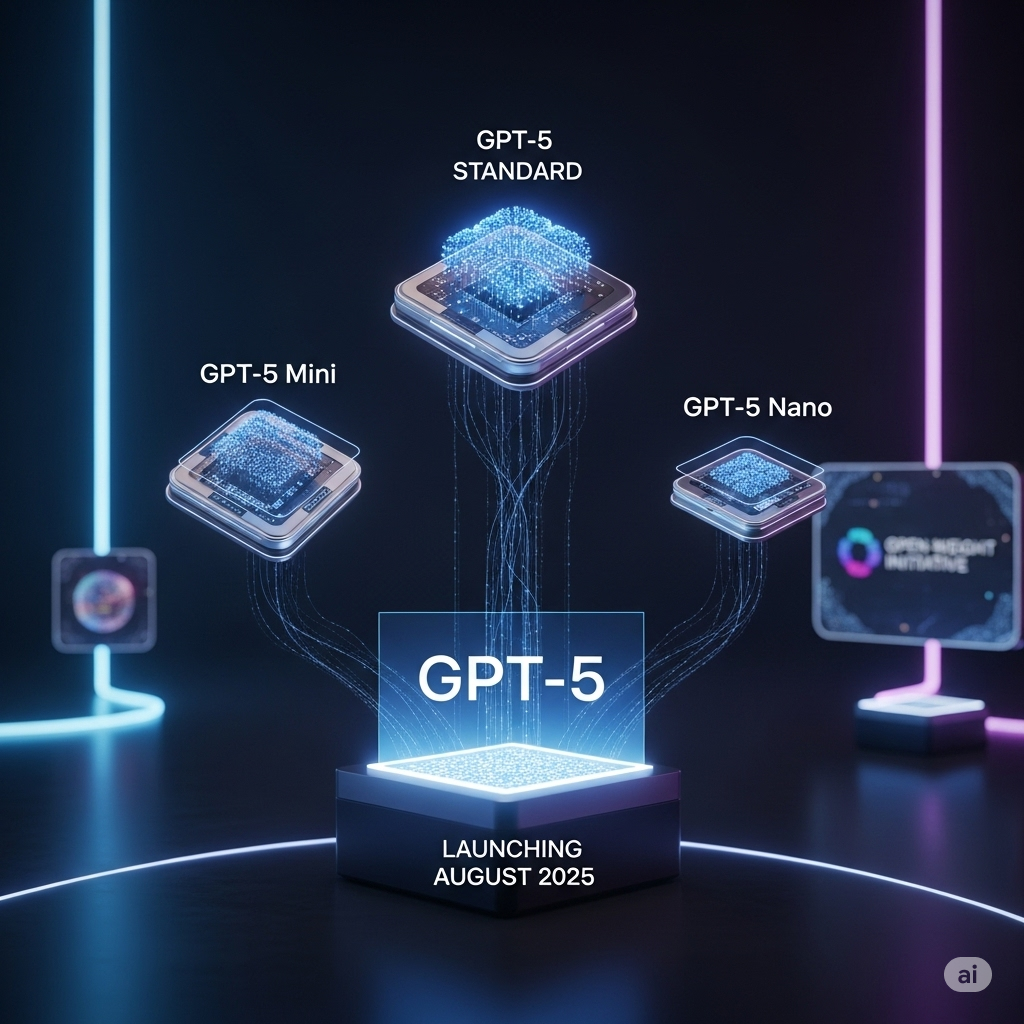
- The model will come in three variants: standard, mini, and nano—targeting use cases ranging from high-performance applications to lightweight deployments.
- GPT-5 simplifies access to advanced reasoning capabilities by merging OpenAI’s separate models into one unified interface.
- The company also plans to release an open-weight model for developers and researchers, expanding transparency and access to reasoning tools.
- Launch timing was adjusted from earlier May targets to prioritize internal safety evaluations, infrastructure readiness, and product stability.
OpenAI is expected to launch its next flagship model, GPT-5, in early August 2025. This update marks a critical evolution in OpenAI’s model design philosophy, combining its advanced reasoning model architecture—known as o3—with the broader GPT framework to deliver what CEO Sam Altman described as “a unified system.”
According to multiple reports, including coverage from The Verge and Reuters, GPT-5 was initially targeted for release in May 2025 but was delayed due to infrastructure upgrades, integration testing, and internal safety assessments. With the release now projected for August, OpenAI appears to be finalizing readiness for what is arguably its most complex and capable model to date.
An Evolution in Architecture: GPT-5 and o3 Combined
Historically, OpenAI’s offerings included a separation between core GPT models used for general conversation and generation, and specialized models like o3 that emphasized reasoning, step-by-step analysis, and structured problem solving. GPT-5 aims to end this division by embedding o3-style reasoning capabilities directly into the core GPT interface.
For users, this means that there will no longer be a need to switch models when working on tasks that require deeper logic, mathematical fluency, or multi-step planning. Instead, all of these abilities will be available through a single system, accessible via both ChatGPT and OpenAI’s API.
Altman confirmed in interviews that GPT-5 integrates many of the components previously distributed across multiple services, including language generation, retrieval tools, and planning models. The move is meant to reduce friction and improve reliability across use cases—particularly in business, research, and development settings.
Three Variants to Fit Multiple Needs
In addition to unifying model capabilities, OpenAI will offer GPT-5 in three distinct versions:
- Standard: The full-featured GPT-5 experience, optimized for accuracy, reasoning depth, and general intelligence. Available through both the ChatGPT web interface and API.
- Mini: A lighter, more responsive version of GPT-5 designed for real-time applications with tighter latency or resource constraints. Also available through ChatGPT and API.
- Nano: The smallest version, tuned for deployment on mobile and edge devices. It will be API-only and optimized for low-resource environments.
This tiered approach reflects OpenAI’s strategic shift toward platform modularity. Rather than building multiple unrelated models for different audiences, OpenAI is building a single model family with layered access points—enabling developers and organizations to choose the right fit for their compute budget, latency tolerance, and integration complexity.
Open-Weight Release Also Expected
Alongside GPT-5, OpenAI plans to release an open-weight model derived from the o3-mini architecture. Unlike GPT-4 and other recent models, this open-weight version will be downloadable and usable outside OpenAI’s infrastructure. It will be made available via Azure, Hugging Face, and other partner platforms.
This marks OpenAI’s first open-weight release since GPT-2 and aligns with industry calls for greater transparency, reproducibility, and public access to foundational models. Developers and researchers will be able to fine-tune the open-weight model, audit its behavior, and run it independently from OpenAI’s hosted services.
OpenAI has stated that the open-weight release will focus on reasoning ability rather than size or generative quality. As such, it may serve as a companion tool for developers building analytical pipelines or custom logic agents.
Delays and Adjusted Expectations
GPT-5 was originally expected to be unveiled in May 2025, with preparations underway as early as February. Microsoft, OpenAI’s infrastructure partner and investor, reportedly had Azure resources lined up to host the new model during the spring conference cycle.
However, OpenAI postponed the launch, citing internal needs for further testing and adjustments. The company reportedly delayed the release of the open-weight o3-mini model first, before ultimately pushing GPT-5’s full debut to August.
Insiders attribute the delay to a combination of server capacity constraints, alignment testing, and the complexity of merging reasoning systems into a single model without performance regressions.
Strategic Implications for OpenAI and Microsoft
GPT-5’s release is not just a technical milestone—it also carries business and legal implications. Under the terms of OpenAI’s agreement with Microsoft, certain IP and revenue-sharing provisions could be affected if a model is deemed to demonstrate artificial general intelligence (AGI)-level capabilities. While GPT-5 is not expected to qualify as AGI, its performance may prompt re-evaluations of those thresholds in the near future.
For Microsoft, hosting GPT-5 on Azure solidifies its dominance in AI infrastructure, especially as competitors like Amazon, Meta, and Google develop their own models. Azure’s ability to deploy and scale GPT-5 efficiently may become a key differentiator in enterprise AI adoption.
The Broader AI Landscape
The rollout of GPT-5 will also impact the broader competitive field. Google, Meta, and Mistral have all made moves to challenge OpenAI’s dominance, particularly in the open-source and fine-tuning markets. GPT-5’s unified architecture, multi-tier access, and open-weight counterpart position OpenAI to compete both at the high end and the mass-developer level.
From a user perspective, the simplification of model selection and expansion of lightweight options may drive faster adoption across education, research, and small business sectors.
GPT-5 is expected to improve in areas where GPT-4 occasionally struggled, including mathematical problem-solving, code generation in complex languages, multi-turn memory, and reasoning in constrained or ambiguous contexts. Early testers have reported gains in contextual continuity and task-switching—two areas critical for enterprise productivity tools and long-running workflows.
Conclusion
GPT-5 is poised to be OpenAI’s most versatile and capable model yet. By integrating advanced reasoning tools, offering lightweight deployment options, and releasing a public open-weight version, the company is doubling down on both accessibility and performance.
Whether it reshapes the competitive dynamics of the AI industry will depend on how smoothly the launch unfolds, how well it performs in real-world tasks, and how organizations choose to adopt or integrate it.
But with a targeted August release, GPT-5 is likely to be the most closely watched AI product launch of 2025—and a signal of where OpenAI intends to take its platform next.
Learn how AI Agents can supercharge your company’s profits and productivity at TMC’s AI Agent Event in Sept 29-30, 2025 in DC.

Rich Tehrani serves as CEO of TMC and chairman of ITEXPO #TECHSUPERSHOW Feb 10-12, 2026 and is CEO of RT Advisors and is a Registered Representative (investment banker) with and offering securities through Four Points Capital Partners LLC (Four Points) (Member FINRA/SIPC). He handles capital/debt raises as well as M&A. RT Advisors is not owned by Four Points.
The above is not an endorsement or recommendation to buy/sell any security or sector mentioned. No companies mentioned above are current or past clients of RT Advisors.
The views and opinions expressed above are those of the participants. While believed to be reliable, the information has not been independently verified for accuracy. Any broad, general statements made herein are provided for context only and should not be construed as exhaustive or universally applicable.
Portions of this article may have been developed with the assistance of artificial intelligence, which may have contributed to ideation, content generation, factual review, or editing.