Three Key Takeaways:
- Postman introduced a set of new tools designed to help developers build, test, and monitor AI agents with greater trust and transparency.
- Postman Insights, Repro Mode, and the world’s first MCP Server Network are central to enabling observability and real-world agent testing at scale.
- The Postman API Network continues to grow as a foundational hub for developers and AI agents seeking reliable, production-grade endpoints.

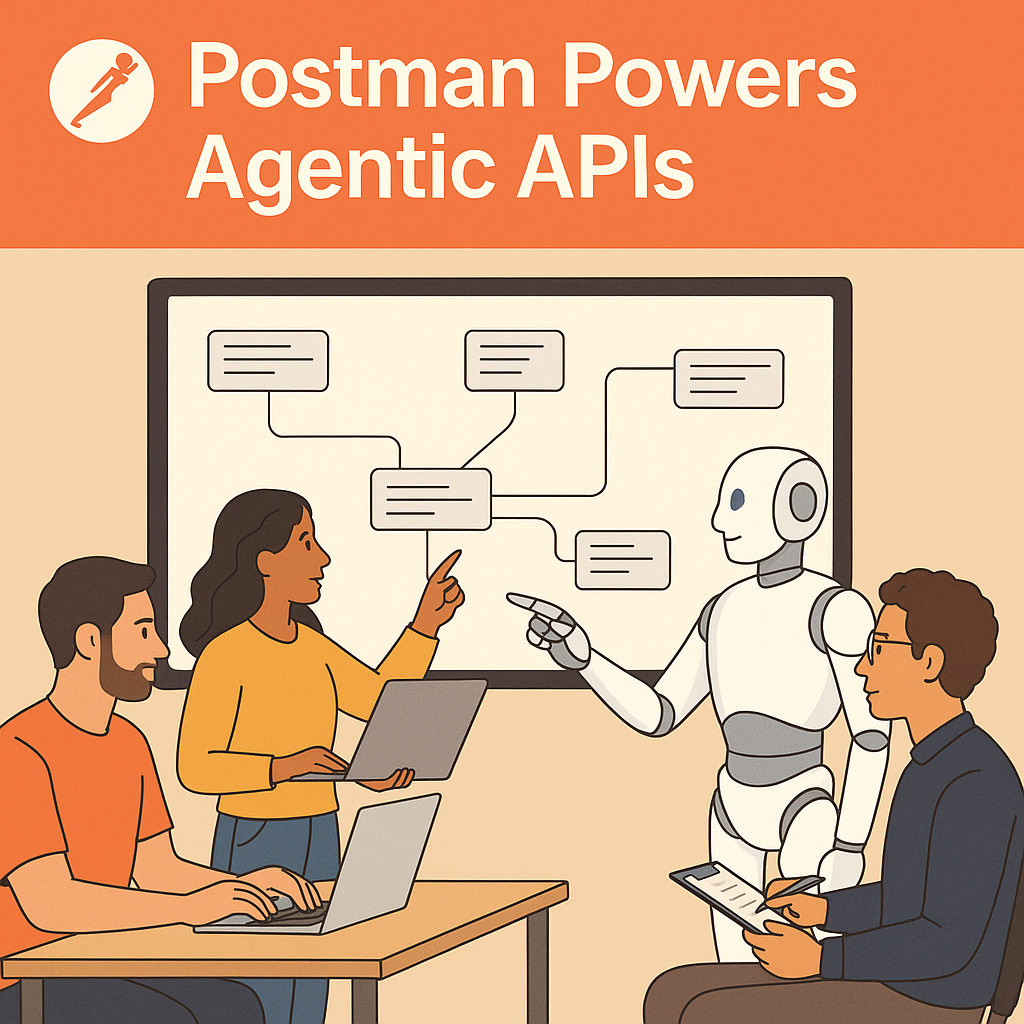
Postman unveiled new platform capabilities aimed at operationalizing agentic AI systems—advancing its mission to make APIs both human- and agent-ready. These features reflect the growing complexity of AI agents in production and the corresponding need for tools that support observability, governance, and collaboration at enterprise scale.
With over 40 million developers and 500,000 organizations using its platform, Postman is positioning itself as a go-to resource not just for API testing, but for intelligent agent deployment. The company’s latest product updates include Postman Insights (now in open beta), the Agentic AI Builder with Model Context Protocol (MCP) integration, and enhancements to collaboration tools spanning GitHub, Jira, Slack, and Microsoft Teams.
“The Postman API Network gives our developers powerful tools to make it easier than ever to build, test and scale AI-powered commerce experiences,” said Alex Chriss, President and CEO of PayPal. “It’s not just speed—it’s developer velocity that translates into real value for customers.”
Insights into API Usage in the Agentic Age
Postman’s internal telemetry between May 2023 and April 2025 illustrates a dramatic rise in traffic related to large language models (LLMs):
- Meta’s Llama traffic increased sevenfold.
- Google Gemini usage grew by 5x, particularly among enterprise teams.
- Open-source model providers like Replicate and Mistral saw doubled and quadrupled traffic, respectively.
Despite OpenAI still accounting for 60% of AI-related traffic on Postman, the data indicates a shift toward model diversification rather than consolidation.

Abhinav Asthana, Postman’s Co-founder and CEO, explained the shift in a statement:
“Agent-based systems aren’t just clever prompts—they’re full systems that must be tested, debugged, and governed like real software. Postman is where you build that intelligent system with trust, transparency, and speed.”
New Tools for a New Development Paradigm
Postman Insights provides real-time observability across both human and AI agent API usage. Features like version-aware monitoring and failure detection help developers spot issues before they impact users. For agents, this level of monitoring is particularly important given their autonomous behavior in production.
The new Repro Mode within Insights lets teams recreate API failures using real-world payloads, headers, and authentication tokens. This is particularly useful for diagnosing unpredictable agent behavior—an increasingly common challenge as enterprises move from pilot programs to production deployments.
Another notable advancement is the integration of the Model Context Protocol (MCP), allowing developers to turn APIs into callable tools for agents. Postman now supports the generation of MCP servers from existing API collections and includes a dedicated MCP request type for agent-specific testing.
With the launch of the world’s first MCP Server Network, developers can now browse and adopt verified, agent-compatible APIs more easily. These curated endpoints are meant to accelerate secure agent integration by giving developers a foundation of trusted, well-documented APIs.
Streamlining Developer Collaboration
To match the growing complexity of agentic software, Postman has also enhanced its workflow integrations:
- GitHub: Sync collections in real time, enforce branch-based governance, and streamline review cycles.
- Jira: Create and track context-aware issues directly from Postman.
- Slack/Microsoft Teams: Receive real-time notifications on API changes, alerts, and issues.
These features are designed to reduce the gap between development and production, allowing cross-functional teams to coordinate better as they scale agent systems.
Enabling Developer Velocity with API Network Expansion
Postman’s API Network—already home to over 18,000 publishers and 100,000+ APIs—plays a central role in AI agent development. It ensures human and non-human consumers can find, authenticate, and reliably interact with APIs, regardless of whether the interfaces are public, private, or limited to partners.
The addition of Notebooks allows teams to onboard faster through interactive guides that merge documentation with live API calls. Activity Feeds and Watchers help keep everyone—human developers and autonomous agents—up to date on breaking changes, version updates, and performance metrics.
In sum, the updates shared at POST/CON 2025 are designed to close the reliability gap between experimental AI agents and production-grade systems. By providing a unified platform for API collaboration, testing, governance, and observability, Postman aims to make agentic software a viable reality for enterprise teams worldwide.
Learn how AI Agents can supercharge your company’s profits and productivity at TMC’s AI Agent Event in Sept 29-30, 2025 in DC.

Rich Tehrani serves as CEO of TMC and chairman of ITEXPO #TECHSUPERSHOW Feb 10-12, 2026 and is CEO of RT Advisors and is a Registered Representative (investment banker) with and offering securities through Four Points Capital Partners LLC (Four Points) (Member FINRA/SIPC). He handles capital/debt raises as well as M&A. RT Advisors is not owned by Four Points.
The above is not an endorsement or recommendation to buy/sell any security or sector mentioned. No companies mentioned above are current or past clients of RT Advisors.
The views and opinions expressed above are those of the participants. While believed to be reliable, the information has not been independently verified for accuracy. Any broad, general statements made herein are provided for context only and should not be construed as exhaustive or universally applicable.
Portions of this article may have been developed with the assistance of artificial intelligence, which may have contributed to ideation, content generation, factual review, or editing.