
Key Takeaways:
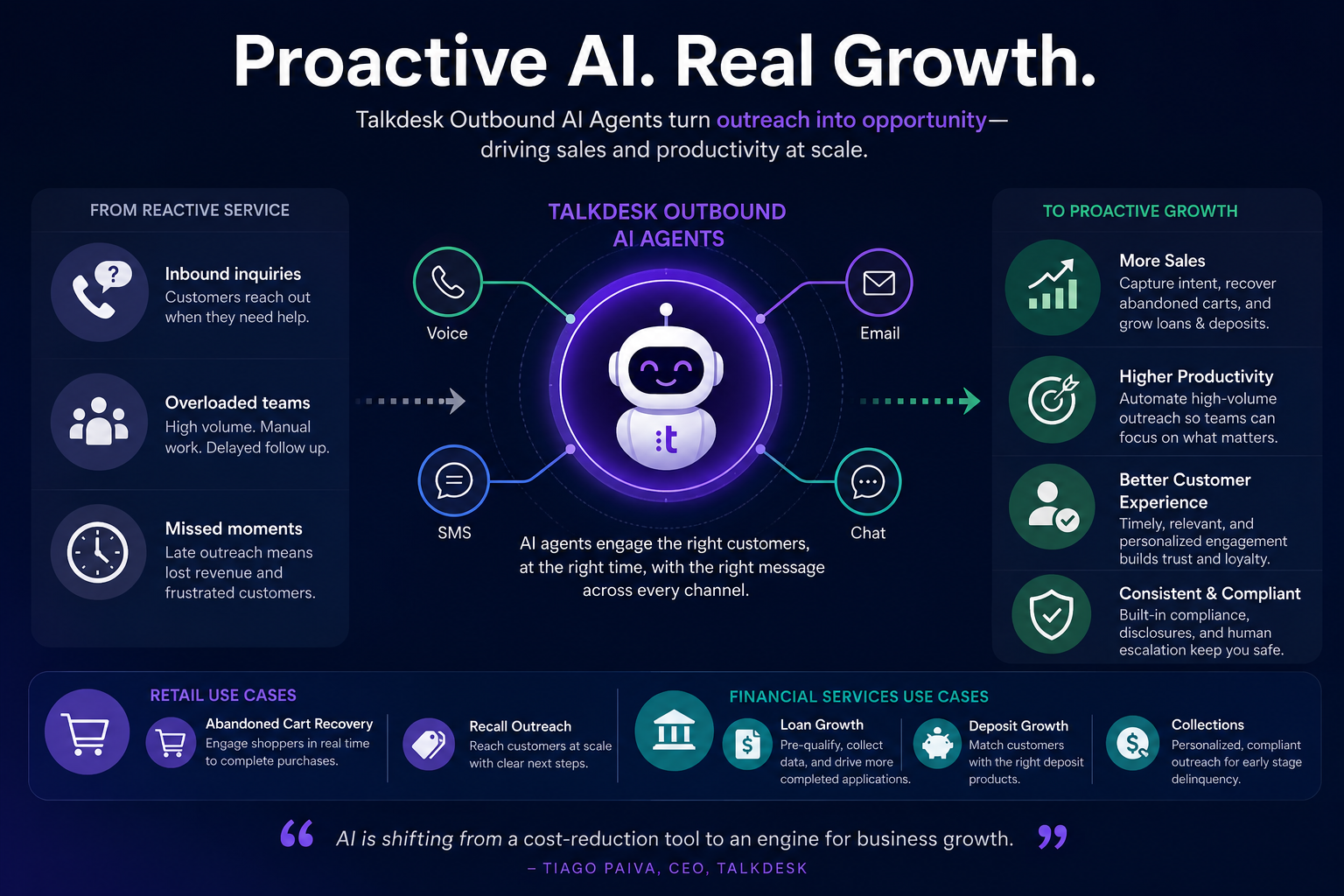
- Talkdesk introduced proactive AI agents for retail and financial services, focused on outbound engagement across voice and digital channels.
- The more interesting angle is not just automation. It is the potential lift in sales productivity, follow up consistency, and revenue capture.
- Retail use cases include abandoned cart recovery and recall outreach, while financial services use cases include loan growth, deposit growth, and collections.
- The rollout reflects a broader shift in AI from reactive customer support to proactive business growth.
For years, contact center AI has mostly been discussed as a way to deflect calls, shorten handle times, and reduce support costs. That is still part of the story, of course. But the more interesting shift now happening in CX is that AI agents are starting to move into proactive revenue work.
That is why Talkdesk’s latest announcement stands out.
The company introduced new proactive AI agents for retail and financial services, designed to automate outbound engagement across voice and digital channels. According to Talkdesk, these agents are part of its CXA platform and are intended to help organizations move from reactive service models toward proactive growth strategies. The company says they can be integrated into key systems, configured, tested, and deployed with templatized multi agent workflows, reducing the need to build basic processes from scratch.
That matters because outbound work is often where sales and service teams lose momentum. Not because people are not capable. Usually, it is because timing, workflow, personalization, compliance, and follow up all have to line up at once. In the real world, they often do not.
A shopper abandons a cart. A bank prospect begins a loan process but does not complete it. A borrower enters early stage delinquency. A customer affected by a product recall needs clear next steps. These are not exotic edge cases. They happen constantly. The problem is that many organizations still rely on overloaded teams, disconnected systems, or generic outreach to respond.
AI agents could change that equation.
Talkdesk’s retail agents are designed for scenarios such as abandoned cart recovery and large scale recall outreach. In the cart recovery example, the AI agent can engage customers in real time, provide personalized product recommendations, and support checkout completion. In recalls, the agents can manage high volume outreach across channels and guide customers through repairs, returns, or exchanges.
The financial services use cases are just as important. Talkdesk says its AI agents can support loan growth by handling data collection and disclosures for pre qualification, drive deposit growth by matching customers to deposit products, and improve collections outcomes through personalized, compliant outreach for early stage delinquency.
This is where the sales productivity angle becomes compelling. If these agents are deployed properly, the expected benefit is not simply fewer manual tasks. It is more consistent execution at moments when timing matters.
In sales and customer growth, speed is often a competitive variable. A lead contacted quickly is different from a lead contacted two days later. A customer receiving a relevant reminder at the moment of intent is different from a customer getting a generic email after the buying window has closed. A collections conversation handled early and respectfully can produce a different result than one handled after frustration has already built.
Talkdesk CEO Tiago Paiva framed the shift clearly, saying, “AI is shifting from a cost-reduction tool to an engine for business growth.” That is the right lens for this announcement. The value is not just that AI can do more work. It is that AI can potentially do the work at the right time, with context, and at a scale human teams often struggle to maintain.
There is another subtle but important point here. AI agents are not just scripts with a better interface. At least in the direction the market is moving, they are becoming workflow participants. They can gather information, trigger next steps, personalize communication, escalate when needed, and measure results. That makes them different from older outbound dialers or campaign automation tools.
Bain recently noted that generative and agentic AI applications have the potential to free up more selling time and improve conversion rates. That is a useful frame because sales productivity has never been only about making more calls or sending more emails. It is about increasing the amount of time and attention available for high value work.
McKinsey has also estimated that applying generative AI to customer care functions could increase productivity by 30 to 45 percent of current function costs. While that figure is not specific to Talkdesk or these outbound agents, it reinforces the broader point that customer operations and sales adjacent workflows are among the areas where AI may have meaningful productivity impact.

Still, companies should avoid treating this as a magic button. Outbound AI requires governance. Especially in financial services, it also requires compliance controls, proper disclosures, auditability, data quality, and human escalation paths. In retail, brands need to ensure that personalization does not become intrusive and that recall outreach is accurate, timely, and clear.
That is why the quote from Garrett Jorewicz of Credit Union 1 is worth noting. He said the “real opportunity is in building capabilities that make financial institutions more proactive.” That is a measured way to think about it. AI agents are not just a tool to cut costs. They are part of a capability buildout.
The companies that benefit most may be the ones that approach outbound AI as an operating model change, not a plug in. They will need to decide which journeys should be automated, where humans should remain involved, how performance will be measured, and how customer trust will be protected.
For retail, the near term opportunity may be revenue recovery and service consistency. Abandoned cart outreach, product recommendations, returns, exchanges, and recalls all involve repeatable processes where timing and personalization matter. For financial services, the opportunity may be even broader because loan growth, deposit growth, onboarding, and collections all depend on disciplined, compliant engagement.
And frankly, that is why this announcement feels more significant than another generic AI launch. It points to a practical direction for AI agents: not replacing strategy, not replacing relationship building, but handling high friction outreach that too often falls through the cracks.
We are impressed by the potential increase in sales and productivity expected from these types of agents as they are rolled out. The technology still needs careful implementation, but the direction is clear. AI agents are moving from answering questions to initiating action. For organizations in retail and financial services, that could become an important shift in how growth, service, and operational efficiency come together.

If you liked this post, you’ll love one of the the leading global business communications and technology events since 1999, the ITEXPO #TECHSUPERSHOW, Feb 9-11, 2027 Fort Lauderdale, Florida.
Don’t forget the collocated MSP Expo – just for managed service providers!
Aside from his role as CEO of TMC and chairman of ITEXPO #TECHSUPERSHOW Feb 9-11, 2027, Rich Tehrani is CEO of RT Advisors and a Registered Representative (investment banker) with and offering securities through Four Points Capital Partners LLC (Four Points) (Member FINRA/SIPC). He handles capital/debt raises as well as M&A. RT Advisors is not owned by Four Points.
The above is not an endorsement or recommendation to buy/sell any security or sector mentioned. No companies mentioned above are current or past clients of RT Advisors.
The views and opinions expressed above are those of the participants. While believed to be reliable, the information has not been independently verified for accuracy. Any broad, general statements made herein are provided for context only and should not be construed as exhaustive or universally applicable.
Portions of this article may have been developed with the assistance of artificial intelligence, which may have contributed to ideation, content generation, factual review, or editing