As AI workloads grow and real time applications expand, the conversation around infrastructure is starting to shift. Cloud is still central, but it is no longer the only answer.
Latency, resiliency, and data locality are forcing companies to rethink where workloads should run.
That shift was clear in a recent in person discussion at an industry event with Bernard Breton from Scale Computing, following the company’s acquisition of Adaptiv Networks.
The deal, which closed in February, is part of a broader strategy.
“The edge is getting hyperconverged,” Breton said. “Workloads need to run closer to where the data is being created.”

That includes AI.
It also includes a range of practical applications that do not always get the same attention. Camera based systems. Retail operations. Security. IoT sensors.
“Cloud is too far for some of these use cases,” Breton said. “You need to process that data locally.”
That does not mean abandoning the cloud. It means balancing it.
“Edge and cloud need to work in tandem,” he said.
That balance is driving the company’s platform strategy.
Scale Computing has built its own hyperconverged infrastructure software designed to run workloads across distributed environments. With the addition of Adaptiv, the company is extending that model into networking.
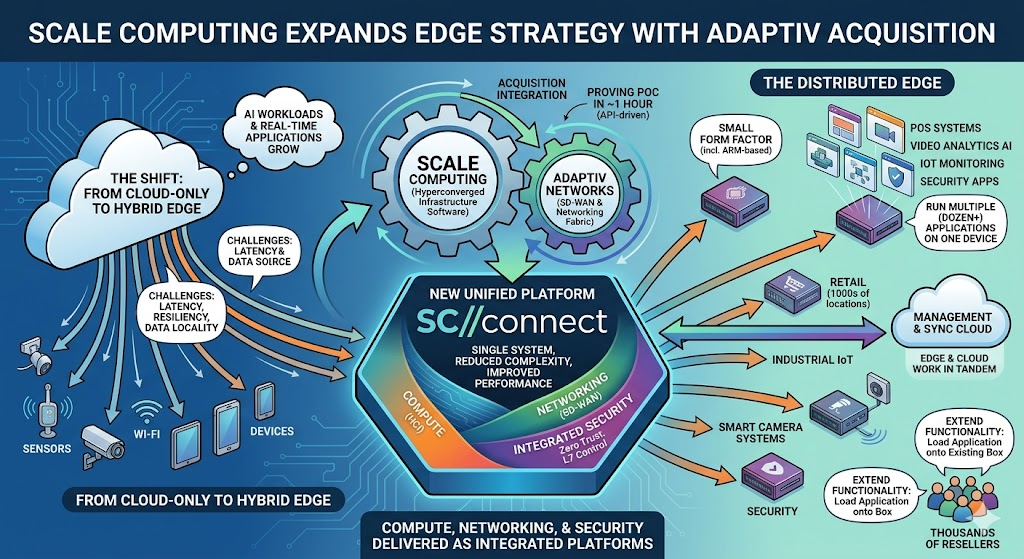
The idea is to create a unified platform where compute, storage, and networking operate together as a single system.
“SD-WAN is becoming the network fabric for the hyperconverged edge,” Breton said.
That framing is important.
Traditionally, networking and compute have been treated as separate layers. By integrating them, the company is trying to reduce complexity and improve performance, particularly in environments with many distributed locations.
Retail is a clear example.
“If you have a retailer with a thousand locations, you need compute at the edge for things like back office apps, cameras, and security,” Breton said.
Those environments often require multiple systems working together. Point of sale. Video. Analytics. Environmental monitoring.
The challenge is coordination.
“That’s why we acquired Adaptiv,” Breton said. “All of these platforms need to communicate.”
The integration appears to be progressing quickly.
According to Breton, the companies were able to complete a proof of concept in about an hour during due diligence, compared to the weeks that similar integrations might traditionally require.
“That’s the power of being API driven,” he said.
That speed is part of the company’s broader positioning.
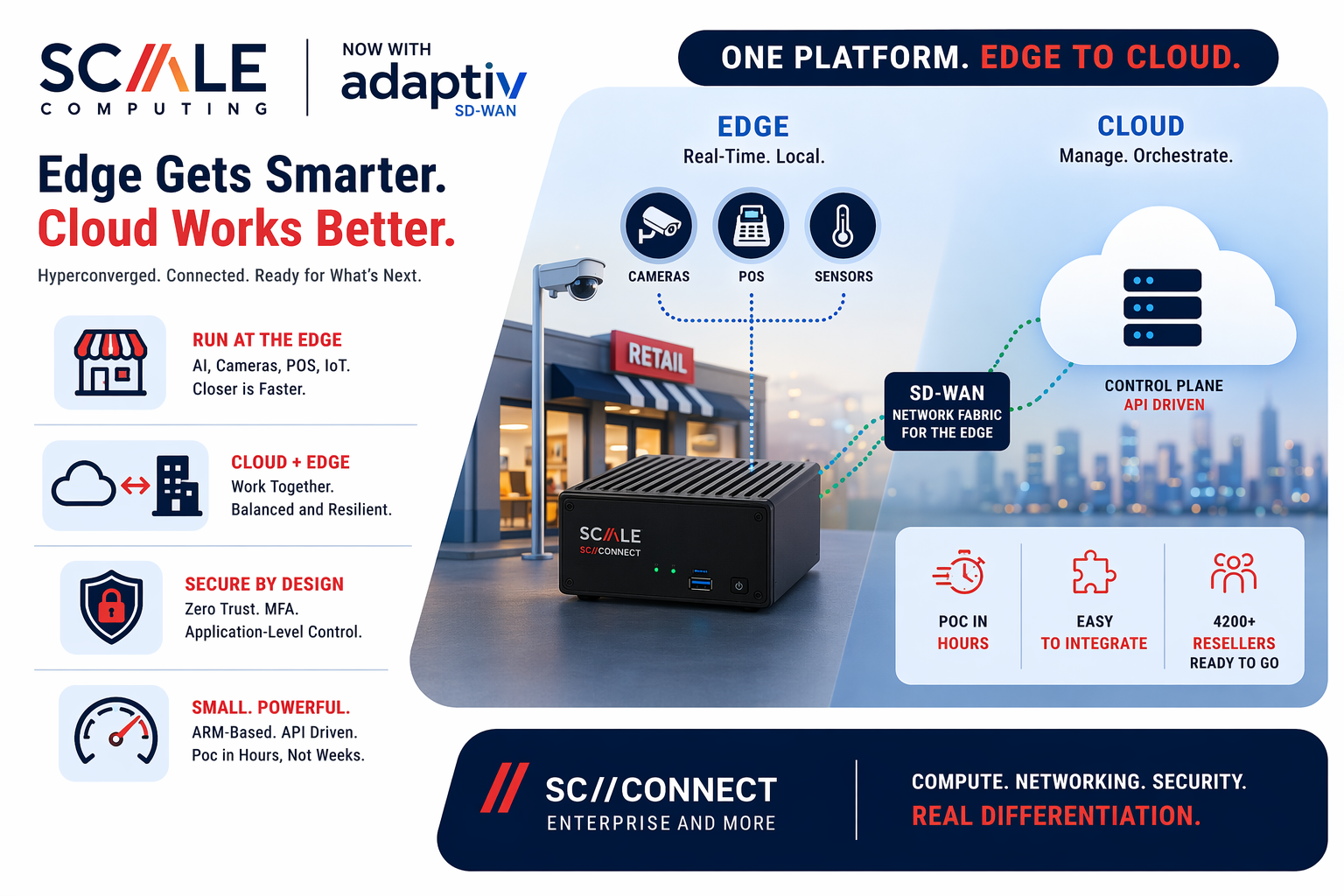
The platform is designed to run on relatively small form factor hardware, including ARM based devices that can sit at the edge of the network.
“You can run these applications on a device the size of a book,” Breton said.
That footprint matters in environments where space, power, and cost are constrained.
It also opens the door to new deployment models.
Instead of installing multiple appliances for networking, security, and compute, customers can run multiple applications on a single device.
“We have customers running a dozen or more applications at the edge,” Breton said.
Those can include POS systems, IoT monitoring, and security applications, all managed through a unified platform.
Security is integrated into that architecture.
Adaptiv’s technology brings a cloud based control plane, along with features like zero trust network access, multi factor authentication, and Layer 7 traffic control.
“We can prioritize, block, or meter traffic based on application level visibility,” Breton said.
That level of control can be important for organizations managing multiple types of traffic across distributed environments.
The combined platform is now being positioned under a new naming structure.
“SC//connect is the new family name,” Breton said, with individual products mapped into that framework.
That branding reflects the integration of networking into the broader platform.
From a go to market perspective, the opportunity is significant.
Scale Computing already works with thousands of resellers. With Adaptiv’s software, those partners can now extend functionality without deploying additional hardware.
“They can just load the application onto a box that’s already there,” Breton said.
That simplicity could accelerate adoption, particularly in environments where adding new infrastructure is costly or disruptive.
The broader trend is worth watching.
As edge computing becomes more relevant, the lines between infrastructure components are starting to blur.
Compute, networking, and security are increasingly being delivered as integrated platforms rather than standalone products.
Scale Computing is positioning itself in that space.
The question is how quickly the market moves in that direction.
Because while the need for edge processing is clear in certain use cases, many organizations are still figuring out how to balance cloud and on premise investments.
What is becoming clearer is that it is not an either or decision.
It is both.
And the companies that can make those environments work together seamlessly may have an advantage.

If you liked this post, you’ll love one of the the leading global business communications and technology events since 1999, the ITEXPO #TECHSUPERSHOW, Feb 9-11, 2027 Fort Lauderdale, Florida.
Don’t forget the collocated MSP Expo – just for managed service providers!
Aside from his role as CEO of TMC and chairman of ITEXPO #TECHSUPERSHOW Feb 9-11, 2027, Rich Tehrani is CEO of RT Advisors and a Registered Representative (investment banker) with and offering securities through Four Points Capital Partners LLC (Four Points) (Member FINRA/SIPC). He handles capital/debt raises as well as M&A. RT Advisors is not owned by Four Points.
The above is not an endorsement or recommendation to buy/sell any security or sector mentioned. No companies mentioned above are current or past clients of RT Advisors.
The views and opinions expressed above are those of the participants. While believed to be reliable, the information has not been independently verified for accuracy. Any broad, general statements made herein are provided for context only and should not be construed as exhaustive or universally applicable.
Portions of this article may have been developed with the assistance of artificial intelligence, which may have contributed to ideation, content generation, factual review, or editing