
Key Takeaways:
- German company Einhaus Group collapsed after a ransomware attack encrypted key systems and data.
- The firm paid the ransom, yet was unable to recover its operations or regain access to backups.
- Despite maintaining cyber insurance and compliance, the breach exploited a guessed password.
- The attack highlights the growing business risk of ransomware—even for well-established firms.
- Experts emphasize recovery readiness, not just prevention, as essential to organizational resilience.
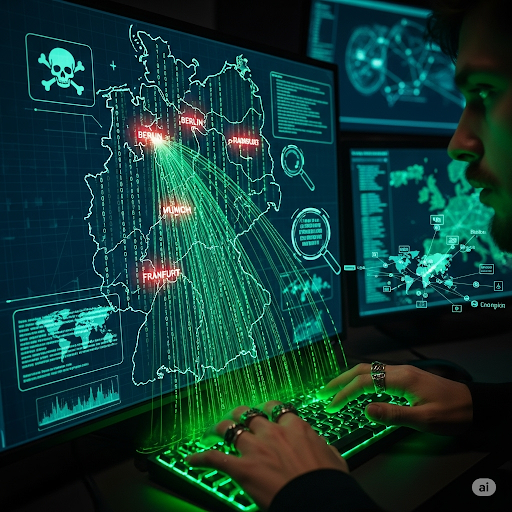
A ransomware attack has forced German phone services provider Einhaus Group into insolvency, underscoring the existential risk cybercrime now poses to even mid-sized, digitally mature businesses. The company, which offered mobile phone sales, repairs, and insurance services across thousands of German retail stores, once generated approximately €70 million in annual revenue and employed around 170 people.
The Attack and Immediate Fallout
In late 2023, attackers linked to the Royal ransomware group gained unauthorized access to Einhaus Group’s systems. The breach was traced to a guessed employee password—a reminder of the continued importance of strong credential management.
Once inside, the attackers encrypted the company’s contract database, billing systems, and crucial operational infrastructure. They printed notices on office printers confirming the breach, creating panic and confusion across the organization. Despite cyber insurance coverage and adherence to cybersecurity frameworks, Einhaus’ response plans faltered. Company backups—some stored locally, others in cloud environments—were also encrypted or rendered inaccessible.
The firm reportedly paid a ransom, estimated at just over €200,000. However, this payment did not enable full data recovery. Within months, the business laid off nearly all staff, retaining just eight employees to oversee wind-down efforts. Its headquarters was sold, operations ceased, and the firm eventually filed for insolvency.
How Could This Happen?
Einhaus was not a small operation. It had longstanding partnerships with major telecom providers, including Deutsche Telekom and Vodafone. It operated under industry cybersecurity standards and carried cyber liability insurance. So how did a single breach bring down the entire enterprise?
Analysts point to a few critical failures:
- Password security breakdown: The attackers entered through weak credentials. Multifactor authentication, if present, didn’t stop lateral movement inside the network.
- Insufficient recovery readiness: Though the company had backups, those systems were reportedly also vulnerable. Some backup data was stored online and was encrypted during the attack.
- Slow and restricted law enforcement response: While authorities did eventually trace and seize some of the attackers’ crypto wallet funds, the funds were not returned to the company, limiting the financial recovery.
Industry Comparisons and Implications
The Einhaus collapse isn’t the only recent example of ransomware shutting down a legacy firm. In the UK, 158-year-old logistics company Knights of Old also filed for insolvency after an Akira ransomware attack. That case, too, stemmed from weak password protection and unpatched systems.
In both cases, compliance with cybersecurity norms and insurance protections failed to prevent business failure. The common threads: weak credential hygiene, poor segmentation of network access, and backups that were either outdated or too easily compromised.
What’s clear is that ransomware has evolved from an IT problem into a full-scale business risk. Boards of directors and CEOs are increasingly being forced to ask: how quickly can we recover? Prevention alone may no longer be enough.
Recovery Over Prevention
Cybersecurity experts increasingly argue that organizational resilience now hinges less on stopping every threat at the door and more on surviving the breach. That means:
- Immutable backups: Backups must be isolated from main networks and cannot be changed or deleted during a breach.
- Access controls and MFA: All remote access points should require multifactor authentication and ideally utilize zero-trust frameworks.
- Employee training: Social engineering and phishing remain common entry points; human error is often the weakest link.
- Incident response drills: Like fire drills, companies should rehearse breach response scenarios regularly to reduce downtime.
A Cautionary Tale for the Mid-Market
Einhaus Group’s sudden collapse serves as a stark warning: even organizations with apparent digital maturity and financial backing can be brought down by a single ransomware event. The cost of downtime, legal liability, lost data, and customer churn often exceeds the ransom itself. And in many cases, paying does not result in full restoration of data or trust.
As threat actors grow more organized and sophisticated, the business case for investing in advanced backup systems, strict credential enforcement, and rapid recovery planning has never been stronger.
Learn how AI Agents can supercharge your company’s profits and productivity at TMC’s AI Agent Event in Sept 29-30, 2025 in DC.
Rich Tehrani serves as CEO of TMC and chairman of ITEXPO #TECHSUPERSHOW Feb 10-12, 2026 and is CEO of RT Advisors and is a Registered Representative (investment banker) with and offering securities through Four Points Capital Partners LLC (Four Points) (Member FINRA/SIPC). He handles capital/debt raises as well as M&A. RT Advisors is not owned by Four Points.
The above is not an endorsement or recommendation to buy/sell any security or sector mentioned. No companies mentioned above are current or past clients of RT Advisors.
The views and opinions expressed above are those of the participants. While believed to be reliable, the information has not been independently verified for accuracy. Any broad, general statements made herein are provided for context only and should not be construed as exhaustive or universally applicable.
Portions of this article may have been developed with the assistance of artificial intelligence, which may have contributed to ideation, content generation, factual review, or editing.