

Key Takeaways:
- The new iPad Pro introduces Apple’s M5 chip, offering up to 5.6x faster performance than M1 and up to 3.5x faster AI processing than M4.
- Apple continues to push the boundaries of chip design with N1 and C1X chips, delivering Wi-Fi 7 and faster cellular connectivity.
- The M5 chip’s power may exceed what current software can utilize, reflecting Apple’s unmatched capability in silicon engineering.
- iPadOS 26 enhances multitasking, creative workflows, and AI-driven tasks while maintaining Apple’s focus on sustainability and performance.
- The M5 iPad Pro is available in 11- and 13-inch models, starting at $999, with preorders open and shipping beginning October 22.
Apple’s latest innovation, the iPad Pro with the M5 chip, represents another leap in the company’s relentless evolution of mobile computing. The new device, announced by Apple Senior Vice President of Hardware Engineering John Ternus, is powered by a next-generation system-on-a-chip that dramatically boosts AI, CPU, and GPU performance while maintaining Apple’s hallmark energy efficiency and portability.
Ternus described it as “the most advanced and versatile iPad experience yet,” explaining that the combination of “a huge leap in AI performance, a big boost in graphics, and game-changing iPadOS 26 features” pushes the limits of what an iPad can achieve.
M5: Apple’s Deepening Focus on AI
At the heart of this upgrade is the M5 chip, Apple’s latest piece of silicon engineering. It features a 10-core GPU with a Neural Accelerator in each core, providing 3.5 times faster AI processing than the M4 iPad Pro and 5.6 times faster than the M1 model. The new Neural Engine is designed for energy-efficient AI workloads such as image generation, video masking, and real-time upscaling — capabilities that reflect Apple’s ambition to embed intelligent computing across its product line.
Developers can leverage these advances to accelerate diffusion-based image generation in apps like Draw Things and perform high-speed AI-driven video editing in DaVinci Resolve. The performance uplift also benefits productivity and design tools such as Adobe Illustrator and SketchUp, allowing professionals to work faster across multiple apps without lag.
Apple’s focus on on-device AI — rather than relying on cloud processing — reinforces its privacy-first approach while keeping latency minimal. The result is an iPad that feels both more powerful and more personal, giving users professional-grade capabilities in a handheld form.
Hardware So Powerful, Software May Struggle to Keep Up
The raw power of the M5 chip underscores a fascinating truth: Apple’s processors have become so advanced that it’s increasingly difficult for software to fully exploit their potential. The M5’s GPU introduces third-generation ray tracing, the same high-end technology found in top-tier desktop systems, enabling realistic lighting and shadows in 3D applications and games.
Yet, few mobile or tablet apps can currently stretch the M5’s limits. This imbalance between hardware and software highlights just how far ahead Apple’s silicon engineering has moved. It’s a reminder that while Apple’s chip teams continue to push the envelope, much of the future innovation may rest in the hands of developers who can harness this untapped power for creative and AI-driven tools.
Still, the hardware itself is a statement. It shows Apple’s ability to build chips that rival — and in many cases surpass — traditional desktop performance, within an ultra-thin tablet. If history is any indication, developers will eventually rise to the challenge, bringing software that fully exploits the M5’s potential in AI, design, and media creation.
Speed, Storage, and Seamless Connectivity
Performance isn’t the only area that received an upgrade. The new iPad Pro includes Apple’s N1 wireless chip and C1X cellular modem, which deliver faster Wi-Fi 7 and 5G connections while improving power efficiency. For those who work on the move, the ability to transfer large files and collaborate in real time over faster networks will be a key advantage.
The device also benefits from 150GB/s unified memory bandwidth — nearly 30 percent higher than the prior model — and offers up to 2x faster storage read and write speeds. The 256GB and 512GB models now start with 12GB of memory, providing more headroom for multitasking and AI processing.
With iPadOS 26, users gain access to a redesigned interface built around multitasking, liquid glass visual effects, and a powerful new windowing system. The software enables better control over multiple apps and introduces a dedicated Preview app for PDFs — long requested by professionals who rely on annotation and form filling.
Design and Display Refinements
Aesthetically, Apple continues to refine the iPad’s minimalist appeal. The 11-inch model measures 5.3 mm thin, while the 13-inch version drops to 5.1 mm — making it Apple’s thinnest product yet. Both feature the Ultra Retina XDR display, which uses tandem OLED technology for high contrast and color accuracy. The display supports 1000 nits of brightness for SDR and HDR, peaking at 1600 nits for HDR content.
Apple has also introduced a nano-texture glass option for users working in bright environments, designed to reduce glare without compromising clarity. The ability to drive external displays up to 120Hz, with Adaptive Sync for smoother rendering, makes the M5 iPad Pro even more suitable for editing and real-time creative workflows.
Environmental and Accessory Updates
As with all recent Apple products, sustainability plays a central role. The new iPad Pro uses 30 percent recycled materials by weight, 100 percent recycled aluminum, and is built using 55 percent renewable electricity across Apple’s supply chain. Paper packaging is now fully fiber-based and recyclable.
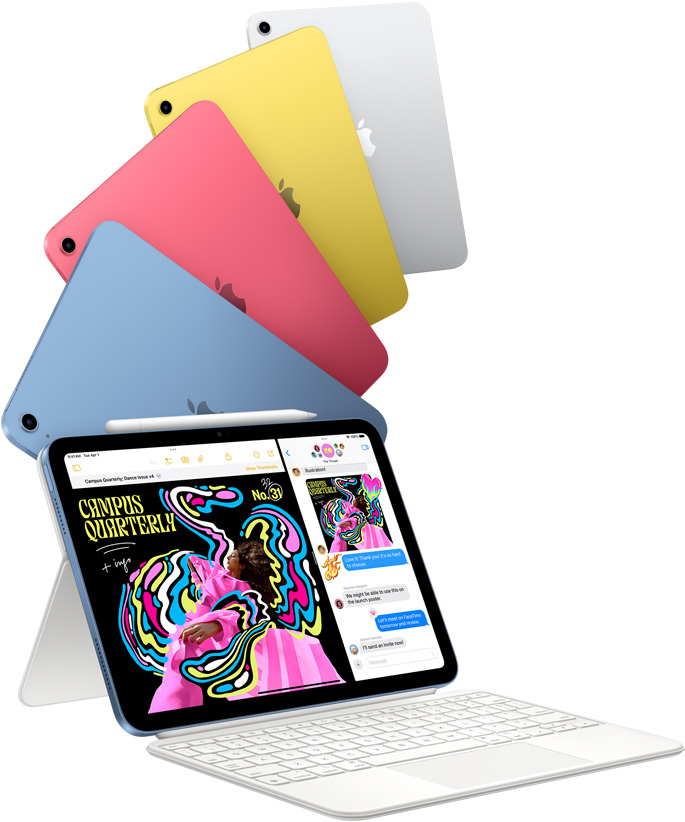
Accessories include the new Magic Keyboard with aluminum palm rest and function row, along with the Apple Pencil Pro and Apple Pencil (USB-C). These tools complete the professional experience by extending the device’s creative range.
A Reflection of Apple’s Unmatched Silicon Mastery
Apple’s introduction of the M5 iPad Pro isn’t just about another generational update — it’s a reflection of the company’s continued mastery in chip design. The performance gains are so significant that the limiting factor is no longer the hardware but the software ecosystem’s ability to take advantage of it.
That reality underscores just how far Apple has come since the first iPad. The M5’s neural and graphical capabilities are extraordinary, and while it may take time for developers to unlock their full potential, the foundation is here for a new era of AI-powered mobile computing.
With preorders underway and availability beginning October 22, the M5 iPad Pro once again positions Apple at the forefront of innovation — not just in performance, but in redefining what a tablet can achieve.

If you liked this post, you’ll love one of the the leading global business communications and technology events since 1999, the ITEXPO #TECHSUPERSHOW, Feb 10-12, 2026 Fort Lauderdale, Florida.
Don’t forget the collocated MSP Expo – just for managed service providers!
Aside from his role as CEO of TMC and chairman of ITEXPO #TECHSUPERSHOW Feb 10-12, 2026, Rich Tehrani is CEO of RT Advisors and a Registered Representative (investment banker) with and offering securities through Four Points Capital Partners LLC (Four Points) (Member FINRA/SIPC). He handles capital/debt raises as well as M&A. RT Advisors is not owned by Four Points.
The above is not an endorsement or recommendation to buy/sell any security or sector mentioned. No companies mentioned above are current or past clients of RT Advisors.
The views and opinions expressed above are those of the participants. While believed to be reliable, the information has not been independently verified for accuracy. Any broad, general statements made herein are provided for context only and should not be construed as exhaustive or universally applicable.
Portions of this article may have been developed with the assistance of artificial intelligence, which may have contributed to ideation, content generation, factual review, or editing