
As AI adoption accelerates across the MSP landscape, most of the conversation has centered on tools. Tools to monitor. Tools to secure. Tools to analyze.
But there is another layer that is starting to shift. The service desk itself.
At an industry event, I met in person with Mark Alayev, founder and Chief of Magic at Thread, to talk through how AI is beginning to change the way MSPs handle support, triage, and customer interaction.

Alayev’s background is rooted in product design and engineering, and his focus is clear. Build around how people actually communicate, not how legacy systems expect them to.
“We were chat first,” Alayev said. “We were told not to reach out on Teams to make tickets. But we knew chat was the best platform for AI. It’s real time and rich. Better than phone and email.”
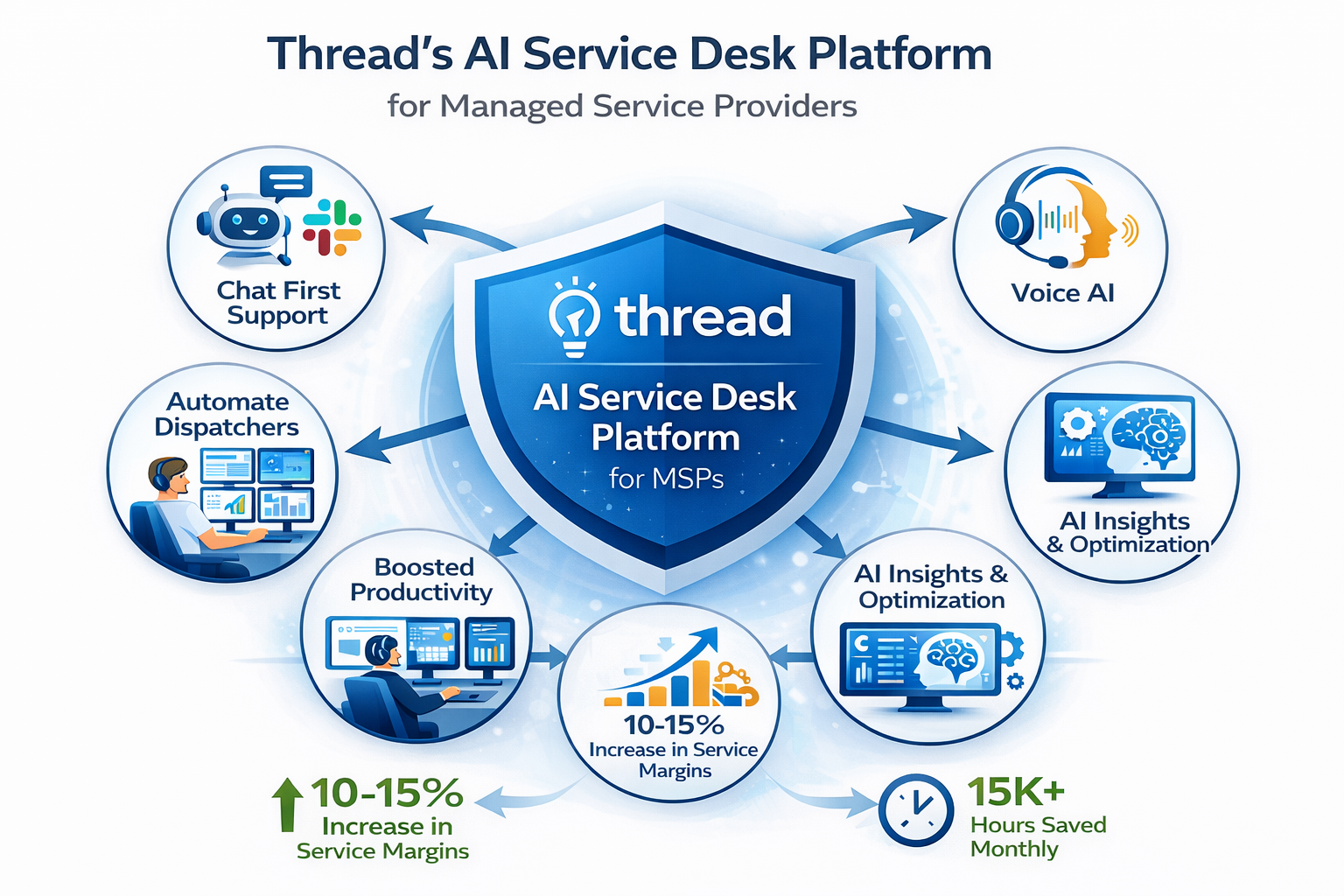
That early bet looks more relevant now than it did then. While many service desks still rely on tickets generated through email or phone calls, Thread started with conversational interfaces, embedding AI agents directly into platforms like Slack.
The result is not just faster response times. It changes the structure of the workflow itself.
Instead of waiting for a ticket to be created, categorized, and assigned, the system can triage in real time.
According to Alayev, the platform can route issues with around 95 percent accuracy, directing requests to the right team without the traditional handoff process.
That has implications for one of the more overlooked roles inside MSPs. Dispatch.
“Dispatchers are pure cost against margin,” Alayev said, reflecting on his own experience running an MSP in New York. “We had nine dispatchers and about 50 to 60 engineers. That’s a lot of overhead.”
With AI handling triage and routing, that structure starts to change.
He pointed to customers already reducing dispatch teams significantly. In one case, a team went from six dispatchers down to two, with those remaining shifting into supervisory roles, managing AI agents rather than manually assigning tickets.
The work itself changes as well.
“No one wakes up and says they want to categorize tickets,” Alayev said. “Dispatchers don’t enjoy that work. They’re happier moving into roles where they’re overseeing systems instead.”
That shift is not just about cost reduction. It is about capacity.
Thread estimates that its platform processes more than 25 billion tokens per month, contributing to a reduction of 15,000 to 20,000 hours of labor across its customer base.
Those numbers are directional, but they point to a broader idea.
AI is not necessarily reducing headcount. It is allowing MSPs to support more customers with the same teams.
Alayev framed it this way.
“Companies will have the same revenue with the same or slightly higher headcount,” he said. “The question is how to support more customers with the same employee count.”
That efficiency shows up in margins.
Thread estimates a potential 10 to 15 percent increase in service gross margin by removing non billable roles and reallocating resources toward higher value work.
But the platform is not limited to chat.
This year, the company introduced a second layer of communication. Voice.
“Phone is 50 percent of service requests, and it’s not automated,” Alayev said.
That gap creates friction. Calls come in. Technicians answer. Notes have to be entered manually. Context is often lost.
Thread’s approach is to apply the same AI layer to voice interactions.
The system can answer calls, identify the user, create a ticket, route it, and transcribe the interaction in real time. It can also provide context to the technician, suggesting related issues or possible root causes.
That last part is where things start to get interesting.
Instead of just recording what happened, the system begins to interpret it.
If multiple users are calling about similar symptoms, it can surface patterns. A firewall issue. A docking station problem. Something upstream that might not be obvious from a single ticket.
In theory, that reduces resolution time. In practice, it depends on how well the system integrates into existing workflows.
Looking ahead, the company has set a near term target.
“In the next 12 to 18 months, we want to automate about 25 percent of tickets,” Alayev said, focusing initially on repetitive tasks like password resets.
That level of automation, if achieved, would represent a meaningful shift in how service desks operate.
It also raises a strategic question for MSPs.
What happens when the cost to deliver support drops?
Alayev’s view is that pricing pressure will follow, but so will market expansion.
“MSPs that get there can charge less and gain more market share,” he said.
Lower costs make services more accessible, potentially bringing in customers who were previously priced out.
At the same time, the role of the MSP may expand.
“MSPs are going to become AI providers,” Alayev said.
That could include building AI agents for customers, handling compliance workflows, or managing automated interactions beyond traditional IT support.
But there is a sequencing issue.
“MSPs need AI adoption and utilization internally first,” he said. “If they skip that step, they miss the competency and end up needing new teams, which increases burn and hurts margins.”
That comment landed. Because it reflects something happening across the industry.
There is a temptation to productize AI for customers before fully understanding it internally. In some cases, that works. In many, it creates gaps.
Thread’s growth suggests that the demand is there.
The company now works with over 700 MSPs, a figure that has tripled over the past year.
Whether that growth continues at the same pace is an open question. The market is still forming, and competition will inevitably increase.
But the direction is clear.
The service desk, long considered a fixed function inside MSPs, is starting to change.

If you liked this post, you’ll love one of the the leading global business communications and technology events since 1999, the ITEXPO #TECHSUPERSHOW, Feb 9-11, 2027 Fort Lauderdale, Florida.
Don’t forget the collocated MSP Expo – just for managed service providers!
Aside from his role as CEO of TMC and chairman of ITEXPO #TECHSUPERSHOW Feb 10-12, 2026, Rich Tehrani is CEO of RT Advisors and a Registered Representative (investment banker) with and offering securities through Four Points Capital Partners LLC (Four Points) (Member FINRA/SIPC). He handles capital/debt raises as well as M&A. RT Advisors is not owned by Four Points.
The above is not an endorsement or recommendation to buy/sell any security or sector mentioned. No companies mentioned above are current or past clients of RT Advisors.
The views and opinions expressed above are those of the participants. While believed to be reliable, the information has not been independently verified for accuracy. Any broad, general statements made herein are provided for context only and should not be construed as exhaustive or universally applicable.
Portions of this article may have been developed with the assistance of artificial intelligence, which may have contributed to ideation, content generation, factual review, or editing