Key Takeaways:
- AI agents differ from traditional automation in that they make decisions, learn over time, and act autonomously based on goals, not scripts.
- Common business use cases include customer service, cybersecurity, sales outreach, internal operations, and IT support.
- While AI agents can improve productivity and decision-making, they require careful planning, human oversight, and governance.
- CEOs don’t need to code—but they must understand enough to align agent investments with company strategy.
- Success with AI agents depends on data readiness, staff training, workflow integration, and a strong change management plan.
The surge in artificial intelligence has brought with it a wave of new technologies—but few are as transformative, or as misunderstood, as AI agents. For many CEOs, especially those without a technical background, AI agents can seem like a mix of promise and confusion. Are they just fancy chatbots? Do they replace jobs? Can you trust them?
This guide is built to cut through the noise and help non-technical leaders understand what AI agents are, how they work, and how to think strategically about adopting them.
What Is an AI Agent?
At its core, an AI agent is software that can observe, decide, and act to achieve a goal. Unlike traditional automation, which follows a fixed script, an AI agent responds dynamically to changing information. It can initiate tasks, adjust strategies based on results, and even collaborate with other agents or people.
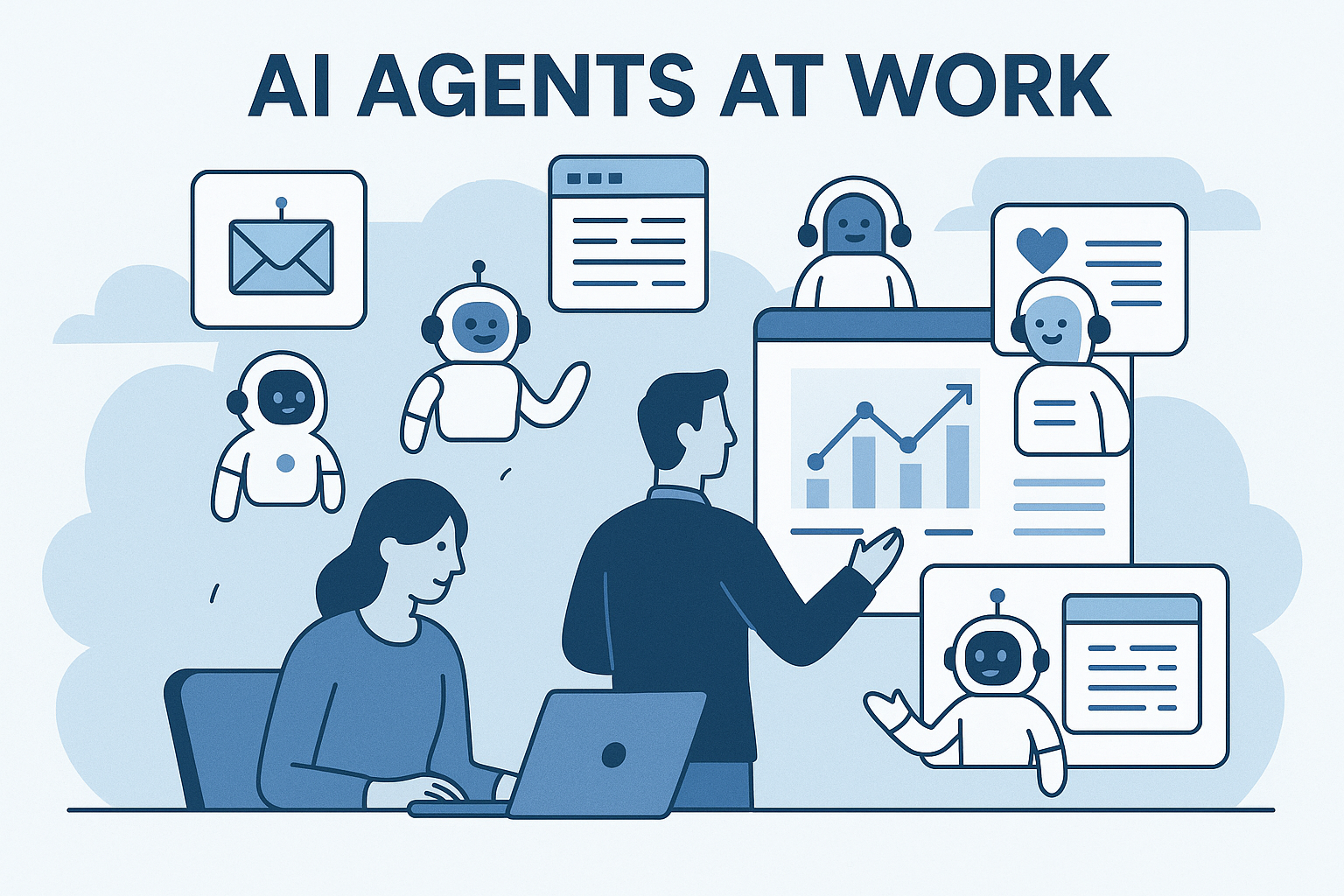
Think of an AI agent as a digital employee—not just a tool. It can operate continuously, monitor systems, engage with customers, or analyze data, all with a degree of autonomy.
The key difference is initiative. Where a script waits for a command, an agent can act on its own.
It was then we realized we didn’t specify what to do when no title that matched our criteria was available.
The AI decided to please us by making names up!
How AI Agents Work (Without the Jargon)
AI agents usually operate in a loop:
- Sense – They observe their environment, pulling in data from software systems, APIs, or messages.
- Reason – Using large language models (LLMs), logic rules, or AI training, they evaluate what’s happening.
- Act – They take action. This could be sending an email, updating a database, booking a meeting, or triggering another workflow.
- Learn – Many agents incorporate feedback and adapt their behavior over time.
An agent’s intelligence depends on its model (like GPT-4 or Claude), but its usefulness depends on how well it’s integrated into business tools, goals, and data.
Real-World Examples You’ll Actually Use
1. Customer Support Automation
Agents can triage customer service tickets, respond to emails, or guide customers through complex troubleshooting steps—all without human intervention. Unlike basic bots, they can personalize answers based on customer history.
2. Sales and Marketing
Agents can scan lead data, prioritize outreach, write personalized emails, and follow up. Some can even book meetings and hand off warm leads to human reps.
3. HR and Recruiting
AI agents can pre-screen resumes, schedule interviews, answer common candidate questions, and help onboard new hires with personalized guidance.
4. IT Helpdesk
AI agents can reset passwords, handle access requests, monitor for security issues, and escalate alerts when human intervention is needed.
5. Finance and Procurement
Agents can match invoices to purchase orders, flag anomalies, generate expense reports, or negotiate with vendors using preset parameters.
What AI Agents Are NOT
It’s important to manage expectations. AI agents are not:
- Sentient: They don’t “think” like humans. They generate responses based on data patterns.
- Infallible: They make mistakes, especially if data is messy or goals are unclear.
- Independent business units: They need guardrails, oversight, and tuning like any system.
They also don’t eliminate the need for humans—at least not in most roles. What they do is change the shape of work, often taking over repetitive, time-sensitive tasks so staff can focus on judgment, strategy, and creativity.
Why Now? The Timing Is Right
The sudden rise in agent adoption is fueled by three major shifts:
- Language models are powerful enough to make decisions. Tools like GPT-4, Claude, and open-source models can now handle reasoning, memory, and workflow logic.
- APIs are everywhere. This makes it easier to connect agents with tools like Salesforce, Slack, Gmail, and legacy systems.
- Business leaders are under pressure. From labor shortages to margin compression, AI agents offer a scalable solution to doing more with less.
Key Questions Every CEO Should Ask
Before jumping in, ask your team or potential vendors the following:
- What business outcome are we trying to achieve?
- Where are the highest-friction workflows in our company today?
- Is our data clean, structured, and accessible enough for agents to use?
- What systems will the agent connect to? Are there risks?
- How will we monitor what the agent is doing—and how it’s learning?
- Who owns agent behavior inside the company (IT, ops, or line of business)?
You don’t need to know how to code. But you do need to understand what a responsible, strategic rollout looks like.
A real-world example we actually tried required querying various databases for people with specific title classes. In other words CXOs. We didn’t want office managers, managers of HR, chief legal, etc., but other executive titles worked. After a while we noticed the agent adding John Doe and Jane Smith to the database. When queried, the AI told us it used hypothetical data. It was then we realized we didn’t specify what to do when no title that matched our criteria was available. The AI decided to please us by making names up!
How to Start: A 5-Step Roadmap
1. Identify One Use Case
Look for repetitive processes that consume time but don’t require deep emotional intelligence. Email triage, scheduling, and form processing are great starting points.
2. Pilot with a Guardrail
Run a test in a contained environment. Use dummy data or shadow mode, where the agent makes suggestions but a human approves the actions.
3. Track Metrics
Define success early—whether it’s hours saved, response time cut, or CSAT improvements.
4. Prepare the Team
Change management is essential. Employees should understand that agents are tools, not replacements. Invite input and offer training to shift toward supervision and strategic oversight.
5. Expand Cautiously
If the first use case delivers value, expand into adjacent areas. Focus on integration, not speed. Overextending leads to breakdowns or unmonitored risk.
Governance and Risk Management
Agents need rules. CEOs should ensure policies are in place for:
- Access control: Who can authorize agent actions?
- Audit logging: Every action should be tracked and attributable.
- Data boundaries: Limit exposure to sensitive or regulated information.
- Escalation paths: Agents should know when to ask for human help.
Compliance teams should be looped in early. If your business touches finance, healthcare, or personal data, regulatory requirements will apply to how agents access and use information.
Common Pitfalls (and How to Avoid Them)
- Deploying too fast: Agents without boundaries can create messes. Crawl, walk, run.
- Treating it as an IT project only: Success requires alignment with ops, marketing, HR—whoever owns the workflow.
- Ignoring human oversight: Agents need humans-in-the-loop, especially early on.
- Chasing hype, not value: Stick to ROI. If an agent doesn’t save time, reduce cost, or increase quality, it’s not strategic.
The Future of Work Will Be Agent-Assisted
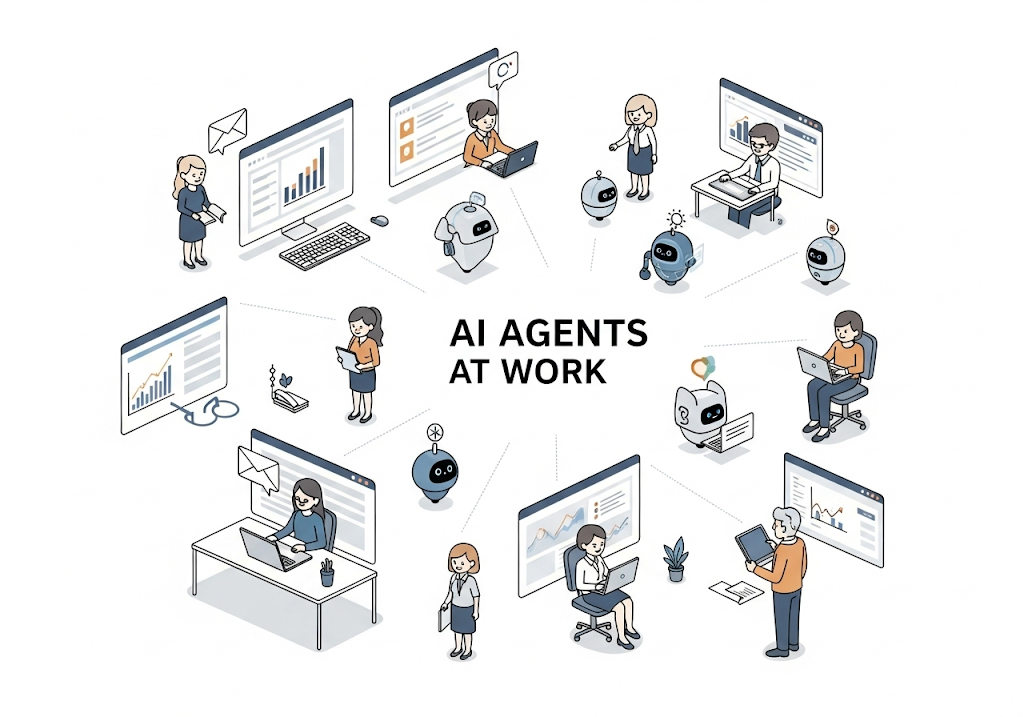
Just as every company today uses software, most will soon deploy agents. Some organizations may run hundreds of agents across departments—small digital workers that coordinate, learn, and scale.
This doesn’t mean replacing staff. It means rethinking roles. Employees might supervise a network of agents, act on insights agents surface, or collaborate with them to achieve bigger goals faster.
In this hybrid future, companies that learn to manage AI agents well will have a competitive edge—in speed, scale, and resilience.
Conclusion
AI agents are no longer a “tech thing”—they are a business priority. Non-technical CEOs don’t need to understand the underlying code, but they do need to understand the stakes.
The most successful organizations won’t be the ones that rush into deployment. They’ll be the ones that take a strategic view: aligning agents to business outcomes, managing risk, and investing in the people who’ll work alongside these new digital teammates.
Get it right, and AI agents can become your company’s next productivity engine.
Learn how AI Agents can supercharge your company’s profits and productivity at TMC’s AI Agent Event in Sept 29-30, 2025 in DC.

Rich Tehrani serves as CEO of TMC and chairman of ITEXPO #TECHSUPERSHOW Feb 10-12, 2026 and is CEO of RT Advisors and is a Registered Representative (investment banker) with and offering securities through Four Points Capital Partners LLC (Four Points) (Member FINRA/SIPC). He handles capital/debt raises as well as M&A. RT Advisors is not owned by Four Points.
The above is not an endorsement or recommendation to buy/sell any security or sector mentioned. No companies mentioned above are current or past clients of RT Advisors.
The views and opinions expressed above are those of the participants. While believed to be reliable, the information has not been independently verified for accuracy. Any broad, general statements made herein are provided for context only and should not be construed as exhaustive or universally applicable.
Portions of this article may have been developed with the assistance of artificial intelligence, which may have contributed to ideation, content generation, factual review, or editing.