Key Takeaways:
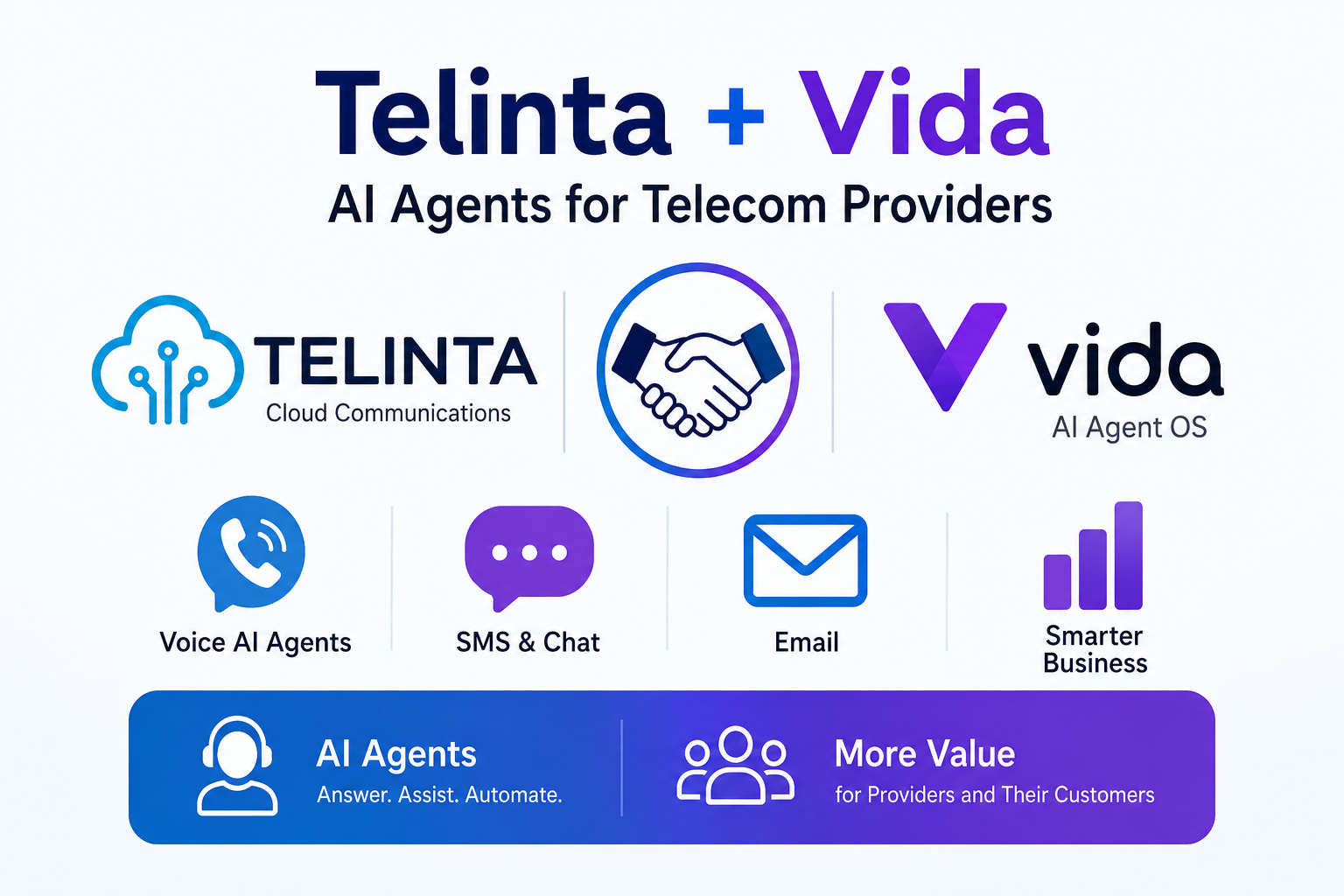
• Telinta has integrated Vida’s AI agent technology into its TeliCore softswitch platform for ITSPs.
• The partnership gives telecom service providers a path to offer AI agents across voice, SMS, email, and chat.
• Vida agents can answer inbound calls, place outbound calls, return missed calls, and use CRM or knowledge base data.
• The companies will host a joint webinar on June 24, 2026.
• The move reflects a broader shift as service providers look for new AI driven revenue opportunities.
ITEXPO #TECHSUPERSHOW exhibitor Telinta and Vida are teaming up to bring AI agents into the telecom service provider market, giving ITSPs a more direct way to add AI driven communications services to their existing offerings.
The partnership centers on Telinta’s cloud based TeliCore softswitch and billing platform, which is used by telecom service providers to deliver services such as Hosted PBX, SIP Trunking, UCaaS, VoIP calling, WebRTC, and related business telecom offerings. Through the integration, Telinta customers can access Vida’s AI Agent technology and offer AI agent services to their own business customers.
For telecom providers, the timing is interesting. Many ITSPs and MSPs are trying to figure out where they fit as AI changes how businesses handle customer engagement, support, scheduling, lead follow up, and internal workflows. The traditional telecom stack has long focused on connecting calls, managing numbers, routing traffic, supporting billing, and helping businesses communicate. AI agents add a new layer to that model: software driven workers that can answer, respond, route, schedule, text, follow up, and potentially create new service revenue around business communications.
Vida’s AI agents are designed to answer inbound calls using natural language responses informed by a customer’s knowledge base and CRM data. During calls, the agents can send SMS messages with links for purchases, documentation, reservations, or other online actions. They can also place outbound calls from predefined lists and return missed calls automatically, which could be particularly useful for businesses that lose revenue when calls go unanswered.
That last point matters more than it might sound. A small service business, medical office, local franchise, dealer, or professional services firm may not always have staff available to answer every call. Larger companies may have contact centers, but smaller organizations often rely on whoever is free. For service providers, packaging AI agents into familiar telecom services may make the technology feel less abstract and more operational.
“Telecom providers have always been the infrastructure layer for business communication, and with this partnership, they can now be the AI layer too,” said Jordan Gadapee, CMO of Vida. “Vida isn’t just an AI feature. It’s the operating system that lets Telinta’s customers run their entire AI agent business, from deployment to monetization. Together, we believe Telinta and Vida give service providers what they need to deploy intelligent agents across voice, SMS, email, and chat, and turn that into a revenue-generating service for their own clients.”
See my most recent interview with Anthony Stiso of Telinta at the ITEXPO #TECHSUPERSHOW this past February – 2026.
That framing is important because it positions AI agents not merely as a feature bolted onto a phone system, but as a product category telecom providers can sell, manage, and support. Vida describes its platform as an AI Agent OS for creating, deploying, and selling AI agents that run workflows and manage communications. Its public materials also emphasize use cases for telecom resellers and providers that want to package AI agent services for customers.
Telinta’s role is equally practical. Many telecom service providers do not want to rebuild their core switching and billing systems to experiment with AI. They need the new capability to sit inside or alongside the systems they already use. Telinta said Vida’s technology is now integrated into TeliCore, its hosted softswitch platform for ITSPs. That gives providers a potentially simpler path to commercialize AI agent services without trying to stitch together every component independently.
“For over two decades, Telinta has built a comprehensive ecosystem of industry-leading partners like Vida to help our ITSP customers grow,” said Alex Ferdman, Telinta CEO. “Telecom service providers can use Vida’s AI together with Telinta’s TeliCore platform to better compete and win in the marketplace.”
The partnership also reflects a broader channel issue: providers are under pressure to bring customers something beyond connectivity and basic communications seats. AI is creating new expectations, but also confusion. Customers may be interested in AI agents, but they may not know how to deploy them safely, connect them to phone systems, manage workflows, or measure business value. Telecom providers already own a trusted communications relationship with many customers. That could give them a logical entry point, especially when the use case starts with phone calls and messaging rather than a broad enterprise AI transformation.
One technical detail stands out. Vida says its AI agents speak 10 languages by default and can register as SIP devices on existing phone systems. Vida’s SIP documentation describes SIP registration as a way for an AI agent to register to an external PBX or SIP server so it can send and receive calls like a VoIP device on the network. For telecom providers, that may help reduce deployment friction because the AI agent can fit into existing voice infrastructure rather than requiring a complete replacement.
The companies are also using the partnership to drive near term adoption. Telinta and Vida said they will hold a free joint webinar on Wednesday, June 24, 2026, at 1:00 p.m. Eastern Time. They also announced promotional offers for new customers signing up in 2026, including a $400 discount from Telinta on the first monthly invoice and $200 off Vida platform fees for Telinta customers on the $500 per month plan for the first three months. Vida also said it is offering a no cost, no commitment proof of concept agent to demonstrate its capabilities.
For service providers, the bigger question is not whether AI agents are interesting. Many already know that. The question is how to turn that interest into a manageable, repeatable offering. A telecom provider needs packaging, pricing, support processes, compliance awareness, customer education, and a clear handoff between the AI agent and human staff. The Telinta and Vida partnership appears aimed at that practical middle ground between AI curiosity and deployable service.
There are still reasonable questions customers will ask. How should an agent be trained? Which CRM or knowledge sources should it use? What happens when the agent gets a request it should not handle? How are calls logged? How are outbound campaigns governed? How does a business keep the agent helpful without making it too aggressive or too broad? Those questions do not make the opportunity less compelling. They make the service provider role more important.
In that sense, this partnership is less about replacing telecom services and more about extending them. Voice, messaging, softphones, PBX, SIP trunks, and UCaaS are still part of the foundation. AI agents may become another layer on top of that foundation, one that helps businesses respond faster, capture missed opportunities, and automate routine interactions while keeping telecom providers involved in the value chain.
Telinta and Vida are making a clear bet: the next phase of business communications will not just be about connecting people. It will also be about helping businesses decide which interactions can be handled intelligently by software, which require people, and how both should work together. For ITSPs, that could open a new path to revenue at a time when customers are asking what AI can actually do for their business.

If you liked this post, you’ll love one of the the leading global business communications and technology events since 1999, the ITEXPO #TECHSUPERSHOW, Feb 9-11, 2027 Fort Lauderdale, Florida.
Don’t forget the collocated MSP Expo – just for managed service providers!
Aside from his role as CEO of TMC and chairman of ITEXPO #TECHSUPERSHOW Feb 9-11, 2027, Rich Tehrani is CEO of RT Advisors and a Registered Representative (investment banker) with and offering securities through Four Points Capital Partners LLC (Four Points) (Member FINRA/SIPC). He handles capital/debt raises as well as M&A. RT Advisors is not owned by Four Points.
The above is not an endorsement or recommendation to buy/sell any security or sector mentioned. No companies mentioned above are current or past clients of RT Advisors.
The views and opinions expressed above are those of the participants. While believed to be reliable, the information has not been independently verified for accuracy. Any broad, general statements made herein are provided for context only and should not be construed as exhaustive or universally applicable.
Portions of this article may have been developed with the assistance of artificial intelligence, which may have contributed to ideation, content generation, factual review, or editing