Key Takeaways
- Logz.io has launched a fully AI-first observability platform, rebuilt to support AI Agents as primary users rather than retrofitting chatbot interfaces.
- Early deployments of the platform’s AI Agents have helped customers reclaim an estimated 25,000 engineering hours per month.
- The platform introduces AI-first dashboards, enabling autonomous monitoring, anomaly detection, and incident response alongside traditional human workflows.
Logz.io, a provider of unified observability tools through its Open 360 platform, has launched what it describes as the industry’s first observability solution built from the ground up for AI Agents. Unlike other platforms that have layered chatbots over legacy architectures, Logz.io says its latest offering positions autonomous agents—not humans—as the primary users of the system. The company reports that this shift has already resulted in over 25,000 hours of engineering time saved monthly for customers.
With more than 1,200 enterprise customers globally, Logz.io’s platform evolution represents a deliberate move toward automating monitoring and incident management in a way that’s native to AI workflows. At the core of the upgrade is a new suite of AI-first dashboards designed to facilitate seamless interaction between humans and agents, with enhanced context awareness and actionable outputs.

A Ground-Up Approach to AI Agent Integration
Logz.io CEO and co-founder Tomer Levy explained the rationale behind the architectural overhaul: “When you have 1,200 customers depending on you, the safe play would be to add a chatbot and call it AI. Instead, we made the opposite bet—that the future belongs to platforms built from the ground up for AI agents, not retrofitted for them.”
The decision appears to be resonating in the market. Over 200 customers across industries including tech, healthcare, financial services, and e-commerce have already integrated Logz.io AI Agents into their production environments. More than 2,000 agents are currently active, and adoption is accelerating.
Concrete Efficiency Gains
According to Logz.io, the use of these AI Agents has reclaimed approximately 25,000 engineering hours this month alone, equating to the workload of about 12 full-time site reliability engineers. If this pace continues, the company projects customers could save roughly 300,000 hours annually—resources that could be redirected toward innovation, performance optimization, or customer-facing improvements.
Several early adopters have shared insights into how the platform has changed their operations. Nir Borenshtein, COO of Bright Data, commented: “At Bright Data we process massive volumes of data and needed an observability solution that could rapidly scale. Logz.io Open 360’s AI Agents automate and accelerate our root-cause analysis, generating on-the-fly visualizations and clear insights.”
Manikandan Sekar, Director of CloudOps and DevOps at Metadata Inc., highlighted the benefit to smaller, innovation-focused teams: “Logz.io’s AI Agents automatically analyze, report, and alert on our application performance, allowing us to focus our resources on innovation and development without compromising the pace.”
Use Case Expansion: From SRE to FinOps
The platform’s AI Agent workflows can be customized through playbooks that automate responses to a wide range of operational challenges. Examples include:
- SRE teams delegating repetitive troubleshooting
- Engineering teams diagnosing production issues or evaluating deployments
- Security teams conducting accelerated threat hunting and correlating logs
- FinOps teams surfacing underutilized resources to manage cost controls
This versatility positions Logz.io’s AI Agents as not only tools for observability but as part of a larger push toward operational intelligence and autonomy across teams.
Redesigning the Dashboard Experience
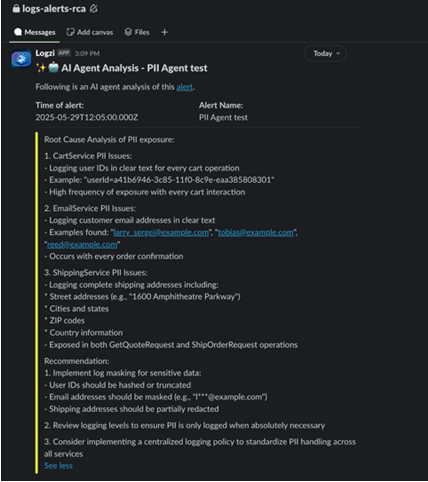
As part of the launch, Logz.io introduced AI-first dashboards that move beyond static visualizations. These dashboards are built with machine-readable schemas that allow AI Agents to generate, interpret, and adapt visual data without requiring human initiation.
Key features include:
- On-demand chart generation via natural language input
- Real-time anomaly detection with contextual overlays
- Dynamic transitions between automated suggestions and manual control
- Integration into broader Logz.io automation workflows
This dual-mode interface—accessible to both humans and AI Agents—aims to support a future in which automated systems shoulder a growing share of observability tasks while keeping humans in the loop for oversight and critical decisions.
Market Context and Competitive Implications
Logz.io’s decision to replatform—rather than retrofit—places it in a distinct category among observability vendors. As AI agents grow more capable and enterprise IT stacks become increasingly automated, the demand for platforms that natively support agentic activity is expected to rise.
Rather than waiting for the market to shift further in that direction, Logz.io is betting that early, foundational changes will put it in a stronger position to compete. In doing so, it may also reshape expectations across the observability market for what AI integration truly means beyond just chatbot functionality.
While AI agents offer considerable benefits in speed and scale, their integration also introduces complexity, particularly around governance, accuracy, and transparency. Logz.io’s approach—integrating these agents deeply into observability systems—may help address some of those concerns by grounding actions in verifiable data and repeatable workflows.
Looking Ahead
The company’s AI-first strategy signals more than just a feature release. It reflects a broader thesis about the future of work in engineering and operations—that increasingly, intelligent systems will monitor, diagnose, and even remediate issues with minimal human input.
If current adoption trends continue, Logz.io’s platform may serve as a test case for how AI-native architectures can improve performance, cut costs, and reduce burnout for IT and DevOps teams.
As platforms continue evolving, the ability to balance automation with human insight will be key—and Logz.io appears to be positioning itself as a facilitator of that balance through AI-first design, rather than post-hoc integration.
Learn how AI Agents can supercharge your company’s profits and productivity at TMC’s AI Agent Event in Sept 29-30, 2025 in DC.

Rich Tehrani serves as CEO of TMC and chairman of ITEXPO #TECHSUPERSHOW Feb 10-12, 2026 and is CEO of RT Advisors and is a Registered Representative (investment banker) with and offering securities through Four Points Capital Partners LLC (Four Points) (Member FINRA/SIPC). He handles capital/debt raises as well as M&A. RT Advisors is not owned by Four Points.
The above is not an endorsement or recommendation to buy/sell any security or sector mentioned. No companies mentioned above are current or past clients of RT Advisors.
The views and opinions expressed above are those of the participants. While believed to be reliable, the information has not been independently verified for accuracy. Any broad, general statements made herein are provided for context only and should not be construed as exhaustive or universally applicable.
Portions of this article may have been developed with the assistance of artificial intelligence, which may have contributed to ideation, content generation, factual review, or editing.