
Key Takeaways:
• OpenAI urges coordinated global efforts to ensure advanced AI systems are aligned with human values.
• The company proposes structured governance, safety benchmarks, and responsible deployment practices.
• Research partnerships and transparency are central to its approach, including shared evaluations and external oversight.
• Ongoing monitoring and collaboration with policymakers aim to balance innovation with risk mitigation.
• OpenAI emphasizes gradual scaling, preparedness, and a focus on long-term societal benefit.
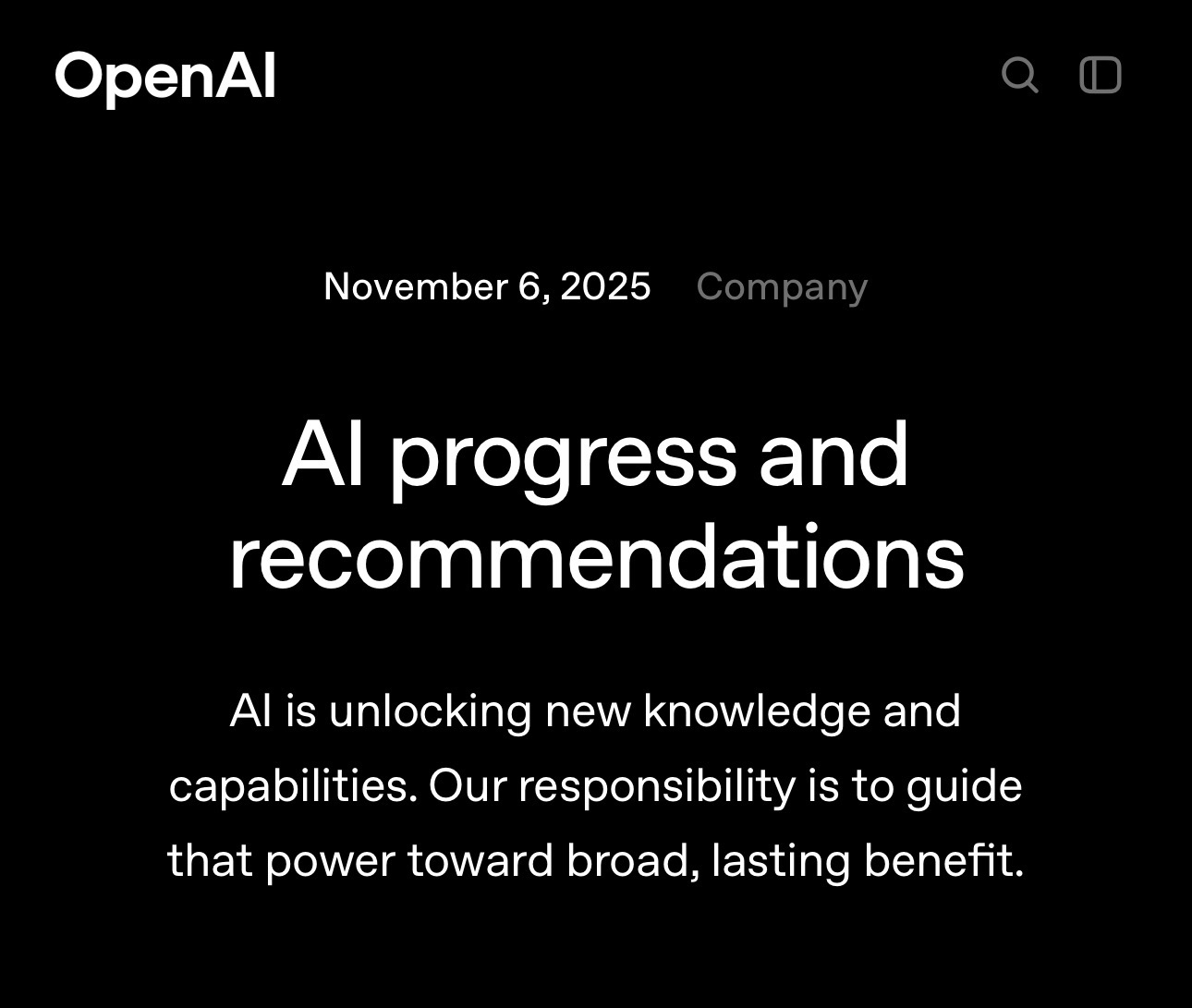
OpenAI’s new “AI Progress and Recommendations” report presents a clear roadmap for how the organization plans to advance artificial intelligence responsibly while encouraging other stakeholders to do the same. The company highlights the need for careful coordination between researchers, developers, and governments as AI systems approach capabilities that may influence economies, national security, and global welfare.
The report begins by acknowledging the rapid progress in AI and the corresponding responsibility to guide that progress toward outcomes that serve humanity as a whole. OpenAI outlines a philosophy rooted in shared safety standards, public transparency, and multi-stakeholder engagement, reflecting its view that no single organization should independently determine the trajectory of advanced AI. “We believe that the development of highly capable AI systems must be governed by a collective effort—one that incorporates a broad range of perspectives,” the company states.
A central theme is preparedness. OpenAI argues that policymakers and developers should work together to establish clear thresholds and evaluation frameworks before AI systems surpass critical capability milestones. The organization notes that proactive assessment and monitoring can help detect emerging risks earlier, reducing the likelihood of misuse or unintended harm. “Preparedness requires not just technical safeguards but also institutional processes that can adapt as technology evolves,” the report explains.
The document also highlights the importance of shared research and benchmarking across the AI field. OpenAI proposes that developers publish structured evaluations on safety and performance, allowing other labs and oversight bodies to cross-reference progress. This transparency, it argues, helps maintain trust and prevents competitive secrecy from undermining collective safety. By promoting open access to findings where appropriate, the company hopes to cultivate a culture of accountability that extends beyond any one firm’s internal policies.
OpenAI’s framework rests on three major pillars: safety, security, and benefit. Safety encompasses technical and procedural efforts to prevent unintended behavior in AI systems. Security involves protecting models and data from malicious use or theft. Benefit refers to equitable access and distribution of AI’s economic and social advantages. The organization stresses that these pillars are interdependent—neglecting one could jeopardize all. For example, without sufficient security, safety research may be compromised; without safety, the benefits of AI may not materialize at all.
The report acknowledges that many of the challenges in AI governance are unprecedented. OpenAI calls for new institutions and adaptive regulatory structures that can operate at the speed of innovation. “Existing regulatory frameworks were not designed for systems that learn, evolve, and make decisions autonomously,” it observes. Rather than prescribing rigid rules, OpenAI suggests creating flexible oversight mechanisms capable of iterative review and continuous improvement as the field matures.
A notable recommendation involves “structured coordination” among leading AI developers. The company advocates for voluntary agreements to share information on key safety metrics, deployment timelines, and risk mitigation strategies. This model, OpenAI argues, can reduce the likelihood of a competitive race dynamic that prioritizes speed over safety. While voluntary, such coordination would be grounded in public accountability and subject to external evaluation.
OpenAI also emphasizes building societal resilience to the changes brought by AI. This includes supporting education and workforce initiatives, encouraging public dialogue about AI’s economic and ethical implications, and helping communities adapt to technological transformation. The report points out that preparing society for AI’s impact is as important as managing the technology itself.
Another section addresses the question of model scaling. OpenAI reiterates its position that scaling should proceed gradually and in alignment with demonstrated safety readiness. “We will only advance to more capable systems when we have confidence in their safety and when appropriate governance structures are in place,” the company writes. This cautious approach, it says, is meant to prevent sudden capability jumps that could outpace societal or institutional readiness.
The company’s transparency plan extends beyond technical disclosures. OpenAI is working to develop shared evaluation tools that can help independent experts assess AI systems’ behavior in critical areas such as reasoning, reliability, and adherence to ethical norms. This initiative is designed to promote a common language around AI safety and allow for evidence-based discussion between developers, regulators, and the public.
In discussing its partnerships, OpenAI stresses collaboration with international research institutions and governments. The goal is to create a unified global approach to safety oversight, where common standards can be recognized across jurisdictions. “Global cooperation on AI safety is essential,” the report notes, citing the interconnected nature of technology and the shared risks that arise from its misuse.
The report concludes with a call for continued engagement and humility in the face of uncertainty. OpenAI acknowledges that many questions remain unresolved, from the technical definition of alignment to the ethical limits of autonomy. However, it argues that the path forward should be one of experimentation guided by caution, openness, and collective learning. “We do not claim to have all the answers,” the company says, “but we are committed to helping build the processes that can find them.”
Taken together, OpenAI’s recommendations represent an effort to bridge the gap between innovation and governance. By promoting shared research, structured coordination, and adaptive oversight, the company hopes to shape an ecosystem where progress is measured not only by capability gains but by the degree to which those gains support human welfare. The document reinforces a principle that may define the next era of AI development: that responsibility and advancement must move in tandem.