Key Takeaways:
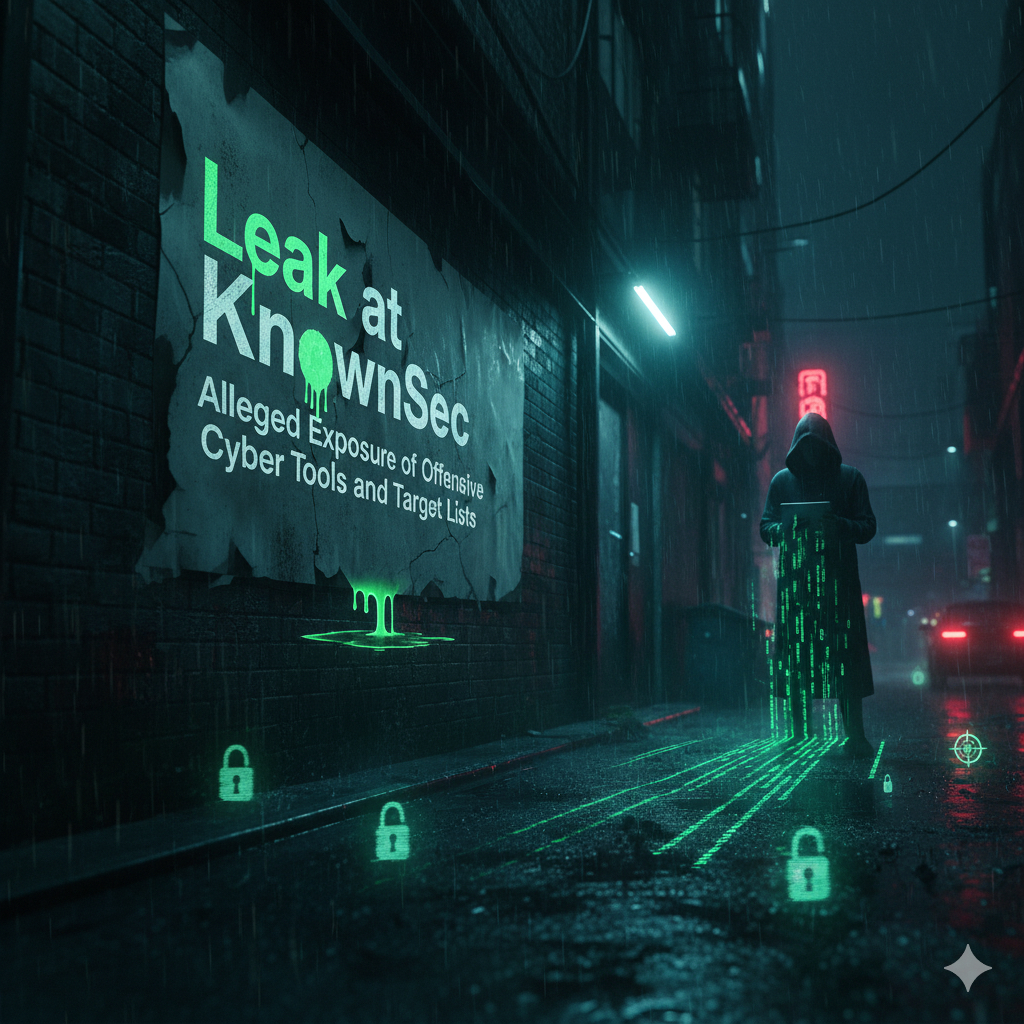
- A breach reportedly affecting KnownSec Information Technology Co., Ltd. (KnownSec) has allegedly exposed over 12,000 internal documents, including offensive cyber-toolkits, internal platform source code, and what are described as global target lists naming countries such as Japan, Vietnam and India.
- The leaked files appear to go beyond routine corporate data, with technical artefacts referencing email interception systems, Wi-Fi intrusion tools, remote-control frameworks and datasets derived from professional social platforms.
- While early technical write-ups and community repositories are circulating, independent forensic verification remains incomplete; caution is advised in drawing firm conclusions about operational impact and attribution.
- Entities using KnownSec services — particularly those tied to scanning, reconnaissance or network-asset discovery — should review any integrations, telemetry or API usage for anomalies.
- The event underscores how private security firms with state-linked ties may function as dual-use intermediaries; the implications extend beyond lost business data into questions of national intelligence and geopolitics.
Around early November 2025, reports surfaced claiming that KnownSec — a Chinese cybersecurity company known for its network-asset-search engine ZoomEye and close cooperation with state agencies — was the victim of a large-scale data breach. One technical write-up indicates that “approximately 12,000 documents” may have been leaked, describing the contents as “internal corporate records, government-linked project documentation, malware source code, C2 frameworks, exploit toolkits, and geopolitical ‘target lists’ naming Japan, Vietnam, and India.”
According to the analysis, the documents include training slides, architecture diagrams, tool manuals and datasets such as folders labelled “linkedin_brazil_202305” and “linkedin_southafrica_202305,” implying ongoing or recently-maintained data collection pipelines through the captured timeframe. The same source reports that one of the leaked tool-sets, named GhostX, includes modules such as “Un-Mail” for email interception, Wi-Fi intrusion attack flows and a Windows trojan remote-control framework.
One researcher observed: “The leaked materials show that KnownSec’s products were deeply integrated into national cyber-defense and intelligence ecosystems… the presence of ‘Key Infrastructure Target Database Manual’ is particularly revealing.”
If authentic, the materials expose both reconnaissance capabilities (global scanning, data harvesting, asset-mapping) and offensive-tool deployment (trojan frameworks, interception tools). For example, the ZoomEye engine — long marketed publicly as a global Internet-asset search engine — appears in the leaked slides with claims of scanning the entire IPv4 address space in 7-10 days and identifying over 40,000 component types. That, combined with internal target-databases, suggests a system that links reconnaissance to exploitation opportunities.
The potential operational impact is significant: once weaponised tools and exploit artefacts enter the wild, they can be repurposed by non-state threat actors, supply-chain risks emerge via compromised vendor updates, and targeted entities become vulnerable if they were previously under reconnaissance or attack without detection.
However, verification remains a critical caveat. The published write-ups emphasize that “while fragments and indexes of the leak are circulating, files appearing in public forums are not, by themselves, proof of authenticity.” Researchers recommend treating public indicators as leads, not definitive proof, and urge extensive cross-checking of file hashes, metadata and telemetry before drawing firm conclusions.
From an operational standpoint, organisations should assume the worst and act accordingly. For instance: review any KnownSec-integrations (APIs, scanning tools, telemetry feeds, ZoomEye usage), examine logs for unusual credentials, block or isolate connections to KnownSec platforms if suspected of compromise, rotate shared credentials, and hunt for persistence or command-and-control artefacts that may have used the vendor’s tooling. Especially concerning are potential supply-chain implications: if KnownSec’s update or cloud services were compromised, clients might already be exposed to undetected intrusion.
On the geopolitical / regulatory front, this incident touches closely on national security questions. The leak is alleged to involve state-affiliated cyber-operations and infrastructure target lists. That raises exposure for the company’s government partners and opens diplomatic and defensive responses. The event also highlights how private cybersecurity vendors can function as extensions of national intelligence apparatuses — raising ethical, legal and operational concerns for clients and global supply-chains.
For clients globally, the KnownSec event underscores the need to monitor and audit vendor dependencies, treat state-linked security contractors with heightened scrutiny, and anticipate the possibility that a vendor breach has implications beyond data loss into operational intrusion.
In summary, while public verification is incomplete, the KnownSec incident appears to represent a rare case where a cybersecurity company’s internal offensive-capabilities, reconnaissance databases and target-mapping assets may have been exposed. The implications extend across intelligence, defence, vendor risk and global cyber-policy. Organisations and governments alike should treat this event as a prompt to review vendor exposures, update threat-hunting playbooks, and prepare for the downstream ripple effects of leaked state-grade cyber-toolkits.